
Contingency in Construction: Types, Uses and How to Set It

A contingency that overlaps an allowance or an escalation line pays for the same risk twice, while one set by habit can leave real exposures unfunded. In construction, contingency is the amount added to an estimate for uncertain items, conditions or events that are likely, taken together, to add cost within the defined scope; size it from the residual risks you can name, not from a standard percentage.
There is no universal “good” contingency percentage. RICS NRM 1 (3rd edition, October 2021) recommends that risk allowances be a considered assessment, taking account of how complete the design is and other uncertainties such as site investigation, rather than a standard percentage. This guide separates contingency from allowances, escalation and management reserve, explains which project conditions change the amount, and shows a risk-register formula with a worked example built on assumed inputs. It does not recommend a percentage or settle contract rights; your project documents do that.
Scroll horizontally to see all columns.
| Input or item | Typical value or source | Why it matters |
|---|---|---|
| Base estimate and cost date | Project estimate, with its stated pricing date | Contingency is added to this base; a different base changes any percentage |
| Estimate maturity | Status of drawings, specifications and other defining deliverables (AACE RP 56R-08 class logic) | Less mature definition leaves more design development uncertainty |
| Allowances already carried | Named estimate lines for known but undefined items | Prevents funding the same item twice |
| Escalation basis | Separate escalation line with its index or assumption | General price change over time is usually kept out of contingency |
| Risk register | Project risk review: event, probability, in-scope cost if it occurs | Supplies the quantities for a risk-based amount |
| Mitigation already paid for | Fixed quotes, insurance or early orders already in the base | Only the residual exposure belongs in contingency |
| Confidence level | Chosen by the budget owner (GAO-20-195G) | Converts a modelled cost range into a funded amount |
This guide belongs to our Market Notes collection, which covers the cost and purchasing questions behind material decisions.
What does contingency in construction cover?
Contingency covers cost that is uncertain but expected, in aggregate, to arise inside the defined scope. AACE International defines it as an amount added to an estimate for items, conditions or events whose state, occurrence or effect is uncertain and that experience shows will likely add cost. It is generally expected to be spent, not held as a windfall.
AACE RP 10S-90, Cost Engineering Terminology (revised June 11, 2026) lists what contingency typically covers and what it usually excludes:
Scroll horizontally to see all columns.
| Usually inside contingency | Usually outside contingency |
|---|---|
| Planning and estimating errors and omissions | Major scope changes, such as a different building size, capacity or location |
| Minor price fluctuations other than general escalation | Escalation and currency effects |
| Design development and changes within the scope | Management reserves |
| Variations in market and environmental conditions | Extraordinary events such as major strikes and natural disasters |
The word “usually” matters. AACE describes cost-engineering practice; a contract, lender or owner’s budget policy may define the contingency line differently, so read that definition before deciding what a draw can pay for. Contingency is also not limited to “unknown unknowns.” An identified risk whose effect is uncertain, such as a quantity that may grow when details are finished, is a normal contingency item.
Contingency only has meaning against a defined scope. Use the specification comparison guide to pin down which drawings, sections and revisions the estimate was priced on. A major change to that scope is normally handled as a change to the estimate, not as a contingency draw.
Takeaway: Contingency funds uncertain cost within a stated scope; write down that scope and the definition your project uses before sizing it.
How is contingency different from an allowance, escalation and management reserve?
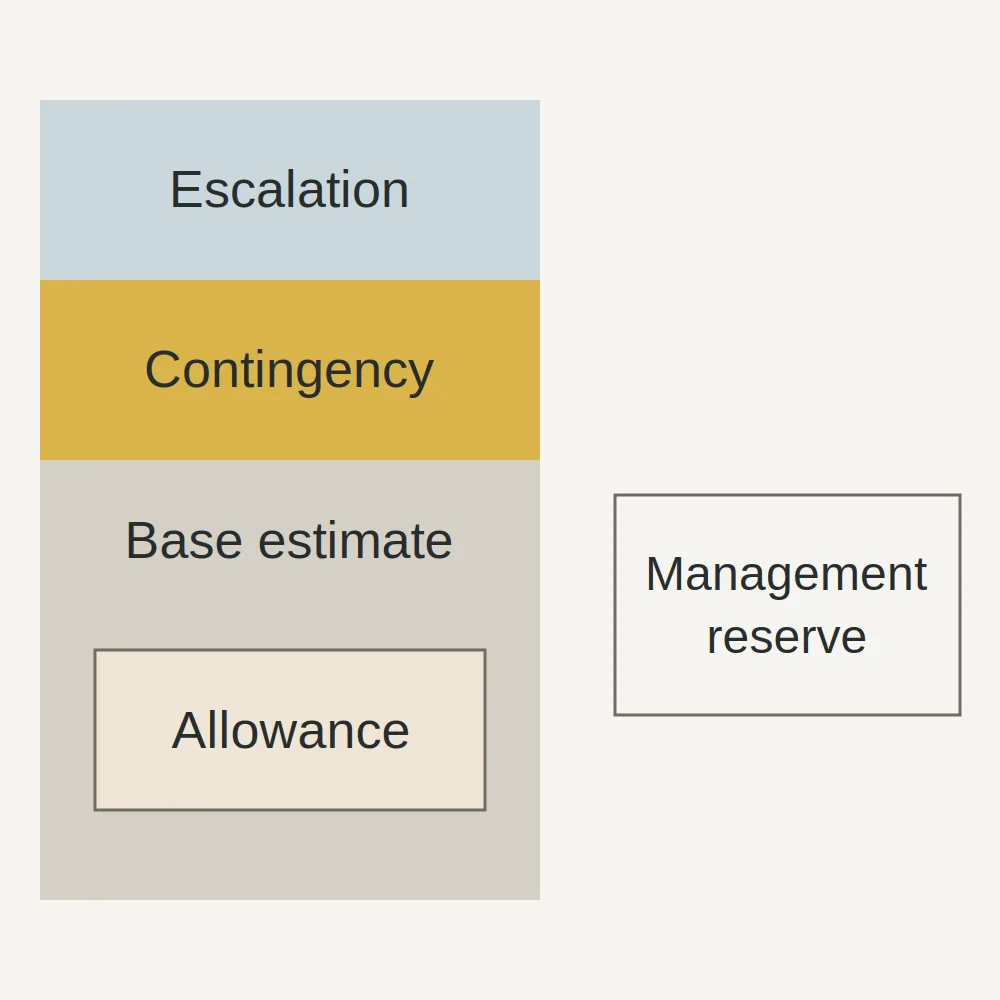
Each line answers a different question. An allowance funds a known item that is not yet defined; escalation funds price change over time; contingency funds uncertain cost within the scope; management reserve is held at management’s discretion, mainly for purposes outside the defined scope. Keep them as separate lines so each exposure is funded once.
Scroll horizontally to see all columns.
| Budget line | Uncertainty it addresses (AACE RP 10S-90) | Editorial example | Check before adding |
|---|---|---|---|
| Allowance | A known but undefined requirement | Light fittings are required, but the fixture has not been selected | Does the allowance cover supply only, or supply and installation? |
| Escalation | Uncertain change in costs or prices over time; inflation is one component | Price movement between the estimate’s cost date and the purchase date | Which cost date and index or assumption does the estimate use? |
| Contingency | Uncertain in-scope items, conditions or events likely to add cost in aggregate | A quantity that grows as details develop; repricing after a quote lapses | Is the exposure already priced in the base, an allowance or escalation? |
| Management reserve | Discretionary purposes outside the defined scope, plus in-scope amounts management chooses not to manage as contingency | A fund held at executive level for decisions outside the project team’s authority | Who controls it, and is it inside the approved project budget? |
RICS NRM 1 reaches the same separation from another direction. Its base cost estimate contains no allowance for risk or inflation; both are calculated separately and added to reach the cost limit. A US estimate may group its lines differently, but the check is the same: every dollar of exposure should appear once, in a line whose purpose matches it.
Common mistake: Adding a general material-inflation figure to contingency when the estimate already carries an escalation line. Check the cost date and escalation basis first; under the AACE definition, contingency covers minor price fluctuations other than general escalation.
The installed-cost comparison guide sets one scope, quantity and delivery basis for material quotes. Use that same basis as the base estimate here, so the contingency is measured against costs that have already been counted once.
Takeaway: Match each exposure to the one budget line whose purpose fits it, then check the other lines do not carry it as well.
What are the types of construction contingency?
Most labels describe one of two things: which risk the money is for, or who holds and controls it. RICS NRM 1 separates design development, construction, employer change and employer other risks. Owner and contractor contingency describe holders, defined by the contract. Treat these as two axes, not as four amounts to add together.
The risk axis, using the four NRM 1 categories in section 2.15:
Scroll horizontally to see all columns.
| Risk category | What it provides for (NRM 1 examples) | Suggested review point |
|---|---|---|
| Design development (often called design or estimating contingency) | Developing the design, changes in estimating data, third-party and statutory requirements, procurement method, tender delays | Each design stage; FHWA’s Major Projects guidance expects design contingency to reach zero when final design is complete |
| Construction | Site conditions such as access limits, existing buildings and occupants, ground conditions, existing services, delays by statutory undertakers | As work packages are bought and completed |
| Employer (owner) change | Client-driven changes in scope, brief, quality or time, during design and construction | When change windows in the brief close |
| Employer (owner) other | Other client risks such as early handover, postponement, acceleration and availability of funds | At each cost-plan update |
The US FHWA guidance on contingency fund management for Major Projects uses a similar split: a construction contingency for cost growth during construction, a design contingency based on the level of design completion, an overall management contingency, and separate contingencies for high-risk areas such as utilities or right-of-way.
The holder axis comes from the contract, not from the risk. An owner contingency sits in the owner’s budget; a contractor contingency is carried in the contractor’s price, with its uses, approvals and any unused balance defined in that agreement. The same risk can sit in either place, so a budget review asks two questions of every line: what is this money for, and who can release it?
One naming caution: in this guide, “design contingency” means estimate uncertainty from design development. Some writers use the same words for a reserve inside a designer’s fee. Ask which one a budget line means before comparing it.
Takeaway: Label each contingency line with both its risk category and its holder before comparing totals.
What decides how much contingency a project needs?
The amount follows the residual risk, so it depends on how mature the design is, how much is known about the site, project complexity, the quality of cost data, market and procurement conditions, what mitigation is already paid for, and the confidence level the budget owner chooses. None of these reduces to one standard percentage.
Scroll horizontally to see all columns.
| Driver | What increases uncertainty | Evidence to collect |
|---|---|---|
| Design maturity and estimate class | Defining deliverables at an early status | Deliverable list with status and revision |
| Site information | Limited site investigation, unknown existing services, access constraints | Survey and investigation reports; known access limits |
| Complexity and novelty | Unfamiliar systems, many trade interfaces, unusual locations | Interface list; comparable project cost history |
| Cost data and estimating method | Weak reference data, untested assumptions, little time to estimate | Data sources, assumptions log, estimating method |
| Market and pricing conditions | Volatile prices, short quote validity | Quote dates and validity; escalation basis. Currency exposure is usually carried outside AACE contingency: check where the contract and budget place it |
| Mitigation already in the base | Exposures assumed closed that are not | Fixed-price quotes, insurance, early orders, and which risks each actually closes |
| Confidence level | A higher confidence target needs more funding for the same risks | The budget owner’s recorded decision |
The drivers come from the sources rather than from habit. NRM 1 names design completeness and site investigation. The AACE RP 56R-08 public sample (August 2020) says estimate class is set by the maturity of the defining deliverables, not by a percent-complete figure, and lists complexity, reference data quality, assumptions, estimating technique, market and pricing conditions and currency among the factors affecting accuracy.
AACE’s estimate accuracy ranges are often misread as contingency guidance. RP 56R-08 describes them as the expected variation of actual cost after appropriate contingency has been applied, and says the range for a specific estimate should come from risk analysis rather than be pre-determined. An estimate class tells you how mature the definition is; it does not tell you what percentage to add.
For envelope packages, the wall-system planning brief records the design inputs whose status drives design development risk. Access, sequencing and site constraints that drive construction risk belong in the site coordination handoff guide.
Takeaway: Collect evidence for each driver; a percentage borrowed from another project carries none of it.
How does material cost risk feed into contingency?
Material cost risk splits into general price change over time, which belongs in escalation, and specific procurement exposures such as an expiring quote, an undefined quantity or a delivery conflict, which can be contingency items. Carry only the residual cost after checking what the quote and base already include. A fund cannot by itself create lead time or make nonconforming material acceptable.
Scroll horizontally to see all columns.
| Material exposure | Likely budget home | Check before carrying it in contingency |
|---|---|---|
| General price movement between the cost date and purchase | Escalation | Cost date and escalation assumption in the estimate |
| Repricing after a short quote validity lapses | Contingency (residual difference only) | Validity date against the planned order date; whether escalation already covers it |
| Quantity correction as details develop, with no scope change | Contingency | Whether the base quantity, waste basis or an allowance already includes it |
| Known item with the selection not yet made | Allowance | Allowance scope: supply only, or supply and installation |
| Delivery-window conflict causing extra site handling | Contingency, if not already priced in logistics | Whether delivery and handling are in the quote or base |
| Substitute product after a supply problem | Contingency if within scope; a change if requirements change | Whether the substitution alters the specified requirement |
Settle what can be settled before funding it. The first-order risk checklist fixes order inputs such as quantities, validity and terms before money is committed. The supplier evaluation guide helps judge whether a supplier’s documents support the dates and quantities your estimate relies on. The material procurement process keeps order, submittal and delivery records connected, so a later draw can be traced to its cause.
Quality failures follow their own path. Rejected material is handled through the project’s QC procedure and recorded with the construction QC checklist; whether its cost becomes a contingency draw depends on the contract and on who carries that risk.
Common mistake: Carrying the full value of a risky order as contingency. Only the residual increment, meaning the cost beyond the base if the event happens, belongs in the calculation.
Takeaway: Put general price change in escalation and carry only the residual cost of specific procurement exposures in contingency.
How do you calculate contingency from a risk register?
Start with the residual risks, not a percentage. For each risk, estimate the probability that it occurs and the in-scope cost increment if it does; the sum of those products is the expected residual cost. That sum describes a central expectation only. Funding at a chosen confidence level needs a model of the whole cost range.
The expected-exposure formula
Scroll horizontally if this diagram is wider than the screen.
E = Σ (p_i × Δc_i)- p_i: probability that risk i occurs (0 to 1), after the mitigation already in place.
- Δc_i: additional in-scope cost if risk i occurs, beyond what the base estimate, allowances, escalation and paid mitigation already cover (USD).
- E: expected residual cost of the listed risks (USD).
This is a standard expected-value calculation, used here as a teaching method. The AACE RP 40R-08 public sample asks that risk quantification start from identified risk drivers and link them to cost outcomes. FHWA’s Major Projects guidance names probability of occurrence, severity and expected dollar value as variables for quantifying contingency, and says funding should reflect the risk remaining after known mitigation. Neither document prescribes this exact formula.
Worked example (example, assumed inputs)
Assume a base estimate B of USD 200,000 at one cost date. It already includes a USD 5,000 allowance for a known item whose specification is not yet selected, plus the confirmed purchasing and logistics costs. The figures are invented for the arithmetic; they are not market prices, a recommended budget or a Muros project.
Scroll horizontally to see all columns.
| Identified risk (example, assumed inputs) | p | Δc if it occurs (USD) | p × Δc (USD) |
|---|---|---|---|
| A short-validity material quote lapses and part of the order is repriced; general escalation excluded | 0.30 | 12,000 | 3,600 |
| Detailing increases a material quantity with no scope change; not covered by the allowance | 0.40 | 7,500 | 3,000 |
| A delivery-window conflict needs extra site handling; separate from the repricing cost | 0.25 | 8,000 | 2,000 |
| Expected residual cost of the three listed risks | — | — | 8,600 |
B + E = 200,000 + 8,600 = USD 208,600. Read that total carefully. It is the base plus the probability-weighted cost of three listed risks; it is not an approved budget, and it is not the amount needed for any particular confidence level. The USD 5,000 allowance is not added again because it is already inside B. The 0.30 is the chance of an event, not a contingency percentage.
From expected exposure to a funded contingency
Expected values add up even when risks are related, but the spread of total cost does not. GAO-20-195G, the GAO Cost Estimating and Assessment Guide (March 2020), notes that positively correlated cost elements tend to move together, which matters for high-confidence targets such as the 80th percentile and less around the 50th. A delivery conflict that also forces a reprice is one cause hitting two lines: model it as one linked scenario and never count the same cost twice.
GAO describes the funded amount as the difference between the point estimate and the modelled cost at the confidence level decision-makers choose, and states that no specific confidence level is considered a best practice. In symbols, C = Q(chosen confidence level) − B, with B and the cost model on the same scope and cost date, and escalation counted once. This guide does not recommend a confidence level; that is the budget owner’s decision.
Where the NRM 1 percentage formula fits
NRM 1 calculates each risk allowance as the base cost estimate multiplied by a selected percentage for that risk category, adds the four results, and adds the total to the base to give a cost limit excluding inflation. The formula applies a percentage someone has already chosen; it does not supply one. To avoid confusing the two methods, write it with distinct names, for example category allowance = base × selected category rate, so the rate is not mistaken for an event probability.
Takeaway: Use the register to price named residual risks, then decide the funded amount through a stated confidence level rather than a borrowed percentage.
How should contingency be tracked and drawn down?
Keep contingency tied to the register. Record each risk’s budget location, holder, residual probability and cost, and review them at every cost-plan stage. When money moves, record why, from which line and under whose approval. Whether unused contingency returns to the owner depends on the contract, not on custom.
Suggested register fields (an editorial tool, not an official template):
Scroll horizontally to see all columns.
| Register field | What to record | Why it helps |
|---|---|---|
| Risk ID and cost item | Link to the estimate line or work package | Shows where the exposure would land |
| Risk category | Design development, construction, owner change or owner other | Matches the money to its purpose |
| Holder and approver | Owner, contractor or other party, and who can release funds | Shows who controls the draw |
| Budget location | Base, allowance, escalation, contingency or management reserve | Catches double counting |
| Mitigation | Action taken or planned, with its cost line | Separates paid mitigation from residual exposure |
| Residual probability and cost | p and Δc after mitigation, with their basis | Supplies the calculation |
| Review point and owner | Stage or date for reassessment, and the responsible person | Keeps the estimate current |
| Draw record | Amount, date, reason and decision reference | Makes each transfer traceable |
NRM 1 recommends reassessing risk registers and risk estimates at regular intervals through cost planning, and notes that the need for a risk allowance falls to zero once accounts are settled. FHWA’s Major Projects guidance asks that the reasons for contingency transfers be noted in reporting, so usage can be compared with the amount still available.
Build the base quantity and separate price-adjustment inputs with the construction material budgeting template before assigning residual risk to contingency.
A draw needs a decision record. The OAC meeting decision-record guide ties a discussed draw to its formal approval. When a draw arises from rework, the construction QC plan guide keeps the cause visible, and the cause decides which line should bear the cost.
Takeaway: Every draw should name its risk, its line, its reason and its approver, so the remaining balance can be reconciled.
When this does not apply
This guide explains how contingency is defined and sized in an estimate. Some decisions sit outside that scope and need the project’s own documents or a specialist.
- Contract rights: who may draw, approve or keep contingency is set by the contract and project documents; this guide does not interpret them.
- Mandated methods: public programs, lenders or owners may require a specific contingency method, confidence level or reporting format. Use that method.
- Large or complex programs: a short register and expected values do not replace a quantitative risk analysis covering estimate uncertainty, correlation and schedule.
- Time contingency: contingency here is money; schedule float and time allowances follow the project’s scheduling rules.
- Items usually outside contingency: major scope changes, extraordinary events and currency effects sit outside contingency under the AACE definition; check how your budget treats them.
Takeaway: Where a contract, funder or specialist analysis governs, follow it; this method supports the estimate, not the entitlement.
Frequently asked questions
What is an example of contingency in construction?
A typical example is a quantity that may grow as details are finished, with no change to the project scope. The base estimate prices the current quantity, and the probability-weighted cost of the increase estimates that item’s expected exposure. The funded contingency is then set for the whole register through the project’s method and the confidence level the budget owner chooses, so it need not equal the sum of expected values. The worked example above shows three such risks with assumed inputs.
What is a 5% contingency?
A 5% contingency is an amount equal to 5% of a stated base; on an example base of USD 200,000, it is USD 10,000. The figure says nothing about which risks it covers or whether it is enough. Ask what the base includes, whether escalation sits elsewhere, and which risks support the amount.
What does 10% contingency mean?
It means the contingency equals 10% of whatever base the estimate names, so the same label produces different amounts on different bases. It does not show the estimate class, the risks behind it or the confidence level. Check those before comparing two budgets that both say 10%.
What is a good construction contingency percentage?
There is no universal good percentage; the amount should follow the project’s residual risks and the confidence level its budget owner selects. To test a percentage you have been given, first restate it on a known base and cost date, since a rate on construction cost and a rate on total project cost are not comparable. Then list the register risks it is meant to cover and confirm that allowances and escalation are not also inside it. A figure that cannot be traced to named risks is a placeholder; the drivers section above shows what to collect.
What is the difference between contractor contingency and owner contingency?
The difference is who holds and controls the money, not which risk it covers. To tell which one a budget line is, find in the contract the party that carries the line, who approves a draw, what a draw may pay for, how draws are reported, and how any unused balance is treated. If the agreement names only a contractor contingency, ask whether the owner also keeps a separate contingency in its own budget, so the two are not compared as one figure.
Should unused contingency be refunded to the owner?
It depends on the contract. An agreement can return unused contractor contingency to the owner, share it, or allocate it another way, and some are unclear. Read the contingency, savings and closeout clauses, and record each draw so the remaining balance can be reconciled at completion.
Methods and sources
Definitions and categories are compiled from the public documents below, checked on October 10, 2026. The budget-line table, type map, driver table, register fields and worked example are editorial tools. The example uses assumed inputs; it is not market data, a recommended budget or a Muros project. For AACE RPs 40R-08 and 56R-08 we read only the public sample pages, not the full documents.
- AACE International, RP 10S-90 Cost Engineering Terminology, revised June 11, 2026: definitions of contingency, allowance, escalation and management reserve.
- AACE International, RP 56R-08 Cost Estimate Classification System for Building and General Construction, August 7, 2020, public sample: estimate class and accuracy logic.
- AACE International, RP 40R-08 Contingency Estimating — General Principles, June 2008, public sample: principles for risk-based quantification.
- RICS, NRM 1 Order of cost estimating and cost planning for capital building works, 3rd edition UK, October 2021 (reissued as practice information in October 2022 without material change), sections 2.15 and Table 2.1: risk allowance categories, the percentage formula, and the separation of risk and inflation from the base.
- GAO, GAO-20-195G Cost Estimating and Assessment Guide, March 2020, chapter 12: risk drivers, correlation and confidence-level contingency.
- FHWA, Contingency Fund Management for Major Projects, page updated May 10, 2023: contingency elements and administration for federal Major Projects; not a rule for private projects.
Related reading:
- Total installed cost model — set one cost basis before estimating contingency on top of it.
- First-order risk checklist — close order inputs that would otherwise become contingency items.
- Construction material procurement process — keep the order and delivery records that explain a draw.
Takeaway: Use the public definitions to label each budget line, and your project’s own risks and documents to size it.
Related articles
Construction Material Budgeting Template: CSI Codes, Waste and Escalation
Copy a construction budgeting template that separates CSI division coding, net and order quantities, waste allowance, price evidence and escalation terms.
Read article: Construction Material Budgeting Template: CSI Codes, Waste and Escalation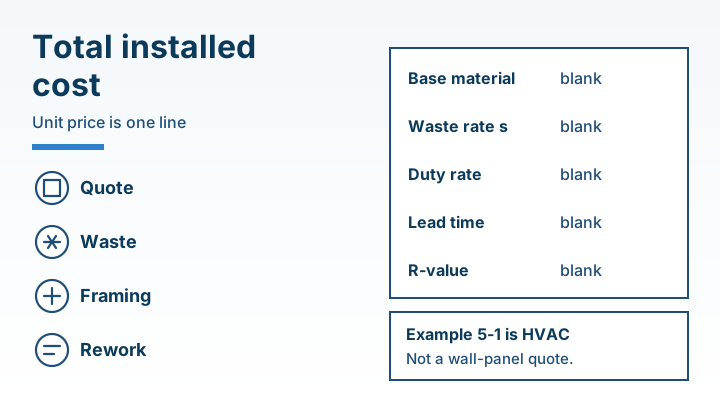
When a Lower Unit Price Costs More: The Total Installed Cost Model in Building Procurement
A lower material unit price can lose to waste, framing, labor, and closed-wall rework. Compare total installed cost on one scope, and keep unprinted prices blank.
Read article: When a Lower Unit Price Costs More: The Total Installed Cost Model in Building Procurement