
Construction Material Budgeting Template: CSI Codes, Waste and Escalation
A material budget becomes unreliable when one line hides waste, scope gaps and price movement. This construction material budgeting template separates CSI coding, measured quantities, order allowances and escalation evidence so each assumption can be checked before purchase.
Build the construction budgeting template around one row per defined material package, with a project specification reference, CSI division, quantity unit, net takeoff, waste basis, order quantity and dated price evidence. Keep contingency and contractual price adjustment in separate fields. The blank worksheet below is designed for copying into a spreadsheet or downloading as CSV; it contains no default material prices, index observations or universal waste rate. The quantity example demonstrates arithmetic only. Complete the coding from the project’s specification index and the financial fields from current project records before treating the sheet as a priced budget.
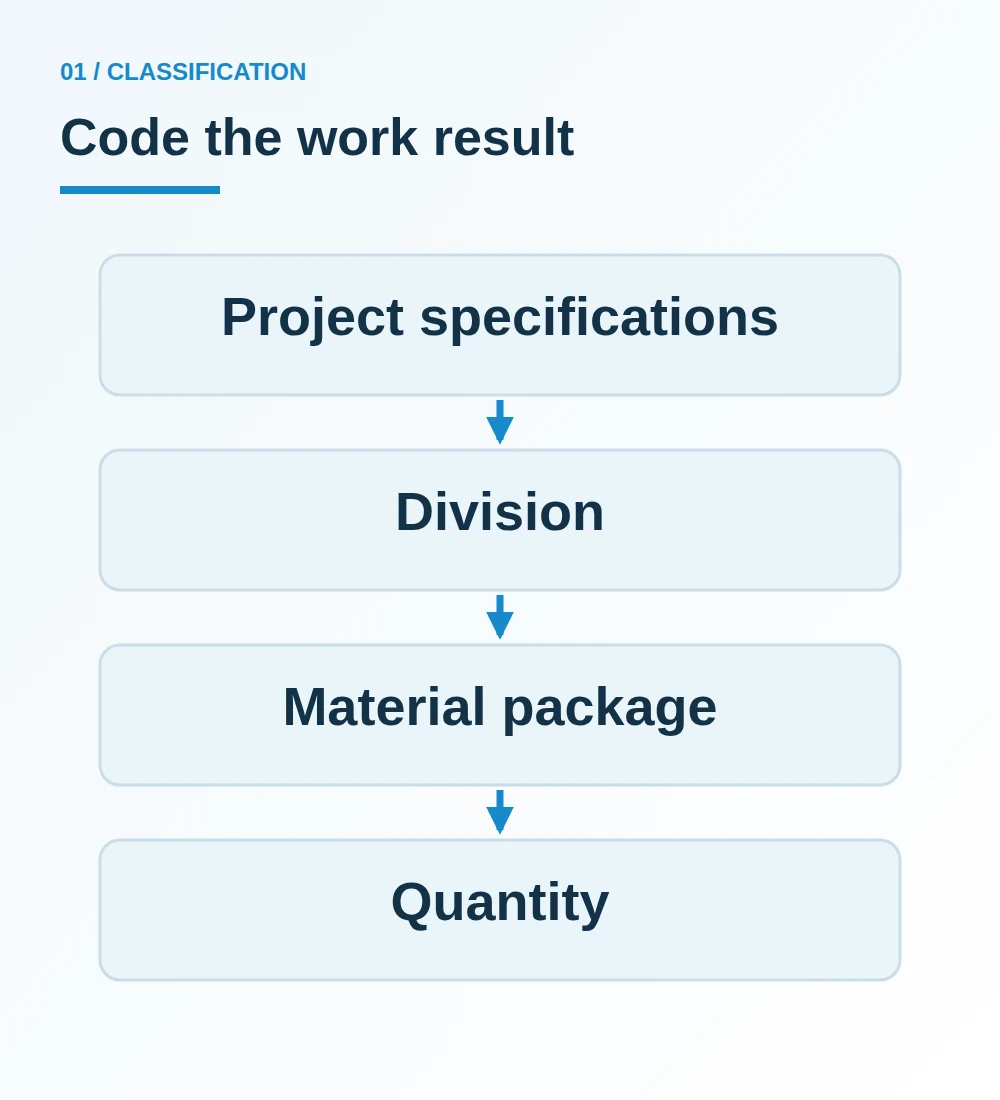
Illustration: classification follows project work results; material descriptions alone do not determine the code.
Scroll horizontally to see all columns.
| Input or item | Value or source | Why it matters |
|---|---|---|
| Scope and revision | Project drawings and specification index | Makes package boundaries comparable |
| CSI division and section | Project specification reference, checked against the applicable MasterFormat edition | Prevents informal material names from controlling the budget structure |
| Net quantity and unit | Checked takeoff | Establishes what the allowance is applied to |
| Waste allowance basis | Layout, cut plan and project evidence | Distinguishes a quantity assumption from a price increase |
| Price and validity | Dated supplier or contract evidence | Identifies what is known and when it expires |
| Escalation arrangement | Actual contract clause and named index, if applicable | Defines eligible price movement and procedure |
This guide belongs to the Market Notes collection. Use the total installed cost comparison when the decision also includes installation, interfaces and rework.
How should CSI division coding work in this template?
Use the project’s specification index as the first coding reference, then map each cost package to its relevant division and section. CSI’s public standards overview describes MasterFormat as organizing specifications by work results. A raw material name is therefore an unreliable coding shortcut: the purchased work result and project specification control the mapping.
These public UFGS section headings show how the two levels can be recorded. They are coding examples, not a project specification or an instruction to apply federal guide specifications to private work. Confirm the project’s own section and edition before entering a code.
Scroll horizontally to see all columns.
| Division example | Section example and public source | Worksheet use |
|---|---|---|
| 03 — Concrete | 03 30 00 — Cast-in-Place Concrete | Identify the actual concrete package and its scope boundary |
| 05 — Metals | 05 12 00 — Structural Steel | Link the steel package to its project section and drawings |
| 09 — Finishes | 09 29 00 — Gypsum Board | Carry the board quantity unit and relevant assembly scope |
Do not create a second budget line merely because the same item appears in a submittal register and a purchase order. Give it one package ID and cross-reference both records. Where a bundled purchase spans sections, either split the cost on a documented basis or identify its allocation rule; do not duplicate the whole purchase in each division.
Download the blank construction material budgeting CSV. The CSV is a field template, not a formula workbook. Copy the formula definitions below into the spreadsheet columns you choose. No downloadable file contains market observations or a completed project estimate.
Copyable CSI division coding and quantity worksheet
Scroll horizontally to see all columns.
| Worksheet field | Project entry |
|---|---|
| Package ID / material or work-result description | |
| CSI division / project specification section | |
| Drawing and specification revisions | |
| Scope included / scope excluded / allocation rule | |
| Takeoff date / quantity reviewer | |
| Quantity unit / net quantity Qn | |
| Waste allowance w / denominator / evidence | |
| Spare-stock quantity Qs / requirement reference | |
| Supplier pack quantity p / source | |
| Calculated order quantity Qo | |
| Dated price evidence / validity date / currency | |
| Unit price / freight / tax treatment | |
| Escalation-eligible cost / clause reference | |
| Index series / base period / update period, if applicable | |
| Contingency reference / approval status | |
| Budget owner / last review / next action |
Keep a blank price as unknown. A zero means no cost, which is a different assertion. Similarly, “no escalation clause” and “clause not yet checked” need different status entries. The material procurement log can carry the package ID through order and delivery tracking.
Which budget lines should stay separate?
Separate quantity growth, price change and uncertainty before comparing package totals. Each has a different source and a different way to go wrong.
Scroll horizontally to see all columns.
| Budget component | Basis to retain | Dominant Failure Mode & Prevention |
|---|---|---|
| Net material quantity | Drawing revision, measurement and unit | Area and piece counts are mixed; record the conversion and reviewer |
| Waste allowance | Rate denominator and cut or handling basis | A generic percentage conceals layout loss; reconcile it to the actual package and avoid adding it twice |
| Required spare stock | Project requirement and quantity | Handover stock is counted as waste; keep it as a separate deliverable |
| Price adjustment | Signed clause, eligible base and source series | An unrelated index is applied to the entire order; use only the cost and period the clause covers |
| Contingency | Named residual risk and budget owner | Escalation or known waste is funded twice; reconcile to the contingency register |
The template stops at the material purchasing boundary you specify. If freight, duties, tax, unloading or storage are excluded from a quote, record those exclusions and identify their budget lines before comparing packages. Do not hide an unpriced scope item in a waste percentage.
How do you calculate the waste allowance and order quantity?
Define the allowance’s denominator before calculating it. In this worksheet, w is an addition to net quantity, not the fraction of purchased material lost. Include required spare stock separately, then round up to the supplier’s pack quantity if ordering requires whole packs.
Qo = ceil([Qn × (1 + w) + Qs] / p) × p
Here Qn is net quantity, Qs is separately required spare stock, p is units per order pack, and ceil means round upward to the next whole pack. All quantities must use compatible units and p must be positive.
Worked example using assumed sheet counts: ceil([100 sheets × (1 + 0.05) + 0 sheets] / 10 sheets per pack) × 10 sheets per pack = 110 sheets. The assumed 5% addition is a calculation input, not a recommended waste allowance. Five sheets are the allowance and five more are the rounding surplus; neither is an observed loss.
If a source instead defines loss as a fraction r of purchased quantity, the corresponding quantity relationship is Qn / (1 − r), before separate stock and pack rounding. Do not substitute r for w: the denominators differ. Use the specification comparison guide to check whether required stock is already included in the purchased scope.
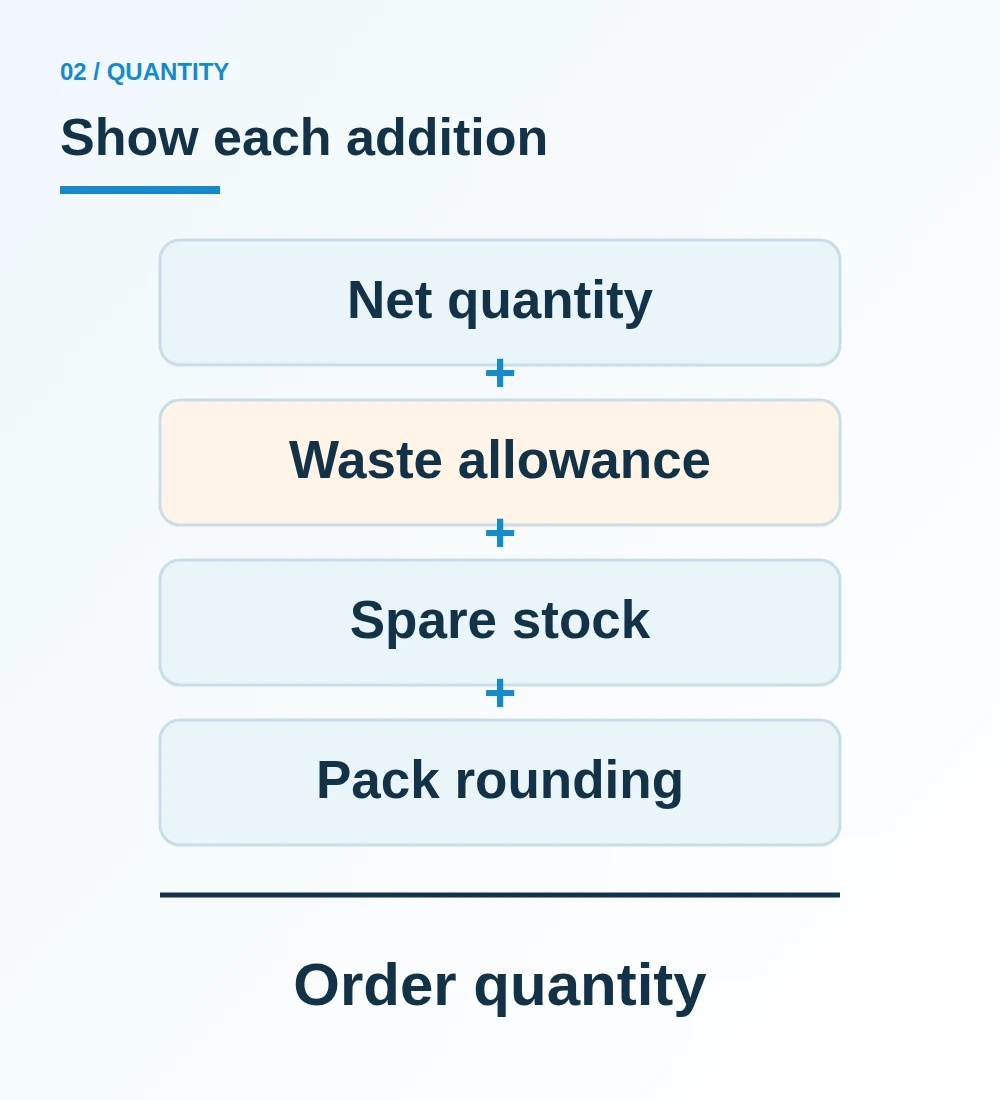
Illustration: the quantity relationship separates waste allowance, spare stock and rounding surplus; the numeric example is in the text.
Procedural threshold rule: if a quote expires before the planned order release date, mark its price evidence for reconfirmation before budget approval. This editorial check uses the actual quote’s validity date; it does not assume a standard validity period or an automatic right to hold the old price.
What should an escalation-clause structure contain?
Record the eligible cost, index series, base and update periods, adjustment frequency, limits, notice process and effective date. An estimate’s escalation assumption does not itself create a contract right.
A public example with an actual formula is GSAM 552.216-71, Economic Price Adjustment—Special Order Program Contracts, basic clause dated August 2010. Paragraph (b) states:
Adjusted contract price = (updated index / base index) × award price.
The basic clause permits an annual upward or downward adjustment, uses a specified originally released, non-seasonally-adjusted PPI, and leaves the upward cap for completion. It also addresses unavailable or discontinued series, notice and effective dates. This is a federal supply-contract example; a construction purchase is governed by its own agreed terms. No index observation or material price is supplied here.
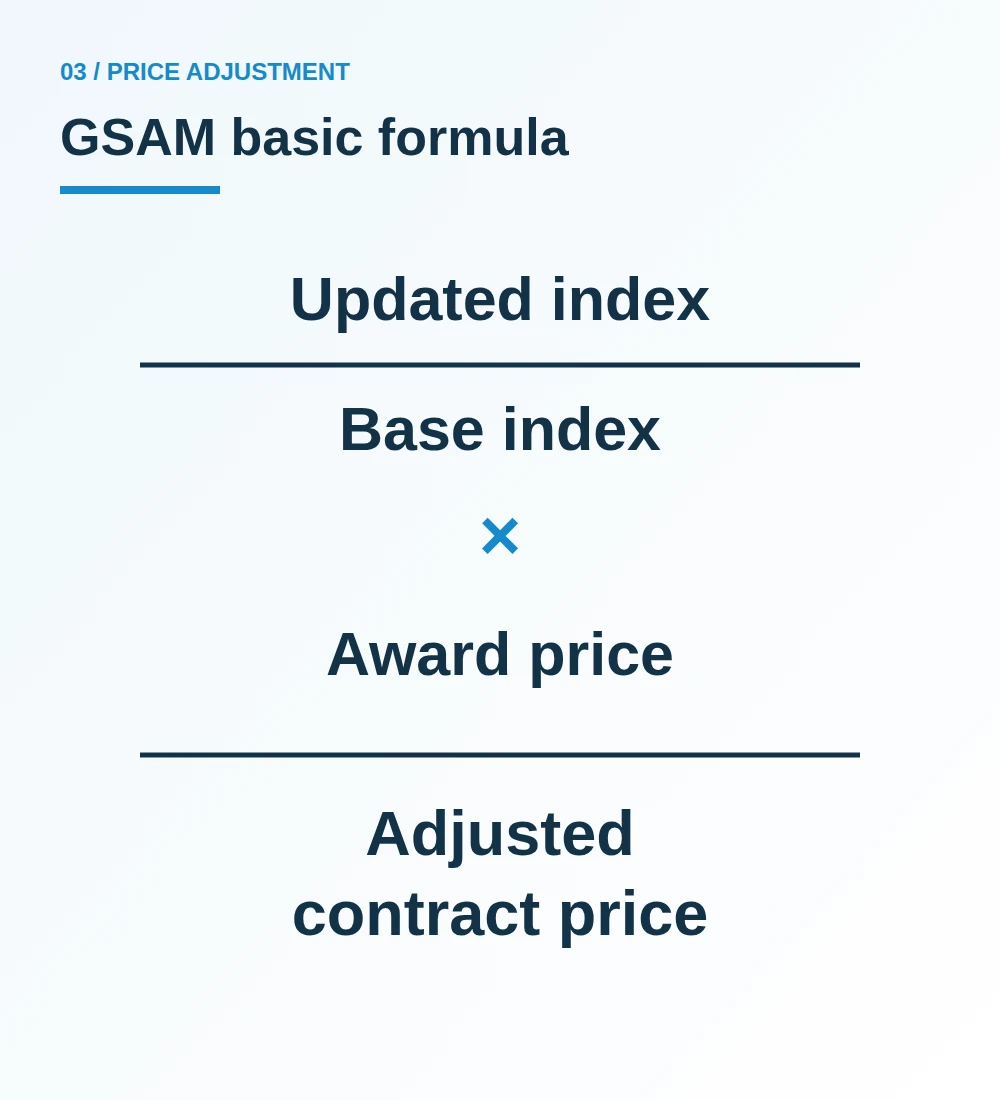
Illustration: the basic GSAM clause’s symbolic relationship. The contract’s conditions still govern its use.
Use this blank structure to check the actual clause, rather than pasting the formula into an unrelated purchase:
Scroll horizontally to see all columns.
| Clause field | What to settle in the agreement |
|---|---|
| Eligible item and cost base | Which line, component or amount is adjustable? |
| Source and series | Exact publisher, series, release basis and units |
| Base and update periods | Which observations apply, and when? |
| Frequency and trigger | When is an adjustment considered? |
| Limits and direction | Cap, floor, threshold and treatment of decreases |
| Missing or discontinued source | Agreed fallback and replacement process |
| Evidence and notice | Required records, recipient and deadline |
| Effective date | Which shipments or orders receive the adjustment? |
| Duplicate coverage | How the budget removes exposure already included elsewhere |
Leave an unagreed term unresolved. A generic “materials escalation” cell cannot establish these details.
What quantity ledger catches hidden material costs?
Track the quantity balance before converting it into money. Net takeoff, ordered quantity, accepted receipts, returns, measured loss, installed quantity and remaining stock describe different states. The order allowance is a forecast; actual waste must come from records.
Scroll horizontally to see all columns.
| Ledger line | Quantity or time to capture | Supporting live guide |
|---|---|---|
| Layout and cut review | Actual review hours and revised net quantity | First-order risk checklist |
| Pack rounding and separate stock | Units above net quantity, with reasons | Material procurement process |
| Receipt damage and discrepancies | Units affected, disposition and replacement status | Construction QC checklist |
| Returns and leftover stock | Units returned, retained or awaiting decision | Material procurement log |
| Price-evidence refresh | Actual review hours and current validity record | Supplier evaluation guide |
For the assumed quantity example, start with 110 ordered sheets against a 100-sheet net takeoff and identify the 10-sheet difference as allowance plus rounding. Do not label all 10 sheets as actual waste. Reconcile physical receipts and subsequent use before closing the package.
Methods and sources
Updated October 19, 2026. Coding follows the work-result organization described in CSI’s public standards overview; this guide does not reproduce the proprietary classification schedule or assign a universal section number. The symbolic adjustment formula was checked visually in the official GSAM 552.216-71 PDF, basic clause paragraph (b); alternate clauses can change the arrangement. The division and section examples were checked against the linked public UFGS title pages. The worksheet, comparison table, threshold and ledger are editorial tools. Quantity formulas are dimensional arithmetic with explicitly assumed inputs. Waste rates, prices, index values and contract entitlements remain project inputs.
Related articles

Contingency in Construction: Types, Uses and How to Set It
What construction contingency covers, how it differs from allowances, escalation and reserves, and how to size it from a risk register, with a worked example.
Read article: Contingency in Construction: Types, Uses and How to Set It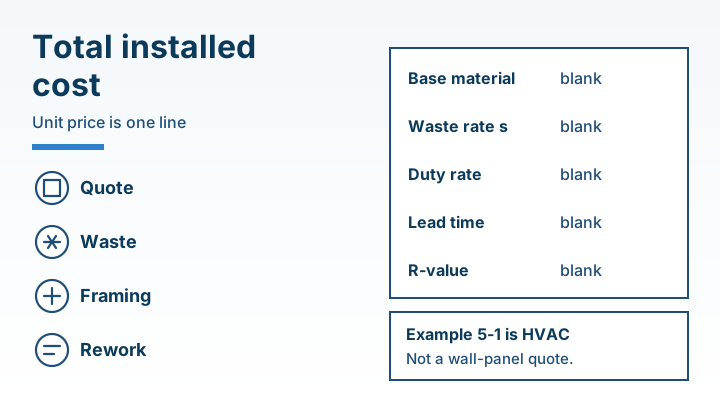
When a Lower Unit Price Costs More: The Total Installed Cost Model in Building Procurement
A lower material unit price can lose to waste, framing, labor, and closed-wall rework. Compare total installed cost on one scope, and keep unprinted prices blank.
Read article: When a Lower Unit Price Costs More: The Total Installed Cost Model in Building Procurement