
How to Evaluate a Building Material Supplier Before Placing a First Order
A first order from a seller with the wrong plant address can be rejected or arrive damaged. Name the seller and the plant, and leave credit score, lead time, and payment split blank.

A first order placed against a seller whose plant address does not match the quotation can be rejected at submittal, or it can arrive damaged with nobody named to answer for the lot. Evaluate the building material supplier, and any construction material procurement company standing in front of that supplier, before the deposit moves.
Evaluate a building material supplier before a first order by naming the legal seller, the plant that will make the goods, and the records that tie those goods to the project specification. Choose a construction material procurement company the same way: the company is the seller only when the contract names it, and the plant still gets its own line. FAR 9.104-1, FAC 2026-01, effective 13 March 2026, prints seven responsibility standards for a federal prospective contractor and prints no credit score, no lead time, and no payment split. When a construction product is placed on the EU market under a harmonised standard or European assessment document cited in the Official Journal, Regulation (EU) 2024/3110 supplies the common performance language and leaves use and installation rules with each country’s building code. Copy a figure only when the saved page or the project file prints it.
Scroll horizontally to see all columns.
| Check | Dominant failure mode | Prevention | Printed figure |
|---|---|---|---|
| Seller and plant | Payment or production sits with a company you never checked | Match the contract name to the name you check, then write the plant name and address on a separate line | Credit score: blank. Lead time: blank |
| Performance history | A blank history is treated as an automatic pass or an automatic fail | FAR 9.104-1(c) says lack of relevant performance history, by itself, does not make the contractor responsible or nonresponsible, except as provided in 9.104-2 | Text of 9.104-2: blank on the saved pages |
| Facilities and controls | A trading name is filed in place of the plant that cuts, coats, or tests the material | Record quality assurance measures and production control procedures for the contractor and for subcontractors who produce the material | Certificate number: blank |
| SAM exclusion | An active exclusion is still in force on the day you commit | Read the record fields FAR 9.404(b) prints before you treat the name as clear | Unique Entity Identifier: blank until that record prints it |
| EU declaration | A performance claim has no declaration behind it | For a product placed on the EU market under the CPR, the manufacturer draws up the declaration and takes responsibility for the declared values | Performance class: blank |
| Code evaluation | The quote says “meets code” and names no report | Use an evaluation report an agency can use for code compliance, and copy the report number from that report | Report number: blank |
The five-stage construction material procurement lifecycle is the sequence this check sits in front of. Qualify the seller before bid leveling, then keep the open cells in the order file.
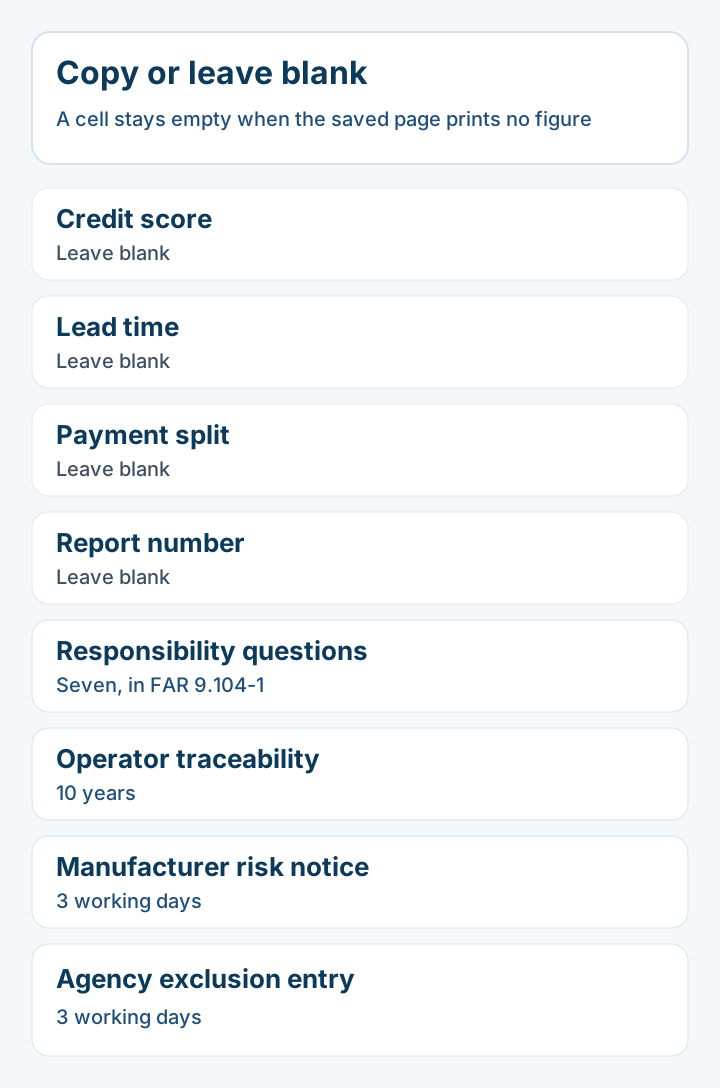
What you line up before the deposit
Line up three identities, then the seven questions in FAR 9.104-1. The legal name on the contract is the seller. The plant name and address are the place that will make the goods. The records are the documents that tie this lot to the project specification. A brochure that shows a different address from the contract is a mismatch, and the file stays open until the names agree.
FAR 9.104-1 is the federal contracting officer’s responsibility test for a prospective contractor. On a private purchase order, copy the same seven questions into the file. A completed private file is a buying record. The agency’s responsibility determination stays with the contracting officer.
The seven standards, from the page marked FAC 2026-01 and effective 13 March 2026, are:
- Adequate financial resources to perform the contract, or the ability to obtain them.
- Ability to comply with the required or proposed delivery or performance schedule, taking into consideration all existing commercial and governmental business commitments.
- A satisfactory performance record. Lack of relevant performance history, by itself, does not determine the contractor responsible or nonresponsible, except as provided in 9.104-2. The saved pages do not include the text of 9.104-2.
- A satisfactory record of integrity and business ethics.
- The necessary organization, experience, accounting and operational controls, and technical skills, or the ability to obtain them. The section includes, as appropriate, production control procedures, property control systems, quality assurance measures, and safety programs for materials to be produced or services to be performed by the prospective contractor and subcontractors.
- The necessary production, construction, and technical equipment and facilities, or the ability to obtain them.
- Otherwise qualified and eligible to receive an award under applicable laws and regulations.
Rule of thumb: If the plant name and address are blank, hold the deposit. Standard (f) asks for the facilities, and standard (e) puts quality assurance measures on subcontractors who produce the material.
FAR 9.105-1 tells the contracting officer to obtain information sufficient to be satisfied that the contractor currently meets those standards. The information is to be obtained or updated on as current a basis as is feasible up to the date of award. The same section lists sources a federal officer should use: office records, the contractor’s own proposal and financial data, information on production equipment and personnel, commercial sources of supplier information of a type offered to buyers in the private sector, preaward survey reports, and other sources such as customers, suppliers, subcontractors, financial institutions, government agencies, and trade associations. It also tells a contract administration office to advise on financial competence and credit needs. The page prints no credit score, so that cell stays blank.
When the quote says only that a product “meets ASTM,” use how to compare building material specifications to separate the method, the edition, and the result. This page checks that the report names the seller and the plant. Certificate type, alloy, and thickness stay blank until the project specification prints them.
ICC Evaluation Service, on its homepage with schema dateModified 24 August 2026, describes its own program as technical evaluations of building products, materials, and systems for code compliance. The homepage counter prints 90 years of experience, 5,000 codes and standards, and 42,500 annual testing hours. The paragraph beside that counter says “over 90 years” and “thousands of reports,” and it states that agencies use evaluation reports to help determine code compliance and enforce building regulations. Those figures describe ICC-ES. They are not a supplier’s test hours, and this page prints no report number for your product.
What a SAM exclusion record shows
Read the exclusion record before you treat a federal supplier name as clear. FAR 9.404 says the General Services Administration operates the web-based System for Award Management, which contains exclusion records, and that SAM is available at sam.gov. The page last updated 23 September 2026, under the same FAC 2026-01, says an exclusion record contains:
- Names and addresses of the entities debarred, suspended, proposed for debarment, voluntarily excluded, declared ineligible, or excluded or disqualified under the nonprocurement common rule, with cross-references when more than one name is involved in a single action.
- The agency or other authority taking the action.
- The cause for the action, and the effect of the action.
- The termination date for each listing.
- The Unique Entity Identifier.
- The Social Security Number, Employer Identification Number, or other Taxpayer Identification Number, if available.
- The name and telephone number of the agency point of contact for the action.
Agencies are told to enter that information within 3 working days after the action becomes effective, and to update the record generally within 5 working days after modifying or rescinding an action. Those clocks belong to the agency that writes the record. They are not a supplier’s delivery time. FAR 9.404(c)(5) tells agencies to have procedures so they do not solicit offers from, award contracts to, or consent to subcontracts with contractors who have an active exclusion record, except as otherwise provided in that subpart. Copy the termination date and the effect from the record you pull. Leave the Unique Entity Identifier blank until the record prints it.
FAR 9.105-1(c) also points the contracting officer to information in FAPIIS on the offeror and any immediate owner, predecessor, or subsidiary identified for that offeror, including information linked from SAM and CPARS. Check those related names when the record identifies them. This page does not print a list of owners.
What to collect when the product is placed on the EU market
Collect the declaration from the manufacturer, and name every operator who handles the product, when the product is placed on the EU market under the Construction Products Regulation. The Commission overview of Regulation (EU) 2024/3110 says the regulation sets harmonised conditions for placing construction products on the single market and does not set the conditions for use or installation. EU countries set those rules through their building codes. Obligations apply when a harmonised standard or European assessment document for the product has been cited in the Official Journal. A product outside that citation is outside this section.
The overview dates the new regulation, Regulation (EU) 2024/3110, as entered into force on 7 January 2025 and in full application since 7 January 2026. It dates Regulation (EU) No 305/2011 as in place since 2011, and it says the 2011 regulation will eventually be repealed in 2039, with product families moving earlier when new harmonised standards are cited. The framework text says products are tested only once to meet European standards. That sentence is about the single EU assessment, not a waiver of the test your project specification names.
The Commission page on CE marking and the declaration says that once assessment and verification procedures are completed, the manufacturer issues a Declaration of Performance under the 2011 regulation or a Declaration of Performance and Conformity under the 2024 regulation. For products placed on the market under the 2024 regulation, that declaration includes information on predetermined environmental characteristics. The CE marking is affixed after the declaration is issued and the technical documentation is prepared. A product bears the CE marking only when it is covered by a harmonised technical specification, or a European Technical Assessment, cited in the Official Journal. Commission Delegated Regulation (EU) 2026/1310 sets out the applicable assessment and verification system for product families and categories. The saved page does not list those families, so the family cell stays blank. Bodies notified under the 2011 regulation must be reassessed until 8 January 2030.
The Commission operators page for the 2024 regulation says Article 20 applies to the manufacturer, the authorised representative, the importer, the distributor, and the fulfilment service provider. On that page, an operator who handles products covered by the regulation keeps the identity of suppliers and of customers for at least 10 years, including contact details, tax, and company registration numbers. Manufacturers draw up technical documentation, which the page points to Article 22(3), and they draw up a declaration of performance and conformity before the product is placed on the market, taking responsibility for compliance with the declared values. They affix the CE marking under the visibility rules the page points to in Article 18. Each product bears a unique identification code of the product type and, where possible, a batch or serial number. Manufacturers carry out sample testing where appropriate and keep a register of complaints, non-conforming products, and recalls.
If a product presents a risk, the manufacturer informs the competent national authorities and all involved economic operators within 3 working days, with the non-compliance and the measures taken. That 3-working-day notice is the manufacturer’s risk clock. It is a different clock from the 3 working days FAR 9.404 gives an agency to enter an exclusion. An operator who believes a product is non-compliant and poses a risk to health or the environment informs the competent national authorities immediately. The page uses both sentences. Keep them on separate lines in the file.
Manufacturers established outside the EU, and the page includes the EEA, Switzerland, and Turkey in that group, contract an authorised representative in the EU. The representative keeps the declaration and the technical documentation at the disposal of national authorities. An importer checks that the manufacturer has drawn up the technical documentation, affixed the CE marking, provided the identification codes, and included the instructions and safety information, and that the declaration accompanies the product or is available digitally. A procurement company that imports into the EU is in the importer seat for those checks. The manufacturer still draws up the declaration.
For certain product families defined by delegated acts, manufacturers make specific, non-generic spare parts available for 10 years after the last product of that type is placed on the market. The same page says no such delegated act has been adopted. Leave the family name and the spare-part duty blank until an act names the family. The 10-year operator traceability period above is already stated. Do not copy it into the spare-part cell.
How to choose a construction material procurement company
Choose the company by writing down who sells, who manufactures, and who is paid. Run the seven FAR questions against the company that signs as seller, and run standards (e) and (f) against the plant, including a subcontractor that produces the material. The six checks below are the written record. A spoken offer of full service is not that record. This page does not rank or endorse any procurement company.
Scroll horizontally to see all columns.
| Question | Direct manufacturer | Procurement company |
|---|---|---|
| Who makes the product | The plant named on the contract | A factory named on each line, with its own address |
| Who signs as seller | The manufacturer’s legal entity | The factory, or the procurement company, as the contract states |
| What you file | The declaration, the evaluation report, and the quality-assurance note the specification asks for | The written scope, the fee basis, the factory names, and the same product records for each factory |
| Who answers for a nonconforming lot | The party the supply contract names | The party the service agreement and the supply contract name, each in its own clause |
| What this page prints for the fee |
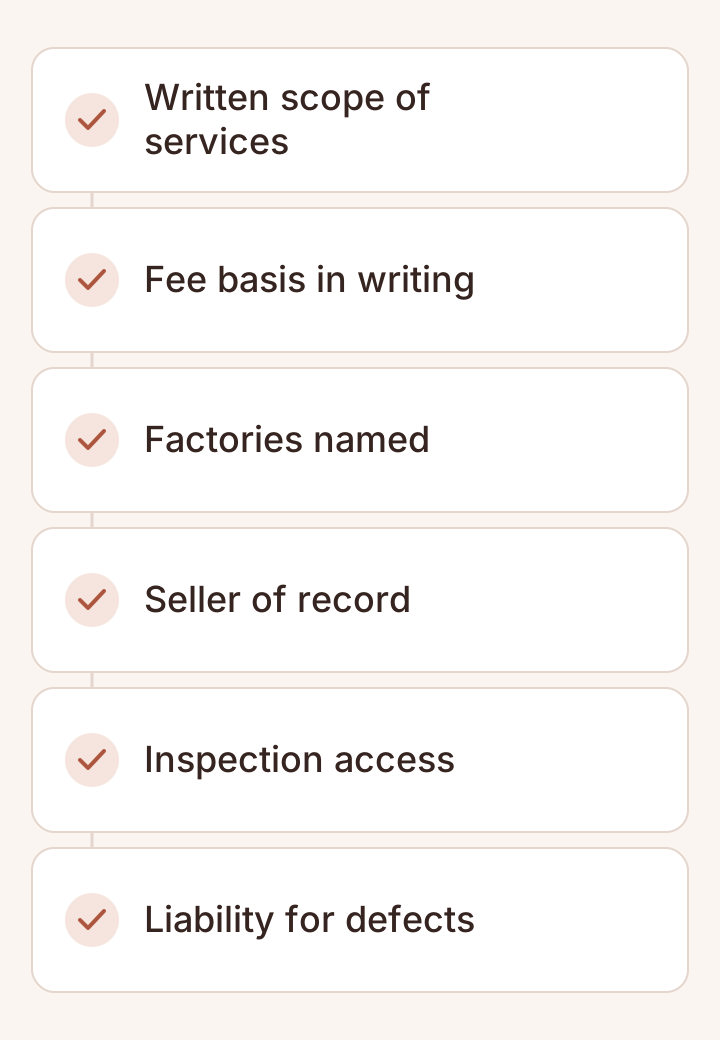
- Written scope of services. The agreement lists the tasks the company will do and the tasks it will not do. Factory search, quotation, production follow-up, inspection, and shipping coordination go on that list only when the agreement includes them.
- Fee basis in writing. The agreement states how the company is paid. Write down any payment the company also receives from a factory it names. The saved pages print no fee percentage and no rebate rate, so those cells stay blank until the agreement prints them.
- Factories named. Each line carries the factory name and address, so the facilities check has a place to inspect.
- Seller of record. The legal name on the contract is the legal name on the commercial invoice. The first-order risk checklist is where you match the beneficiary account to that legal name and where you leave the payment percentage blank until the purchase order prints it.
- Inspection access. The agreement states whether your inspector attends, and you keep one report the company has already issued with the old project identifiers removed. A report written only by the company’s staff is the company’s record. An inspector you appoint is a separate record. Sample size and acceptance numbers stay blank until the inspection plan prints them.
- Liability for defects. The contract states who files the claim and who replaces nonconforming goods, and whether any insurance applies. Limits and warranty months stay blank until the contract or the policy prints them.
Price stays off this page. Put freight, handling, and delay on the total installed cost comparison once the quotes use the same quantity and the same delivery point.
Count the open standards before you release the file
Count how many of the seven FAR 9.104-1 standards have a current note, then subtract that count from 7. FAR 9.104-1 prints no minimum count that releases a deposit.
Recorded standards = the count of standards (a) through (g) with a current note in the order file
Open standards = 7 - recorded standards
Worked example. The notes below are sample file entries for the arithmetic. They are not a responsibility determination, and they are not a pass score.
- (a) Financial resources: a statement is in the file.
- (b) Schedule: the delivery date this quote prints is in the file.
- (c) Performance record: blank.
- (d) Integrity: a note of the SAM exclusion search is in the file.
- (e) Controls: a note of the plant’s quality assurance measures is in the file.
- (f) Facilities: blank.
- (g) Eligibility: blank.
Recorded standards = 4. Open standards = 7 - 4 = 3. The plant line is one of the open three, so the deposit stays held under the rule of thumb above. Copy the open cells into the construction material procurement log and assign an owner to each one.
A federal award still follows the contracting officer’s determination under FAR Part 9 and the agency’s procedures. CPR declarations apply when the product is placed on the EU market under a cited harmonised standard or European assessment document. Acceptance on a US project follows the project specification.
Method and sources
Checked 18 October 2026 against the saved pages, not against a supplier’s certificate.
FAR 9.104-1 General standards, FAR 9.105-1 Obtaining information, and FAR 9.404 Exclusions in the System for Award Management, Acquisition.gov, FAC Number 2026-01, effective 13 March 2026, pages last updated 23 September 2026.
European Commission, Construction Products Regulation overview: Regulation (EU) 2024/3110 and Regulation (EU) No 305/2011. European Commission page on economic operators under the 2024 regulation, including Article 20, Article 22(3), and Article 18 as that page cites them. European Commission page on CE marking and the Declaration of Performance and conformity, including Commission Delegated Regulation (EU) 2026/1310 and the reassessment date 8 January 2030.
ICC Evaluation Service homepage, schema dateModified 24 August 2026, for the program description and the three homepage counters.
A local industry-library search returned packaging pages, not a construction-product primary text, so no library figure is used here. Certificate numbers, code section numbers, prices, lead times, and credit scores that these pages do not print are left blank.
Related articles
First-Order Risk Checklist for Commercial Construction Buyers
Choose construction material procurement requirements for a first order: freeze the drawing revision, name the Incoterms 2020 rule, and copy only figures a saved official page or the project file prints.
Read article: First-Order Risk Checklist for Commercial Construction BuyersPCO in Construction: From Material Change to Order Release
Understand construction PCO terms, distinguish bulletins from change orders, and use a blank record to connect material revisions to order-release authority.
Read article: PCO in Construction: From Material Change to Order Release
OAC Meetings: Agenda, Roles and Follow-Up
Run a construction OAC meeting with a focused agenda, clear roles and a blank action record connecting submittals, ordering decisions and delivery dates.
Read article: OAC Meetings: Agenda, Roles and Follow-Up