
First-Order Risk Checklist for Commercial Construction Buyers
Choose construction material procurement requirements for a first order: freeze the drawing revision, name the Incoterms 2020 rule, and copy only figures a saved official page or the project file prints.
A first order that arrives damaged, short, or built to the wrong revision stops the crew that was ready to install it. This first-order risk checklist is how you choose construction material procurement requirements before the deposit moves: copy the current documents, name the Incoterms rule, and leave every unprinted figure blank.
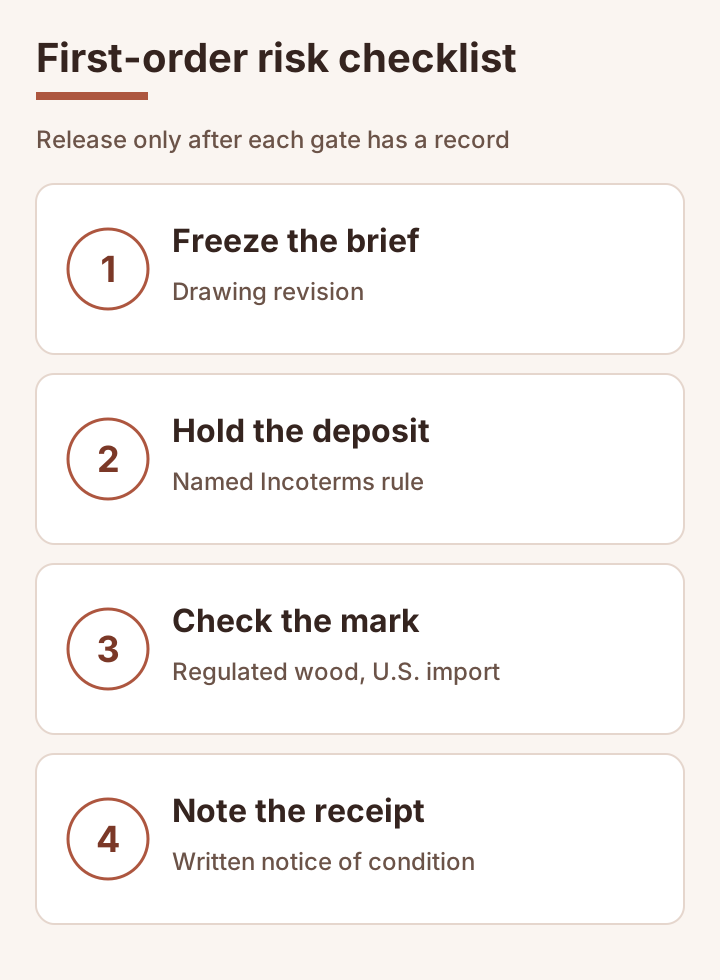
Choose construction material procurement requirements by writing down the drawing revision, the acceptance values the project specification already prints, and the carriage or border rule that governs this shipment. A first-order risk checklist holds those copies in four release gates: the brief, the deposit, the packaging mark, and the delivery notice. You release the deposit only after the purchase order names the contracting party, the Incoterms 2020 rule and place, and the evidence the specification prints. Wood-packaging marks matter when regulated wood enters or transits the United States. Ocean notice periods matter when the bill of lading is a Carriage of Goods by Sea Act contract to or from a U.S. port in foreign trade. Specification section numbers, spare counts, coating thickness, payment percentages, treatment temperatures, and this booking’s free-time days stay blank on this page until the project file or the carrier tariff prints them.
Scroll horizontally to see all columns.
| Item | Printed figure | Where that figure applies | Order-file cell |
|---|---|---|---|
| Specification section number | |||
| Spare piece count | |||
| Coating thickness, alloy, color difference | |||
| Payment percentage | |||
| Free-time days on this booking | The 2019 FMC report defines free time. It does not set this booking’s allowance. | ||
| Notice if damage is not apparent | 3 days | COGSA section 3(6), in the 2023 U.S. Code note to 46 U.S.C. 30701, for a sea bill of lading to or from a U.S. port in foreign trade | |
| Time to sue under that sea bill | 1 year | Same COGSA section 3(6) | |
| Carrier package limit | $500 per package | COGSA section 4(5) in that 2023 edition, unless nature and value were declared before shipment and inserted in the bill of lading | |
| Inland truck notice period | |||
| Piece outside regulated wood packaging | Less than 6 mm thick in any dimension | 7 CFR 319.40-1 | |
| Heat-treatment temperature and hours | 7 CFR 319.40-3(b)(1) requires treatment under 7 CFR part 305 and does not print the schedule |
What the requirements brief has to contain
Pull the brief from the current contract documents. A request that says only “grey panels, as per drawings” leaves the acceptance test unnamed, so two bidders can price two different products.
The construction material procurement lifecycle is the wider sequence this checklist sits inside. Use it to see who reviews the brief before the purchase order goes out.
Copy these inputs when the current set prints them:
- Architectural drawings: the item, where it sits, and the revision.
- Structural drawings: loads, connections, and the substrate the supplier has to meet.
- The specification section the project manual prints, including the test method and the submittal it names.
- Addenda and approved submittals, with the drawing number and revision you are buying against.
Sort each line before it enters the brief. A mandatory line comes from the project specification or the contract drawings, and you keep the section identifier those documents print. A code line comes from the adopted code the design documents already name. This page does not print a building-code section, so that cell stays blank until those documents do. A preference is a habit or a finish the contract never wrote down. Label it as a preference so a bidder can offer another product without being thrown out.
The specification comparison guide shows how to separate those three kinds of lines when two submittals look alike. Copy thicknesses, ratings, and tolerances from the project documents. Do not replace a blank cell with a catalog value.
The brief itself needs six fields: the item and its drawing revision, the tests the specification names, the quantity basis, the delivery point and need-by date the schedule prints, the submittals required before production, and the questions the design team has not closed. If a field has no printed value, leave it blank and make the bidder price that blank as an open question.
Release quantity = scheduled count + spare count
Worked example. The inputs below are sample file entries for the arithmetic, not a waste factor and not a code allowance. The schedule prints 120 pieces. The specification prints a spare count of 6. Release quantity = 120 + 6 = 126. If the specification prints no spare count, leave the spare cell blank and do not insert a percentage.
What you lock before the deposit
Hold the deposit until a purchase order names the contracting party, attaches the approved drawings, and states the commercial term.
Match the beneficiary account name to the legal name on the contract. If the payee is a different company, stop and run that name through the buyer’s own verification before any transfer. The supplier evaluation guide is the place to organize identity, plant, and inspection evidence. This page does not print a credit-score threshold.
On the technical attachment, record the alloy, coating, dry-film thickness, color reference, and color-difference limit only when the approved specification prints them. The table at the top leaves those cells blank on purpose.
Which Incoterms 2020 rule matches the move
The ICC seller flowchart, in the Incoterms 2020 checklist, sorts the rule by who moves the goods and where risk passes. It does not print the named place for your job. Write that place from the contract, or leave it blank.
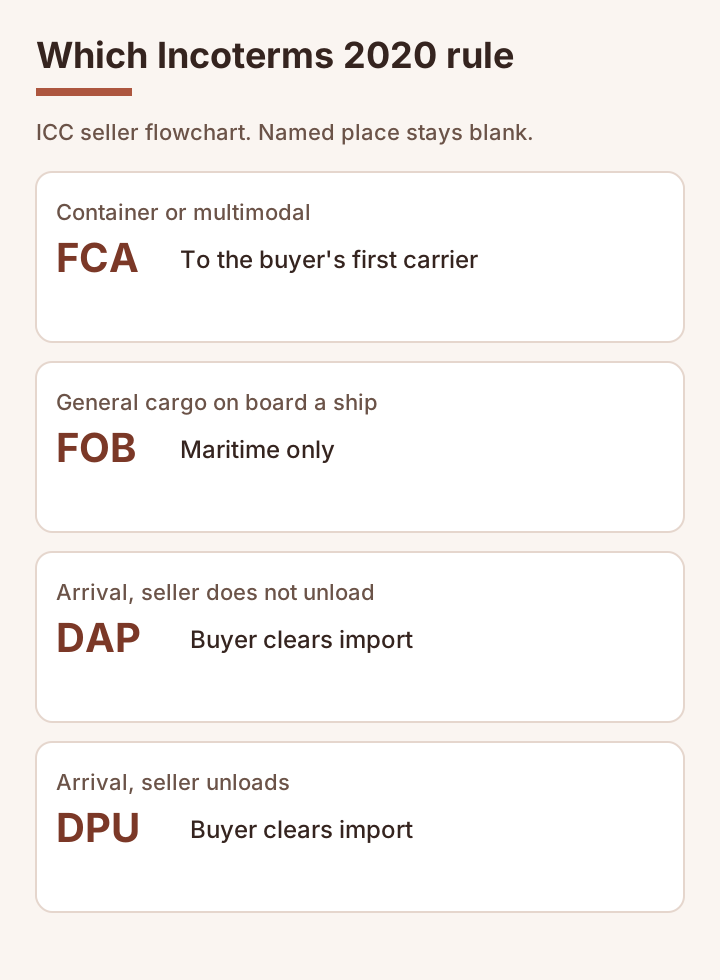
Use the flowchart this way:
- Container, multimodal transport, or delivery to an inland or port terminal: FCA. The seller delivers to the first carrier the buyer engages, at the seller’s premises or at a terminal.
- General cargo or bulk loaded on board a vessel, or a container the seller loads that way: FOB. The same note limits FAS and FOB to maritime transport. FCA can be used for any transport, including multimodal.
- You want risk to pass at shipment in the seller’s country, and the move is containerized or multimodal: CPT if the price excludes insurance, CIP if it includes insurance. The ICC Incoterms 2020 page says CIP requires cover compliant with Institute Cargo Clauses (A) or similar clauses. CIF, which that page reserves for maritime trade, keeps Institute Cargo Clauses (C) as the default.
- You want risk to pass only on arrival: DAP if the seller does not unload and does not clear import, DPU if the seller unloads and does not clear import, DDP if the seller also takes import clearance through delivery at the named point.
The ICC page also says FCA article A6/B6 lets the parties agree that the buyer will instruct the carrier to issue an on-board bill of lading to the seller after loading. Costs for a chosen rule are gathered at article A9/B9 of that rule. The checklist names Verified Gross Mass among the documents a seaborne full-container shipment can require. Copy the mass from the packing list. This page does not print one.
Rule of thumb: If the goods move in a container or by more than one mode, prioritize FCA over FOB, because the ICC flowchart limits FOB to maritime loading on board a ship.
Free time is the grace period before demurrage or detention. The Federal Maritime Commission’s April 2019 report defines demurrage as a charge for the use of space and detention as a charge for the use of equipment. It describes five working days of free time as the historical allowance and, for most U.S. ports in the tariffs it studied, still the standard, with four days as the standard demurrage free time at New York/New Jersey, Los Angeles, and Long Beach. The report calls that description a snapshot of those tariffs. It does not bind a later booking. Copy this booking’s free days and daily rate from the tariff or the service contract, and leave both cells blank until that document prints them.
Overrun days = available days - free days printed on the booking
Holding charge = overrun days x daily rate printed on the booking
Worked example. Count only figures the booking prints. This page prints neither a free-day count nor a daily rate for your booking, so the holding-charge result stays blank. The installed-cost comparison is where you place replacement, idle crew, and this holding charge on one sheet once the file has the rates.
The payment percentage cell stays blank. Write the split the purchase order prints. Do not borrow a split from another job.
What production records you can require
Wait for the evidence the frozen specification names. Leave certificate type, coating thickness, and color difference blank unless the specification prints them.
Scroll horizontally to see all columns.
| Phase | Dominant failure mode | Prevention | Record this page can name |
|---|---|---|---|
| Incoming material | The heat or lot does not match the approved grade | Hold the lot until the certificate the specification names is in the file | Certificate type: blank |
| First piece | The run continues at the wrong size | Stop the run until measured size matches the drawing tolerance the specification prints | Tolerance: blank |
| Finish | Color or adhesion drifts from the approved sample | Compare against the sample and the test method the finish specification names | Delta and thickness: blank |
| Trial fit | Parts meet on the floor and miss at the building | Dry-fit against the approved details before packing | Photo set named in the inspection plan |
If a revision arrives after the brief is frozen, route it through the material-change and order-release steps before the factory cuts the new revision. The quality-control plan is the handoff for who signs that disposition.
Which wood packaging needs a mark
Two official pages describe U.S. imports, and they do not use the same boundary. Read both before you treat a crate as exempt.
The IPPC publication page for ISPM 15 says the standard covers wood packaging material made from raw wood in international trade, includes dunnage, and excludes wood packaging made from wood processed so that it is free from pests, with plywood given as the example. It also says those measures are not ongoing protection from contaminating pests.
APHIS, on the import page last modified 27 July 2026, tells the importer to ensure wood packaging material entering or transiting the United States is pest-free, debarked, heat-treated or fumigated, and marked with an ISPM 15 logo. Shipments with noncompliant wood packaging material will not be allowed to enter. The same page says the official mark includes the IPPC logo, a two-letter country code, a unique facility number, and a treatment type of HT for heat treatment or MB for methyl bromide. It tells you to put ISPM 15 compliance in the contract and to have the exporter inspect the packaging for pests when it is delivered or before it is used.
7 CFR 319.40-1 defines regulated wood packaging material as wood packaging material other than manufactured wood materials, loose wood packing materials, and wood pieces less than 6 mm thick in any dimension, used with cargo to prevent damage. The examples it prints are dunnage, crating, pallets, packing blocks, drums, cases, and skids. Loose wood packing material, on the same definitions section, is excelsior (wood wool), sawdust, and wood shavings. The saved page does not define manufactured wood, so that cell stays blank. Keep the plywood example on the IPPC line only.
Rule of thumb: If wood thickness is under 6 mm in any dimension, 7 CFR 319.40-1 places that piece outside regulated wood packaging material.
7 CFR 319.40-3(b) allows regulated wood packaging material to enter under a general permit when two conditions are met. It must be treated in accordance with 7 CFR part 305. It must be marked in a visible location on each article, preferably on at least two opposite sides, with a legible and permanent mark that the IPPC has approved to show an approved measure. The mark includes a unique graphic symbol, the ISO two-letter country code, a unique producer number assigned by that country’s national plant protection agency, and a treatment abbreviation such as HT or MB. The section’s format line uses XX for the country code, 000 for the producer number, and YY for the treatment type.
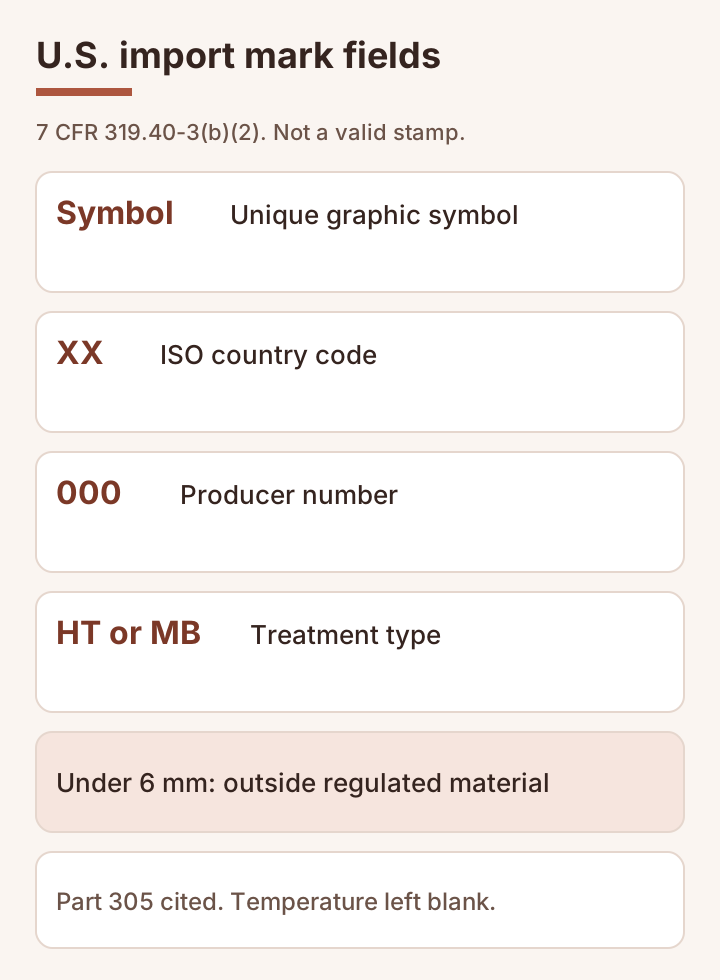
The same paragraph authorizes an inspector at the port of first arrival to order immediate reexport of regulated wood packaging material imported without that mark, along with or instead of the arrival procedures in 7 CFR 319.40-9. Part 305 is cited for the treatment. Temperature and duration are not printed on the saved page, so those cells stay blank.
Common mistake: Calling a plywood sheet noncompliant because it has no HT mark. The IPPC description excludes plywood. A solid-wood block, pallet, or piece of dunnage in the same crate can still be regulated. Check the piece, not the word “crate.”
When this does not apply: 7 CFR 319.40-3(b)(4) prints an exception for regulated wood packaging material the Department of Defense uses to package nonregulated articles, including commercial shipments under a Department of Defense contract. A private commercial order does not sit in that exception. Domestic moves that never enter or transit the United States are outside the APHIS import sentence.
Desiccant weight, banding strength, and shock-indicator type are not printed on these pages. Copy them from the packing plan or leave them blank. The site coordination notes cover how the truck, the hoist, and the floor hand the crate off once it is allowed in.
What you write on the delivery receipt
The notice rule depends on the contract of carriage. For a bill of lading or similar document of title that evidences carriage of goods by sea to or from ports of the United States in foreign trade, the 2023 U.S. Code reproduction of the Carriage of Goods by Sea Act states the following.
Section 3(6) says that if written notice of loss or damage, and the general nature of it, is not given to the carrier or the carrier’s agent at the port of discharge before or at the time the goods are removed into the custody of the person entitled to delivery, that removal is prima facie evidence that the goods were delivered as the bill of lading described them. If the loss or damage is not apparent, the notice must be given within three days of delivery. The notice can be endorsed on the receipt given to the person taking delivery. Written notice is not required when the condition of the goods has already been the subject of a joint survey or inspection at receipt.
The same paragraph discharges the carrier and the ship from all liability for loss or damage unless suit is brought within one year after delivery, or after the date the goods should have been delivered. It also says that missing the notice does not take away the right to sue inside that year. The carrier and the receiver are to give each other reasonable facilities to inspect and tally the goods.
Section 4(5) in that edition prints a liability ceiling of $500 per package, lawful money of the United States, or per customary freight unit if the goods are not shipped in packages, unless the shipper declared the nature and value before shipment and that declaration was inserted in the bill of lading.
The Act’s definition of goods excludes live animals and cargo that the contract states is carried on deck and that is so carried. Its definition of carriage of goods runs from the time the goods are loaded to the time they are discharged. A later inland truck receipt is a different contract. This page does not print a notice period for that inland leg, so the inland cell stays blank.
When this does not apply: The three-day figure belongs to the sea bill described above. A domestic truck ticket, an air waybill, or a voyage outside that text keeps a blank notice cell. Under that sea bill, removal without the written notice is prima facie evidence of delivery as described. Endorse the exception on the receipt while the driver is still there: crate identity, what you can see, and that concealed condition is still open.
Photograph the damage in the crate before the pieces come out. Separate the nonconforming pieces. The formal notice goes to the carrier named on the bill and to the cargo underwriter, with the photos and the invoice reference. The site handoff notes are where that receiving record meets the installation sequence.
The blank release record
Copy this table into the order file. Write the purchase-order number, the item, and the drawing revision above it. A gate stays on hold until its evidence cell and its disposition cell are filled from the file, not from this page.
Scroll horizontally to see all columns.
| Gate | Evidence reference | Open issue | Reviewer and release |
|---|---|---|---|
| 1. Brief and deposit | |||
| 2. Production | |||
| 3. Packaging and shipment | |||
| 4. Receipt |
Keep the filled record with the procurement log so the next expediting meeting sees the same blanks and the same releases.
Method and sources
The four gates are this page’s release order. They are not a published standard. A requirement appears above only when the saved page prints it. Sample inputs in the quantity example are labeled as sample inputs.
Sources checked 18 October 2026:
- IPPC, ISPM 15 publication page, describes raw-wood scope, dunnage, and the processed-wood exclusion that names plywood.
- USDA APHIS, “Import ISPM 15-Compliant Wood Packaging Material into the United States,” last modified 27 July 2026, states the importer conditions and the mark fields.
- 7 CFR 319.40-1 and 319.40-3(b), eCFR subpart on logs, lumber, and other wood articles, print the regulated definition, the 6 mm exclusion, the mark contents, the part 305 citation, and the reexport authority.
- ICC, Incoterms 2020 page and the Incoterms 2020 checklist and flowcharts, print the seller choice among FCA, FOB, CPT, CIP, CFR, CIF, DAP, DPU, and DDP, the maritime limit on FAS and FOB, and the CIP and CIF insurance-clause difference.
- Federal Maritime Commission report filed at fmc.gov in April 2019, defines demurrage, detention, and free time, and describes the tariff snapshot noted above.
- Carriage of Goods by Sea Act, sections 3(6) and 4(5), as reproduced in the 2023 edition of the United States Code, statutory note to 46 U.S.C. 30701.
- The CSI MasterFormat page was opened and prints no division numbers, so none are used.
Related articles

AIA Contract Documents: A Procurement Form Guide
Match A101, A102, A104, A133, A141, A201, and A401 to the price clause and the delivery route before the wrong general conditions are incorporated.
Read article: AIA Contract Documents: A Procurement Form GuideHow to Choose Construction Material Procurement Software: A Demo Worksheet
Evaluate construction material procurement software with a blank five-test vendor demo worksheet covering submittal revisions, PO release, split deliveries, damaged receipts and CSV export.
Read article: How to Choose Construction Material Procurement Software: A Demo Worksheet
Construction Manager at Risk: When the Price Is Set
A construction manager at risk advises during design, then builds under a price ceiling. When that price is set, what it includes, and who awards the trades.
Read article: Construction Manager at Risk: When the Price Is Set