
Construction Material Procurement: Lifecycle Stages, Sourcing Channels and Verification Checklist
Five release gates for construction material procurement, plus sourcing channels and a verification checklist. Cost share, waste, lead time, markup, and attic stock stay blank unless a saved source prints them.
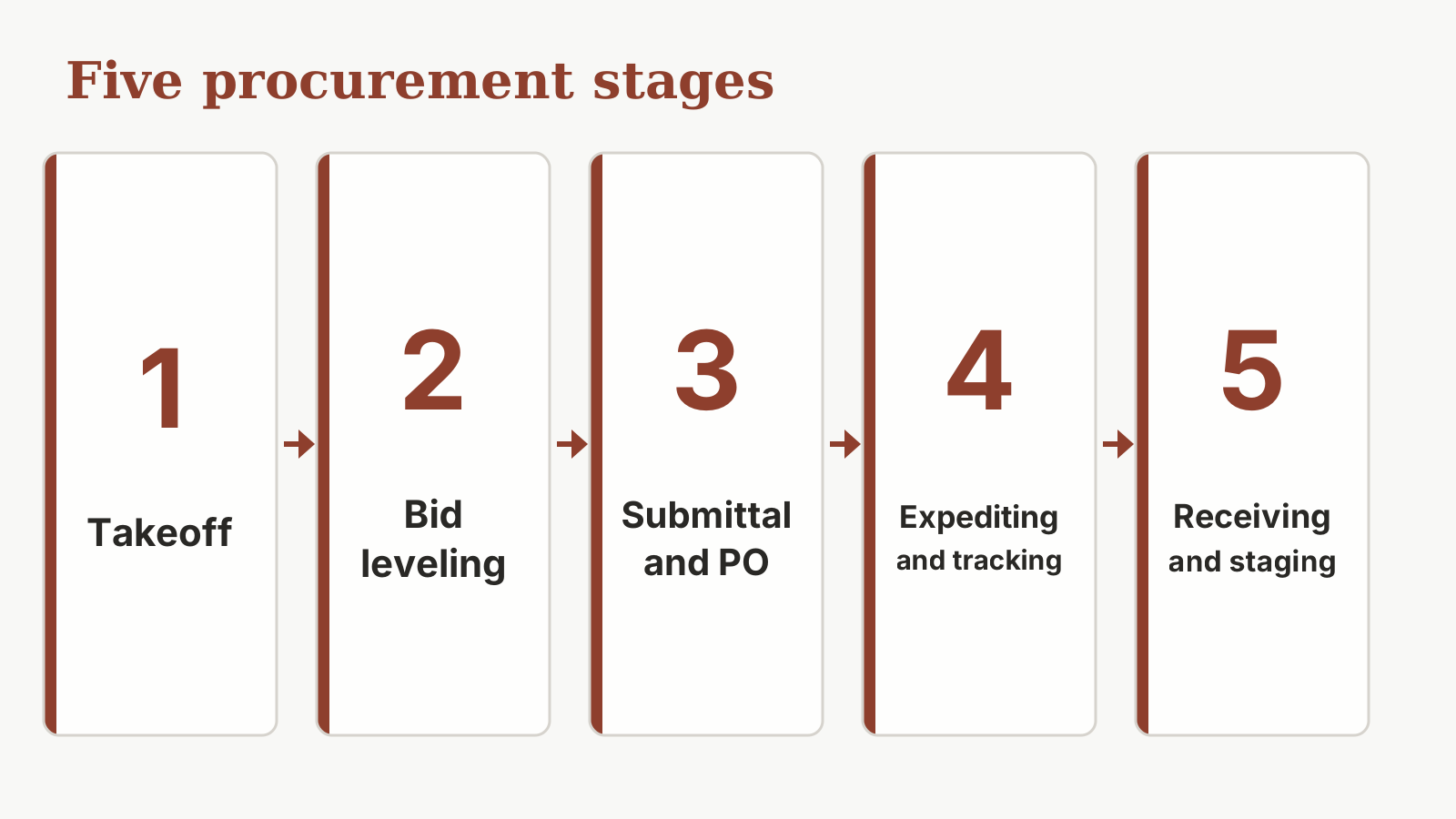
A rejected submittal or a damaged delivery fails the job after the purchase order is already out. Material procurement is five release gates: takeoff, bid leveling, submittal and purchase order, expediting, and receiving. Open a gate only when its document is in the file.
Buy materials by clearing five gates in order. Define the quantity from the drawings, level quotes on one scope and one delivery rule, release fabrication only after the submittal action authorizes the work, track the expected delivery date against the site need date, and inspect the goods before acceptance. Cost share, waste allowance, lead time, channel markup, and attic-stock percentage stay blank on this page. Stack limits and the O&M withhold come from 29 CFR 1926.250 and UFGS-01 33 00 (August 2026). Delivery rules come from UCC § 2-319, UCC § 2-513, and the ICC Incoterms 2020 checklist. Who holds the design and construction contract is a separate decision, covered in construction procurement methods.
Scroll horizontally to see all columns.
| Input | Printed value | Why it matters |
|---|---|---|
| Gate sequence | Five documents, in order | The package waits until that document is filed |
| Waste allowance a | Purchased quantity = net measured quantity x (1 + a). The takeoff supplies a | |
| Cost share | ||
| Channel markup | ||
| Lead time | The supplier’s written confirmation for this order | |
| Attic stock | The quantity the project specification prints | |
| UCC F.O.B. place of shipment | Seller bears expense and risk of putting the goods into the carrier’s possession | § 2-319(1)(a), unless otherwise agreed |
| UCC F.O.B. place of destination | Seller bears expense and risk of transport to that place and tenders delivery there | § 2-319(1)(b), unless otherwise agreed |
| Incoterms 2020 FOB | Maritime transport. Risk and cost divide once the goods are on board | ICC checklist. Containers and multimodal transport: FCA |
| UFGS mark that authorizes work | “approved”, “accepted”, or “approved as noted” with no contractor exception | UFGS-01 33 00 (August 2026), paragraph 1.12.1 |
| UFGS O&M data, Navy forwarding section | 30 calendar days after delivery. Withhold: 50 percent of the price of those items | Paragraph 1.5.1 |
| Loose brick | 7 feet maximum. Above 4 feet, taper 2 inches per foot of height | 29 CFR 1926.250(b)(6) |
| Floor load | Paragraph (a)(2) names pounds per square foot and prints no number |
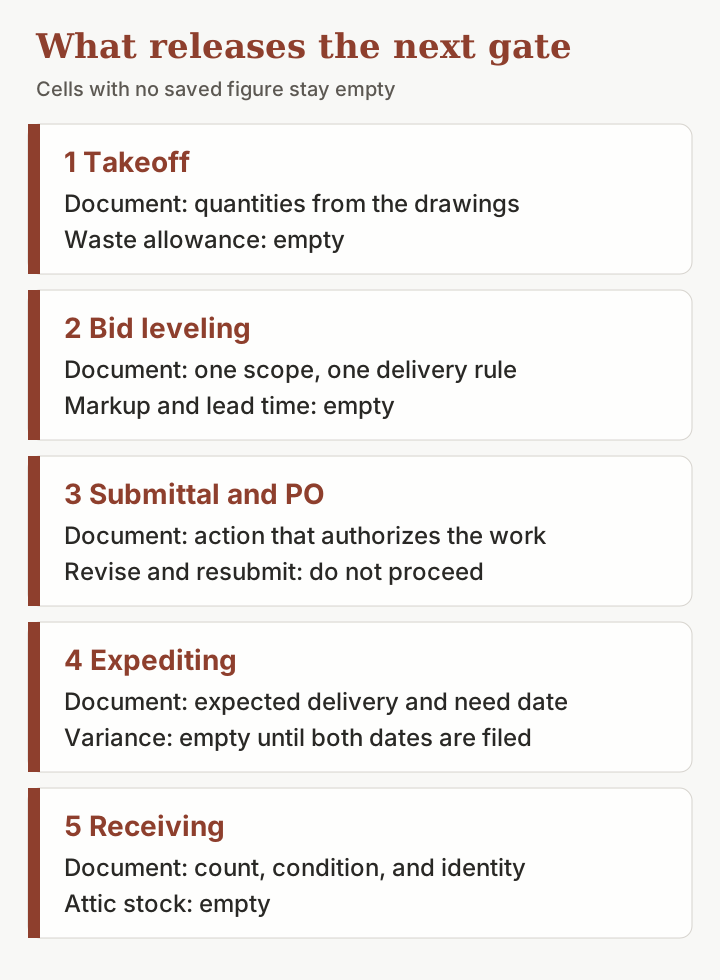
Each gate opens on a document. Waste, markup, lead time, and attic stock stay empty on this page.
The five stages of material procurement
Run the package through the five gates below. The sequence is the release order for this guide. It is a buying checklist, and the filled numbers later in the section are the ones the saved pages print.
Scroll horizontally to see all columns.
| Stage | Release document | Stop when | Dominant failure mode and prevention |
|---|---|---|---|
| 1. Takeoff | Quantities taken from the drawings, tied to the specification section | The waste allowance is unprinted and a percent is typed anyway | Ordering a generic waste percent. Prevention: leave the allowance empty and buy the net quantity |
| 2. Bid leveling | Quotes leveled on one scope and one named delivery rule | Two quotes name different places or different rule sets | Treating a UCC F.O.B. term and an Incoterms 2020 rule as the same price. Prevention: write the instrument and the place on every quote |
| 3. Submittal and PO | The returned action that authorizes the work | The mark is “not approved”, “disapproved”, or “revise and resubmit” | Fabrication before that mark. Prevention: hold the order |
| 4. Expediting | Expected delivery date and site need date, kept apart from the confirmed ship date | Either date for the variance is missing | Reading an empty date as on time. Prevention: leave the variance empty |
| 5. Receiving | Count, condition, and identity written at receipt | Visible damage is unsigned | A clean receipt over damaged goods. Prevention: write the exception on the receipt before the driver leaves |
Takeoff
Start from the current drawings and the specification section that names the product. Read whether that section names a product, states properties, or states a test the product has to pass. Record the net measured quantity in the unit the section uses.
Purchased quantity = net measured quantity x (1 + a)
a is the waste allowance the takeoff prints for this product and this installation. This page prints no value for a.
Worked example. When the takeoff prints no allowance, the order you can defend today uses a = 0. Purchased quantity = net x (1 + 0) = net. A later allowance from the takeoff replaces the zero. Sheet-good percents, tile percents, and framing percents stay off this page.
For a wall package, finish the briefing on wall-system planning before the quotes are treated as equal, then bring the quantity back here.
Takeaway: Buy the net quantity until the takeoff prints a.
Bid leveling
Use the same scope, the same quantity basis, and the same delivery rule for every supplier on the list for that package. This page prints no minimum number of bidders. A contract or an agency that prints a minimum controls that job.
Level the quotes on the specification comparison. Qualify a new supplier with the supplier evaluation checks, and run a first order through the first-order risk checklist before the deposit moves.
Write the delivery instrument in words.
Under UCC § 2-319, unless otherwise agreed, F.O.B. at a named place is a delivery term even when it appears only next to the price. F.O.B. the place of shipment means the seller ships the goods as Article 2 provides and bears the expense and risk of putting them into the carrier’s possession. F.O.B. the place of destination means the seller, at the seller’s expense and risk, transports the goods to that place and there tenders delivery. Cornell publishes the uniform text. The governing state’s enactment controls.
The ICC Incoterms 2020 checklist, publication PUB817E, is a different instrument. It limits FAS and FOB to maritime transport. It allows FCA for any transport, including multimodal. For goods in containers, for multimodal transport, or for delivery at an inland or port terminal, the checklist selects FCA, with delivery to the first carrier the buyer engages. It selects FOB for general cargo or bulk commodities loaded on board a vessel, and for the case where the parties divide risk and cost once the goods are on board. The checklist also says disputes still arise over loading, unloading, terminal handling, container rental, and customs processing, and it tells the parties to add that allocation in the contract.
A domestic order that says “F.O.B. jobsite” is the UCC destination term, with the jobsite as the named place. An import order names the Incoterms 2020 rule, the year, and the place. The duty rate stays empty. No saved page used here prints one.
Rule of thumb: If the two quotes name different delivery places, or one quote is a UCC F.O.B. term and the other is an Incoterms 2020 rule, write both rules out and re-level before award.
The lines that sit outside the unit price, including freight the rule excludes, belong in the total installed cost comparison. Dollars for those lines stay on the quote.
Takeaway: One scope, one quantity basis, one named rule. An open cell waits.
Submittal and purchase order
On a job that incorporates UFGS-01 33 00 (August 2026), paragraph 1.12.1 returns the submittal with one of these actions when the approving authority is the Contracting Officer:
- “approved” or “accepted” authorize proceeding with the work covered.
- “approved as noted” or “approved, except as noted, resubmittal not required,” authorize proceeding with the work covered provided the contractor takes no exception to the corrections.
- “not approved,” “disapproved,” or “revise and resubmit” mean the submittal is incomplete or out of compliance. Do not proceed with work for that item until the resubmittal is approved.
- “receipt acknowledged” applies only to information-only submittals.
Paragraph 1.13 adds that no item of work requiring a submittal change is accomplished until the changed submittals are approved. Paragraph 1.14 states that approval does not relieve the contractor of responsibility for meeting the contract requirements, and that a later substitution needs an explanation of why the substitution is necessary.
The section is a guide specification. Bracketed choices and editor notes are for the specifier. On a contract that does not incorporate this UFGS section, the release mark is the action that contract prints. When the clause is silent, the authorizing-action cell stays empty and fabrication waits.
Rule of thumb: If the mark is “not approved”, “disapproved”, or “revise and resubmit”, paragraph 1.12.1 says not to proceed with that item until the resubmittal is approved.
The guide’s submittal descriptions used on that file include SD-02 shop drawings, SD-03 product data, SD-04 samples, SD-06 test reports, and SD-07 certificates. For SD-06, unless another section specifies otherwise, the test date is within three years of the date of contract award. An SD-07 certificate is dated after award and names the project.
Section 1.5, which the guide marks for Navy projects, says to forward the required shop drawings, product data, and samples before procurement or fabrication. Paragraph 1.5.1, in that forwarding section, sets O&M data for a given item at 30 calendar days after the item is delivered to the contract site. If the data misses that limit, the paragraph authorizes a withhold of 50 percent of the price of the items to which the data apply. That 50 percent is the O&M withhold in this Navy-tailored paragraph.
Tie payment milestones on the purchase order to the authorizing action, to delivery, and to field acceptance when the contract gives you those hooks. The order names the delivery rule from the leveled sheet.
Takeaway: Release fabrication on an authorizing mark. A revise-and-resubmit holds the item.
Expediting and tracking
Variance days = expected delivery date - site need date
The material procurement log keeps the supplier-confirmed ship date in its own column. Variance is the difference between the expected delivery date and the site need date. This page subtracts in that order.
Worked example. When the expected delivery date is missing, the subtraction has no first date, and the variance stays empty. When the two dates fall on the same calendar day, variance days = 0. A positive result means the expected delivery date is later than the site need date. Any other gap waits for the two dates the file prints. This page prints no lead time in weeks.
UFGS-01 33 00 paragraph 1.9.1 keeps a Contractor Material Needed By Date on the submittal register. Paragraph 1.9.3 describes the Contractor Material field as the date the contractor needs the material delivered to contractor control. Use that date as the site need date on a UFGS job. On any other job, the need date is the date the schedule and the specification print.
Copy the live row into the log: package, owner, submittal status, site need date, confirmed ship date, expected delivery date, variance, next action. When the weekly update no longer fits the sheet, test those fields with the procurement software selection criteria.
Adapt the delivery to other work already on the site, using the site coordination notes. A plant visit or a mock-up happens when the contract calls for it. The visit adds no duration this page can print.
Takeaway: A missing ship date is an empty variance, and the package stays on the log.
Receiving and staging
UCC § 2-513(1), unless otherwise agreed and subject to subsection (3), gives the buyer a right before payment or acceptance to inspect the goods at any reasonable place and time and in any reasonable manner. When the seller is required or authorized to send the goods, subsection (1) allows that inspection after arrival. Subsection (2) places inspection expenses on the buyer and provides for recovery from the seller if the goods do not conform and are rejected. Subsection (3) takes away the right to inspect before payment when the contract provides for delivery C.O.D. or for payment against documents of title, except where that payment is due only after the goods are available for inspection. Subsection (4) treats a place or method the parties fix as exclusive. Unless expressly agreed, that choice does not postpone identification or shift where delivery happens or where risk passes.
Count pieces against the packing list and the purchase order. Check the product identity against the approved submittal. Write shortages and visible damage on the delivery receipt before the driver leaves. Keep the packaging and the photographs with that receipt. The notice period for a later claim is the period the carrier’s tariff and the purchase order print. This page prints no claim deadline.
Stage what you accepted under 29 CFR 1926.250. Paragraph (a)(1) requires material stored in tiers to be stacked, racked, blocked, interlocked, or otherwise secured so it does not slide, fall, or collapse. Paragraph (a)(2) says the weight on floors inside buildings shall not exceed maximum safe load limits, and employers post those limits in pounds per square foot, except on a slab on grade and except in single-family residential structures and wood-framed multi-family residential structures. The paragraph prints no pounds-per-square-foot figure, so that cell stays empty. Paragraph (a)(3) keeps aisles and passageways clear for material handling and for people.
Scroll horizontally to see all columns.
| Stored condition | Figure 29 CFR 1926.250 prints | Paragraph |
|---|---|---|
| Inside a building under construction | Not within 6 feet of a hoistway or an inside floor opening, and not within 10 feet of an exterior wall that does not extend above the material | (b)(1) |
| Noncompatible materials | Segregate them | (b)(3) |
| Bagged materials | Step the layers back and cross-key at least every 10 bags high | (b)(4) |
| Loose brick | Not more than 7 feet. Above 4 feet, taper 2 inches in every foot of height above 4 feet | (b)(6) |
| Masonry block | Above 6 feet, taper one-half block per tier above the 6-foot level | (b)(7) |
| Lumber | Nails withdrawn from used lumber. Stack on level, solidly supported sills, stable and self-supporting. Piles not over 20 feet. Lumber handled manually not over 16 feet | (b)(8) |
| Steel, pipe, bar, and other cylindrical material | Stacked and blocked against spreading or tilting, unless racked | (b)(9) |
Taper inches = 2 * (H - 4)
H is the loose-brick stack height in feet. Paragraph (b)(6) stops the stack at 7 feet.
Worked example. 2 * (7 - 4) = 6. At the 7-foot limit the taper is 6 inches.
Rule of thumb: If a loose brick stack is above 4 feet, taper it 2 inches for every foot above 4 feet, and stop at 7 feet. 29 CFR 1926.250(b)(6).
The standard does not print a millimeter clearance under the pile. Lumber sits on sills. A dunnage height in millimeters stays empty. Attic stock stays empty until the specification prints a quantity.
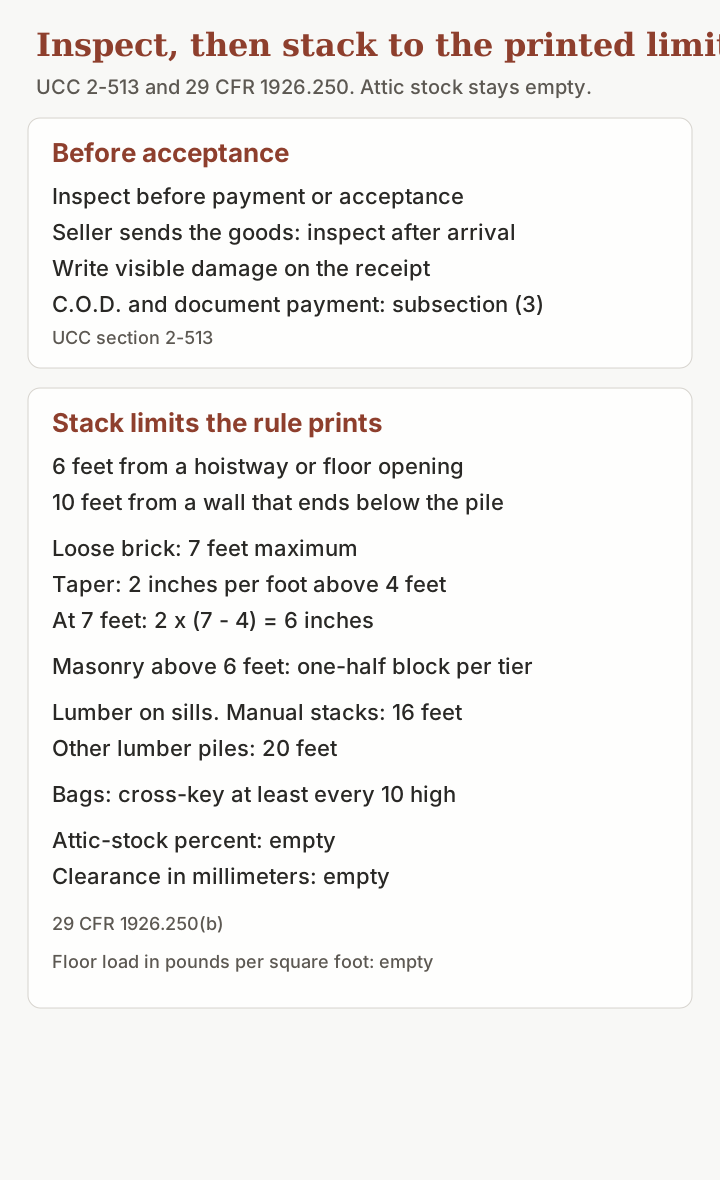
Inspection follows UCC § 2-513. Stack heights follow 29 CFR 1926.250. Attic stock and a millimeter clearance stay empty.
Takeaway: Record condition at receipt, then stack to the limit the standard prints.
Comparing procurement channels
Choose the channel per package from like-for-like quotes. The table leaves markup, lead time, and cost share empty because no saved page prints them.
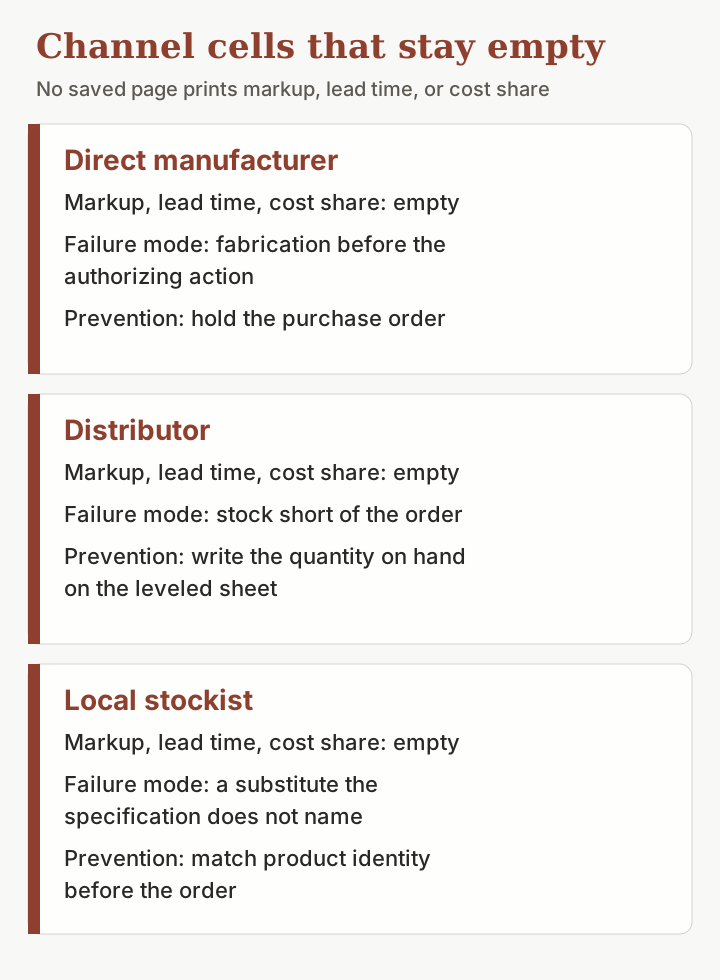
Markup, lead time, and cost share stay empty. The failure mode is what the channel gets wrong when the document is thin.
Scroll horizontally to see all columns.
| Channel | What the quote has to show | Markup | Lead time | Cost share | Dominant failure mode and prevention |
|---|---|---|---|---|---|
| Direct manufacturer | Minimum order, whether the item is made to order, freight, and the delivery rule | Fabrication before the authorizing action. Prevention: hold the purchase order | |||
| Distributor | Quantity on hand versus the balance, accessorial charges, and the returns terms | Stock short of the order. Prevention: write the quantity on hand on the leveled sheet | |||
| Local stockist | The unit for this small quantity, the delivery charge, and the product identity | A substitute the specification does not name. Prevention: match the product identity before the order |
A lower unit price still has to survive the installed-cost lines on when a lower unit price costs more. Freight the rule excludes, handling, and a rejection are separate lines. Their dollars stay on the quote.
Takeaway: Award the package whose leveled sheet has the documents, and list every empty commercial cell beside it.
Procurement verification checklist
Release the supplier’s final payment when each line has a document in the file. A line with no document stays open.
- Submittal returned with an action that authorizes the delivered material. On a UFGS-01 33 00 (August 2026) job, that mark is “approved”, “accepted”, or “approved as noted” with no contractor exception. Open comments are closed or the item is held.
- Test reports and certificates the specification requires are filed. On that UFGS job, an SD-06 test report uses testing within three years of contract award unless another section specifies otherwise, and an SD-07 certificate is dated after award and names the project.
- Delivery receipts are filed, with shortages and visible damage written on the receipt.
- Releases the contract requires from the supplier, and from its suppliers when the contract says so, are filed.
- Attic stock or other extra material is delivered in the quantity the specification prints, with a signed acknowledgment. The percent cell on this page is empty.
- O&M data, where the specification requires it. On the Navy forwarding section of this UFGS, paragraph 1.5.1 sets 30 calendar days after delivery and authorizes a withhold of 50 percent of the price of the items if the data misses that limit.
Scroll horizontally to see all columns.
| Record | Printed figure | Source |
|---|---|---|
| Waste allowance | Project takeoff | |
| Channel markup | ||
| Lead time | Supplier confirmation for this order | |
| Cost share | ||
| Attic stock | Project specification | |
| Dunnage height | ||
| UFGS O&M clock | 30 calendar days after delivery | UFGS-01 33 00 (August 2026) ¶ 1.5.1, Navy forwarding section |
| UFGS O&M withhold | 50 percent of the price of the items | Same paragraph, if the data misses the clock |
| SD-06 testing age | Within three years of contract award, unless another section specifies otherwise | UFGS-01 33 00 SD-06 |
| Loose-brick taper at 7 feet | 6 inches | 2 x (7 - 4), from 29 CFR 1926.250(b)(6) |
Takeaway: Pay the supplier when every line has a document. An empty attic-stock cell means the specification has not printed a quantity.
When this does not apply
Owner-furnished material follows the owner’s buying terms.
A public owner that prints its own procedure controls that job. UFGS-01 33 00 (August 2026) is the federal guide specification cited above, with tailoring. It is the rule on a job that incorporates it.
An international purchase names the Incoterms 2020 rule and the place. The duty cell stays empty until a broker’s document prints a figure and the rule it used.
Method and sources
Checked 18 October 2026.
The five gates, the channel rows, and the empty commercial cells are the editorial frame of this guide. A number appears only where a page saved for this article prints it. Cost share, waste allowance, channel markup, lead time, attic-stock percentage, a minimum number of bidders, a claim deadline, a floor-load figure, and a millimeter clearance are empty because those pages do not print them.
Library search on 18 October 2026, Vespa direct after the research service refused the connection. “Incoterms FOB FCA” returned trade explainers, which were not used as the Incoterms authority. Searches limited to osha.gov, law.cornell.edu, and wbdg.org returned no hits. A cached search-results list for “construction material procurement” was empty, so this page has no question section drawn from a results page.
Each official URL was fetched once on 18 October 2026 and saved with the task. None was retried.
- UCC § 2-319, F.O.B. and F.A.S. Terms, Legal Information Institute, Cornell Law School, https://www.law.cornell.edu/ucc/2/2-319, HTTP 200. Subsections (1)(a) and (1)(b) as cited. Uniform text. The governing state’s enactment controls.
- UCC § 2-513, Buyer’s Right to Inspection of Goods, same publisher, https://www.law.cornell.edu/ucc/2/2-513, HTTP 200. Subsections (1) through (4) as cited.
- ICC Publication No. PUB817E, Incoterms 2020 Checklist and Flowcharts, ISBN 978-92-842-0626-1, https://library.iccwbo.org/content/clp/Others/incoterms_2020_checklist_2024-update.pdf, HTTP 200. Used for the maritime limit on FAS and FOB, FCA for any transport including multimodal, FCA for containers, multimodal moves, and inland or port-terminal delivery, FOB for general cargo or bulk loaded on board, and the instruction to spell out loading, unloading, terminal, container-rental, and customs-processing charges in the contract. The checklist prints no duty rate.
- UFGS-01 33 00 Submittal Procedures (August 2026), USACE / NAVFAC / AFCEC, preparing activity USACE, superseding the August 2018 section. Fetched from the Whole Building Design Guide PDF address, HTTP 200, final file on the WBDG storage host. Paragraphs 1.5 and 1.5.1 (Navy forwarding tailoring, 30 calendar days, 50 percent withhold), 1.9.1 and 1.9.3 (material need date), 1.12.1 (review notations), 1.13, 1.14, and the SD-02, SD-03, SD-04, SD-06, and SD-07 descriptions, including the three-year testing window unless another section specifies otherwise.
- 29 CFR 1926.250, Materials storage, OSHA standard page https://www.osha.gov/laws-regs/regulations/standardnumber/1926/1926.250, HTTP 200. The same section on eCFR, HTTP 200, was saved as a second copy and not used beyond confirming the OSHA text. Paragraphs (a)(1), (a)(2), (a)(3), (b)(1), (b)(3), (b)(4), (b)(6), (b)(7), (b)(8), and (b)(9) as cited. The OSHA page lists amendments through 84 FR 21577 (2019).
No business-registry page and no customs-credit page was fetched for this article.
Related articles
How to Choose Construction Material Procurement Software: A Demo Worksheet
Evaluate construction material procurement software with a blank five-test vendor demo worksheet covering submittal revisions, PO release, split deliveries, damaged receipts and CSV export.
Read article: How to Choose Construction Material Procurement Software: A Demo Worksheet
AIA Contract Documents: A Procurement Form Guide
Match A101, A102, A104, A133, A141, A201, and A401 to the price clause and the delivery route before the wrong general conditions are incorporated.
Read article: AIA Contract Documents: A Procurement Form Guide
Construction Manager at Risk: When the Price Is Set
A construction manager at risk advises during design, then builds under a price ceiling. When that price is set, what it includes, and who awards the trades.
Read article: Construction Manager at Risk: When the Price Is Set