
OAC Meetings: Agenda, Roles and Follow-Up
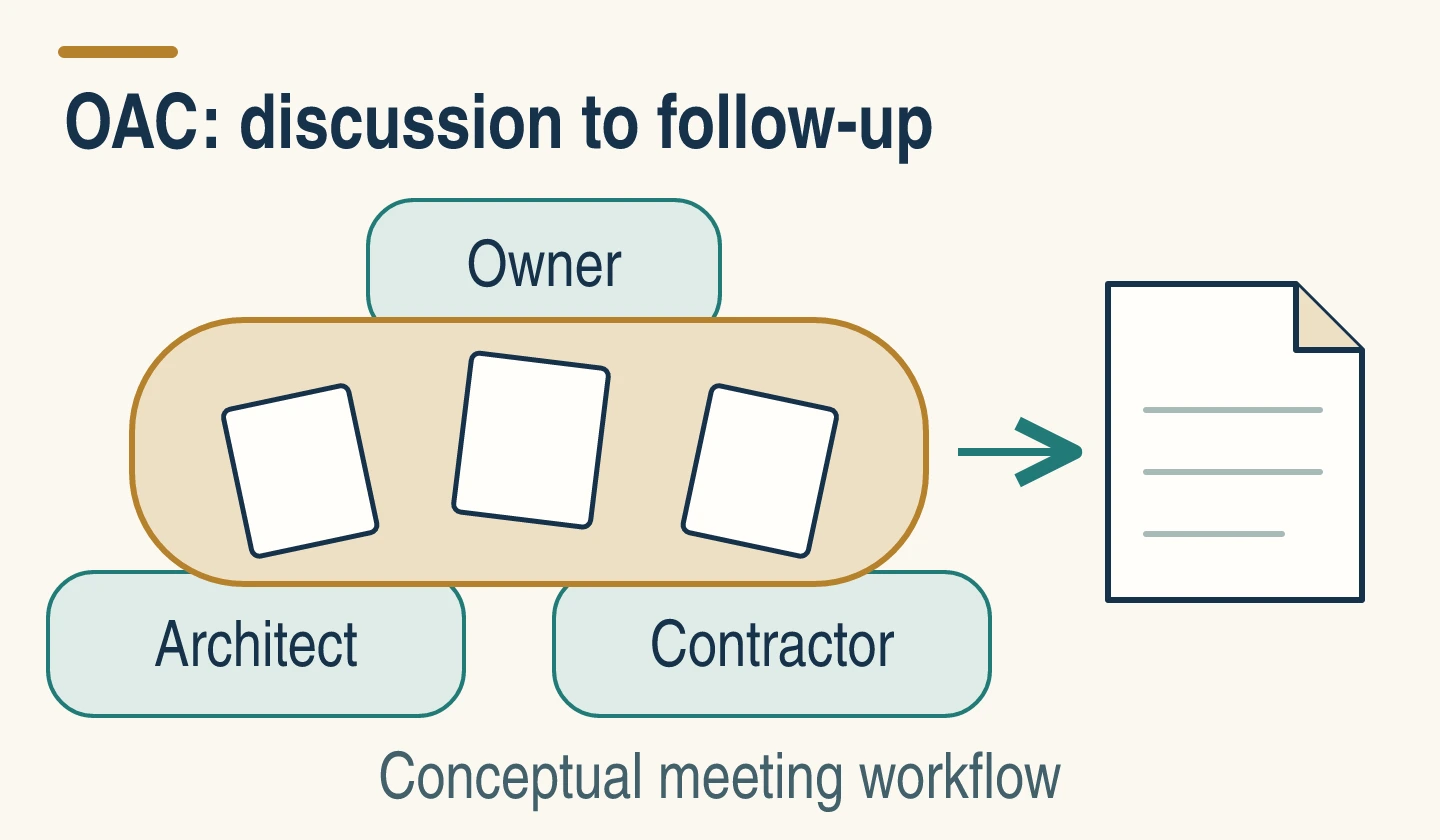
When an unresolved review item has no named follow-up, a meeting can end without protecting the next material order or delivery. Use an OAC meeting in construction—bringing the owner, architect and contractor together—to identify the decision needed, the person responsible for the next action and the evidence that will close it.
This guide provides a suggested agenda and blank tracking fields. It is for project coordinators and buyers connecting administrative decisions with field work, not for deciding contractual authority or claims. For the broader handoff process, use the site-coordination guide; the planning archive collects related construction guides.
Scroll horizontally to see all columns.
| Input or item | Typical value or source | Why it matters |
|---|---|---|
| Meeting purpose | Project’s agreed coordination procedure | Sets which decisions belong in this meeting |
| Current records | Schedule, submittal log, RFI log and previous minutes | Gives each discussion an identifiable starting point |
| Decision needed | A specific question with supporting references | Prevents a status update from disguising an unresolved decision |
| Action responsibility | Named person and organisation, confirmed at the meeting | Makes follow-up possible without guessing who owns it |
| Timing | Project-agreed due date and affected activity | Connects the administrative item to purchasing or site work |
| Closure evidence | Document reference or verified completion record | Shows why an action changed from open to closed |
Define the meeting’s job before setting the agenda
OAC means owner, architect and contractor. It is a coordination forum, not a substitute for each participant’s separate approval and communication procedures. A useful meeting makes the next step explicit: what is missing, who will provide it, which record will carry the response and what activity depends on that response.
A public-owner example is the Alabama Community College System’s Construction Manual of Procedures, updated March 20, 2026. Its Exhibit J includes previous minutes, schedules, RFIs and submittals, procurement, changes, logistics and field observations. That shows the breadth of an OAC agenda; it does not make the ACCS procedure a requirement on another project. Read the ACCS manual, Exhibit J, page 95.
Before issuing an invitation, write down the outputs the project needs. Those might include a clarified review responsibility, an updated expected response date or an identified delivery constraint. Avoid an agenda that merely lists every package without identifying what requires attention.
An OAC discussion can expose a purchasing problem without settling the underlying technical question. Detailed fabrication, lifting and field-sequencing requirements remain subject to their own project procedures.
Takeaway: Define a usable output for the meeting, not simply a list of topics to discuss.
Confirm roles without inventing approval authority
The title on an invitation does not establish what a person may approve. Confirm representation, the meeting chair, the recorder and the route for decisions before the meeting. Distinguish the person taking an action from the person authorised to approve the resulting document.
Scroll horizontally to see all columns.
| Participant or function | Useful input to request | Boundary to confirm |
|---|---|---|
| Owner representative | Operational priorities, required choices and constraints | Which decisions can this representative make or refer onward? |
| Architect or design representative | Design information and review status | Which response needs a formal document outside the meeting? |
| Contractor representative | Progress information, procurement status and field constraints | Who will provide the underlying schedule or package record? |
| Relevant consultant or trade | Evidence for an identified issue | Which agenda item requires their input? |
| Chair and recorder | Agenda control and an accurate record | Who distributes the agreed record and manages corrections? |
This is a suggested preparation matrix, not a universal allocation of professional duties. Some projects combine functions; others involve a construction manager, separate owner advisers or additional designers. Name the actual person who can supply the next piece of information instead of assigning everything to a broad organisation label.
In an AIA member article, Yu-Ngok Lo explains that responsibility for preparing and distributing minutes follows the relevant agreement; it should not be assumed from convention. We use that point as a reason to confirm the recorder early, not to interpret anyone’s contract. Documenting construction meeting minutes.
If an item concerns a building-product supplier, obtain the technical or commercial response through the appropriate project contact. Our supplier-evaluation guide addresses checking that organisation; an OAC invitation does not replace supplier verification.
Takeaway: Record who supplies information, who follows it up and where approval authority must be confirmed.
Build an agenda around decisions and dependencies
Send the relevant references with the agenda so participants can identify the item before the discussion starts. A title such as “cladding” is too broad to tell someone which response is needed. Include the package or document reference and a short description of the outstanding question, without embedding an unreviewed conclusion in the heading.
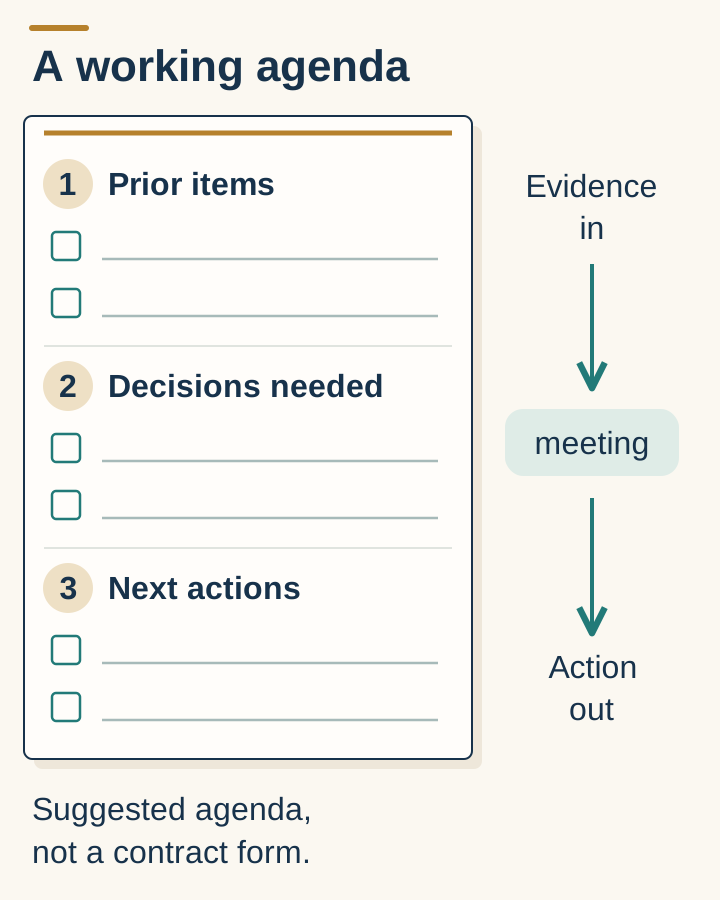
The working sequence below is our editorial proposal, informed by the public agenda example above. Adapt its order to the project’s actual deadlines and decision routes.
- Confirm the starting record. Identify the previous minutes and any corrections awaiting resolution. Keep the original item references visible.
- Locate the affected activity. Establish which upcoming activity or delivery depends on an outstanding response. Use the current project schedule rather than a remembered date.
- Resolve information gaps. Identify the missing drawing, sample, clarification or supplier confirmation, and assign the next step.
- Review changes with their references. Keep the status of a proposed change separate from its formal approval and from its purchasing effect.
- Check field constraints. Identify access, receiving or coordination information needed before the delivery or work proceeds.
- Read back actions. Confirm the named person, due date, document reference and expected closure evidence before moving on.
Do not copy a public owner’s turnaround periods into a different project without checking its procedures. Similarly, a routine meeting interval is not a reason to hold an urgent question until the next meeting. Use the project’s agreed communication route when the affected activity comes sooner.
Link an item involving technical alternatives to its specification comparison. That lets the meeting consider an identified option and its unresolved evidence instead of reopening the entire material choice from memory.
Takeaway: Each agenda item should arrive with a reference and leave with an explicit next step.
Connect submittals, ordering and delivery without merging their statuses
A single “approved” cell is not enough to describe procurement readiness. Track at least three separate questions: what is the formal review status, who can authorise ordering, and what delivery information is confirmed? A meeting record should point to those records, not pretend to be all three.
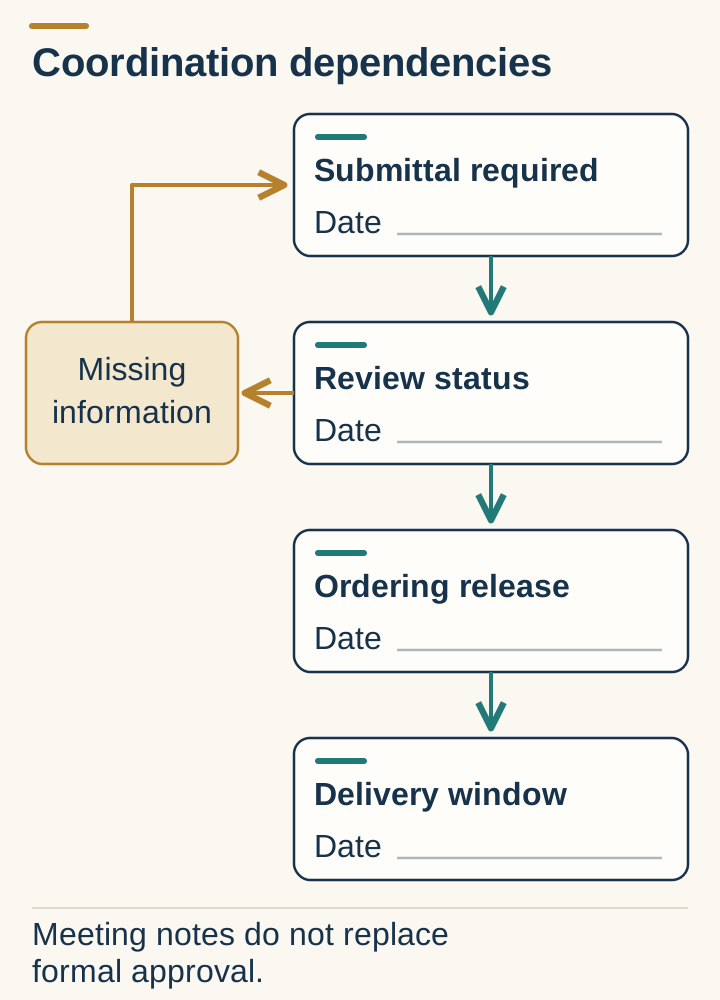
For each affected package, locate the current submittal reference and its revision. Identify any outstanding information before asking for an ordering date. If that information changes the selected configuration, route the change through the project’s process and update the purchasing record accordingly. This is a coordination check, not a rule that every package follows the same release sequence.
Then separate a required delivery date from a supplier’s confirmed date. The first states the project’s need; the second records what the supplier has actually committed to through the appropriate channel. An unconfirmed date belongs in the follow-up list. Do not make the timeline appear complete by copying one date into both fields.
Work back from the field requirement using the project’s own review, purchasing and delivery information. Leave unknown durations open for confirmation. We provide no standard lead time or review allowance here, because a generic number could conceal the constraint the meeting is meant to expose.
The construction-material procurement process explains the broader buying stages. Use the first-order risk checklist when the unresolved action concerns an initial purchase, and the procurement archive for the surrounding workflow.
Common mistake: closing an action because somebody promised to send a document. The promise identifies a next step; receipt and the required review remain separate events.
Takeaway: Preserve separate statuses for technical review, ordering authority and delivery confirmation.
Write minutes that distinguish discussion from action
Minutes should let someone who missed the meeting understand what was considered and what still needs doing. Record the meeting identity and participants, the item reference, the factual status discussed and any agreed next action. Attribute a statement where its source matters, and avoid rewriting an unresolved disagreement as a group decision.
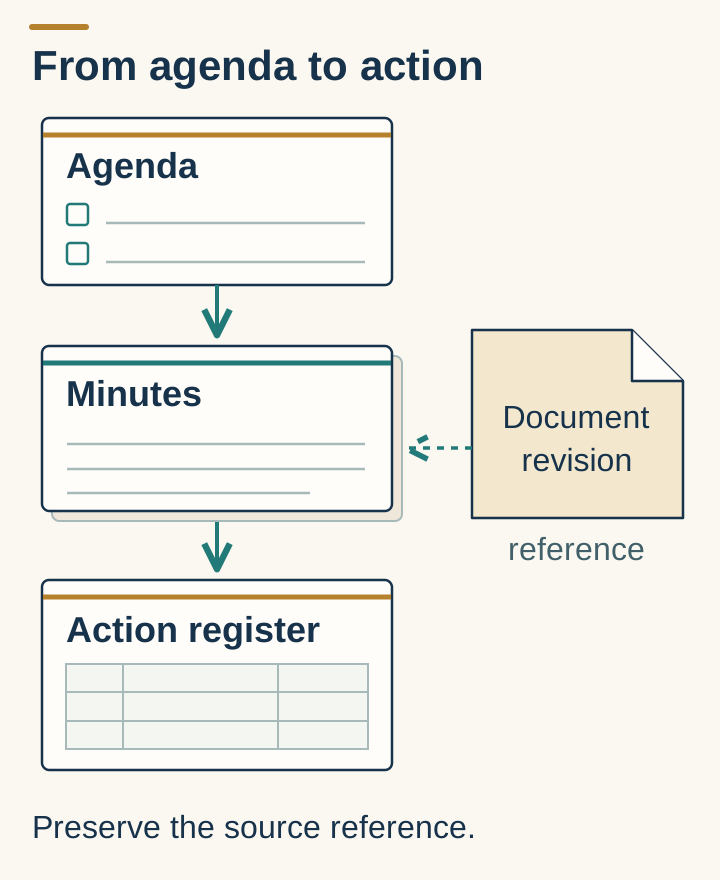
AIA’s article recommends neutral third-person recording and identifiable numbered items. We apply that principle by separating three fields in the suggested record: the information reported, the next action and the evidence required to close that action. These fields help prevent a discussion summary from being mistaken for a release instruction.
When the team cannot settle an item, record the outstanding point and the agreed route for clarification. Do not fill the gap with the recorder’s preferred answer. If a later correction changes the record, preserve the project’s revision history and distribute the correction through its agreed process.
The minutes can also identify where a decision belongs outside the meeting. For example, an unresolved requirement in a wall-system brief should be directed back to the relevant design or specification record. Listing it under “discussed” does not resolve the requirement.
Takeaway: Describe what happened accurately, then state the next action without inventing agreement.
Use a blank action record and evidence-based closure
Use one continuing identifier for an item rather than giving it a new identity every time it appears. Keep the record short enough to review, but specific enough that another person can locate the underlying document. The following fields are our proposed starting point; the empty cells are deliberate.
Scroll horizontally to see all columns.
| Item ID | Action needed | Responsible person | Due date | Document and revision | Status | Closure evidence |
|---|---|---|---|---|---|---|
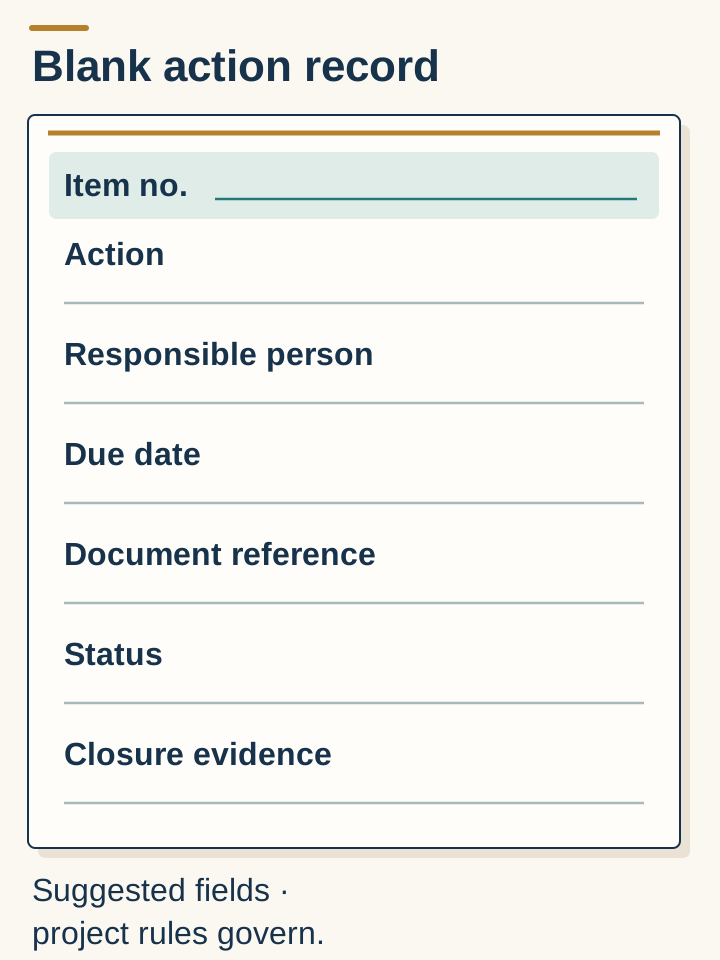
Download the blank CSV action record to adapt to your team’s system. It contains column headings and empty rows, not a completed sample or a mandated format.
At the end of the meeting, check that the named person understands the action and the expected output. At follow-up, attach or reference the actual output before changing the status. If the output requires another review, make that dependency visible rather than declaring the whole package complete.
A closed action may still have a consequence for another record. When a response changes a purchase scope, make sure the purchasing team receives the applicable reference. When it changes a planned delivery, route the updated information to the receiving team. The action register should point to those handoffs rather than become a disconnected checklist.
For cost-related discussions, use the total installed cost guide to identify what the comparison includes. The meeting record should name the unresolved scope or assumption; it should not turn an incomplete quotation into a cost conclusion.
Takeaway: Close an action against its required evidence, and pass the result to the next affected record.
When this approach does not apply
This is a suggested coordination workflow for ordinary project administration. It does not replace contract notices, formal changes, technical approvals, quality records or the project’s document-control rules. We do not interpret contractual liability, claims, meeting-minutes acceptance periods or recording laws.
An OAC meeting also has a different purpose from a trade-detail workshop or a safety briefing. The guide does not provide toolbox-talk content, lifting plans or instructions for carrying out work. Where a question falls outside the meeting’s remit, identify the appropriate process and record the handoff.
Takeaway: Use the meeting to connect the right processes, not to replace them.
Frequently asked questions
Can we use a spreadsheet or Word file instead of project-management software?
Yes, as a working format if the project accepts it. Check that users can identify the current issue, preserve earlier versions and find the referenced documents. Before choosing a tool, try exporting a record and opening it outside the original account. A portable, readable record is more useful than a feature-rich file that a future team member cannot access.
Can an AI transcript become the official minutes automatically?
Treat a transcript as input for review, not an automatically agreed record. A human should check names, document references, dates and whether a tentative suggestion was mistaken for a decision. Confirm the project’s recording, confidentiality and retention requirements before using a recording tool. This guide does not assess consent law or recommend a transcription service.
Should site-walk notes be on paper or a tablet?
Use a method that lets you preserve the location and document reference while observing the work safely. A paper sketch or digital note can both work if they are transferred into the agreed record with a clear source. Keep personal reminders distinguishable from observations intended for circulation, and label photographs so they can be connected to the right item later.
How should a junior team member suggest a correction to minutes?
Send the item number, the wording in question and the proposed factual correction through the team’s agreed review route. Confirm whether you are providing an internal observation or an authorised response for your organisation. This avoids treating a junior person’s helpful note as an unapproved external commitment. Keep the explanation tied to the record rather than to criticism of its author.
Must every subcontractor attend the whole OAC meeting?
The project’s procedure and agenda determine the required attendance. For a specialist issue, consider whether a named trade representative needs to join for that item or a separate technical session. Send the question and supporting reference in advance. Do not assume that copying someone on the minutes means they attended, agreed with a decision or received a specific instruction.
How do we stop the RFI discussion becoming a long design workshop?
Identify which RFI needs a coordination decision and which needs technical work by a smaller group. For the latter, agree the session, required participants and return item for the OAC record. Preserve that follow-up reference when moving on; simply dropping a difficult topic to shorten the meeting leaves its dependency unresolved.
Sources and method
Muros Construction prepared this guide with AI assistance as an independent editorial resource. We used the ACCS March 2026 manual, especially Exhibit J, as a public project-management example, and Yu-Ngok Lo’s AIA member article for minute-taking principles. The suggested workflow, diagrams and blank record are editorial tools, not official ACCS or AIA forms.
FAQ demand was checked against real discussions about meeting software, AI minutes, field-note methods, internal feedback on minutes and specialist attendance and lengthy RFI discussions. The software and internal-feedback discussions were available as indexed excerpts during this review; the other discussions were readable. Community posts establish the questions, not contractual duties or a universal construction procedure.
Related articles
PCO in Construction: From Material Change to Order Release
Understand construction PCO terms, distinguish bulletins from change orders, and use a blank record to connect material revisions to order-release authority.
Read article: PCO in Construction: From Material Change to Order Release
Construction Site Coordination Notes
Work that follows a drawing after the specification has changed can be rejected at the contractor's expense. Construction site coordination notes record the drawing set on the work site, the superintendent who can act, and the storage clearances before material is set down.
Read article: Construction Site Coordination Notes
Better Walls Begin with Better Questions: A Comprehensive Wall-System Briefing Guide
A closed wall hides leakage the brief never assigned. Record the pressure band, the cavity, and the joint before comparing wall-system proposals.
Read article: Better Walls Begin with Better Questions: A Comprehensive Wall-System Briefing Guide