
Special Inspections in Construction: A Material Handoff Worksheet
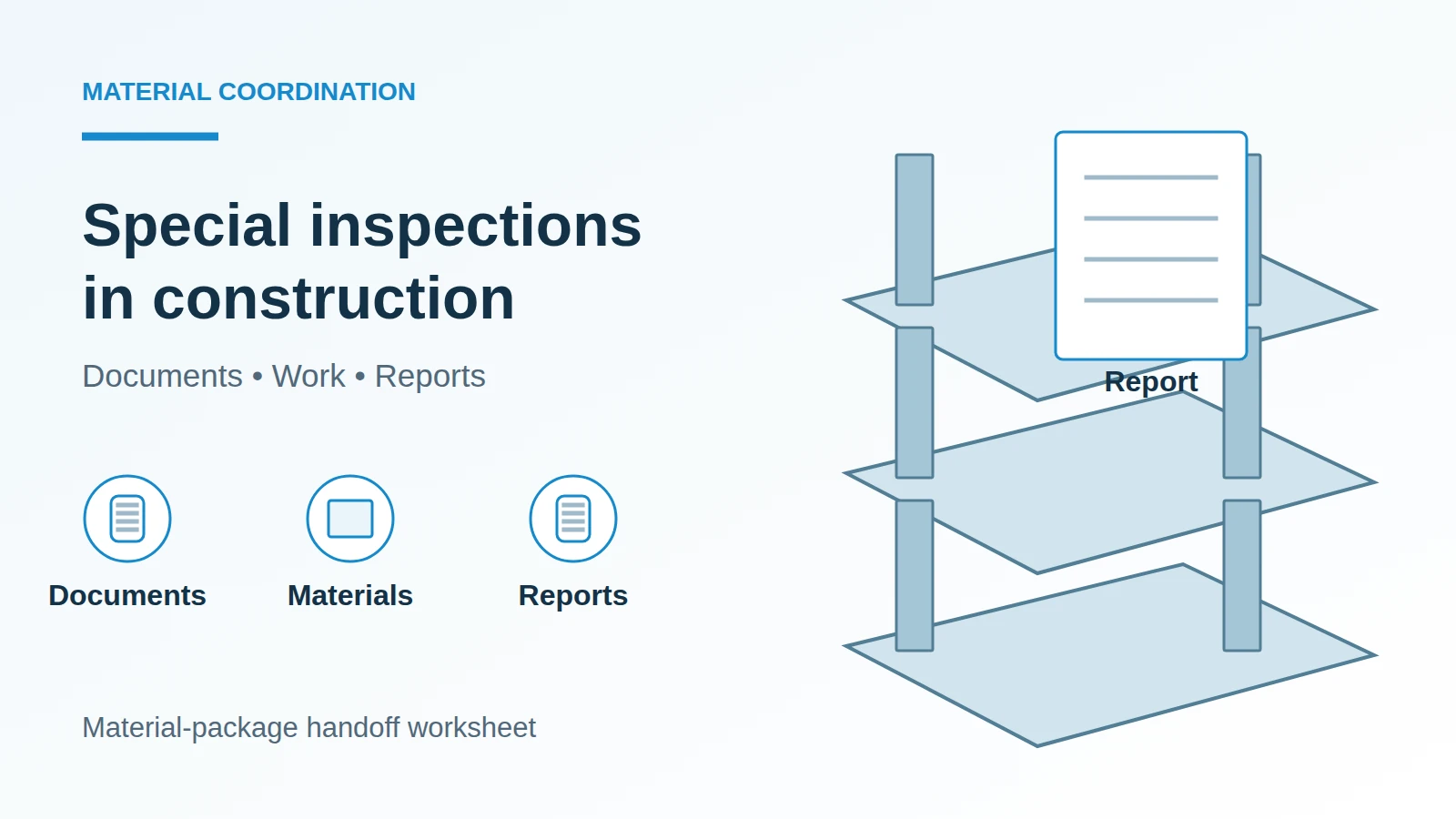
Covering work before a required inspection can waste crew time when access must be reopened. Special inspections in construction need a separate requirements and reporting track alongside contractor quality control, connected through the same material-package and work-location identifiers.
Coordinate special inspections by first obtaining the project-specific inspection requirements from the design professional and the authority having jurisdiction. Then identify the responsible inspection party, current documents, notice arrangements, accessible work and required reports for each material package. A contractor’s receipt check or QC checklist does not establish that a required special inspection has occurred. The worksheet below separates these records so a delivery, a QC check and an inspection report cannot accidentally become the same approval. It is a coordination tool; technical criteria, inspection frequency and authority to proceed come from the applicable project requirements.
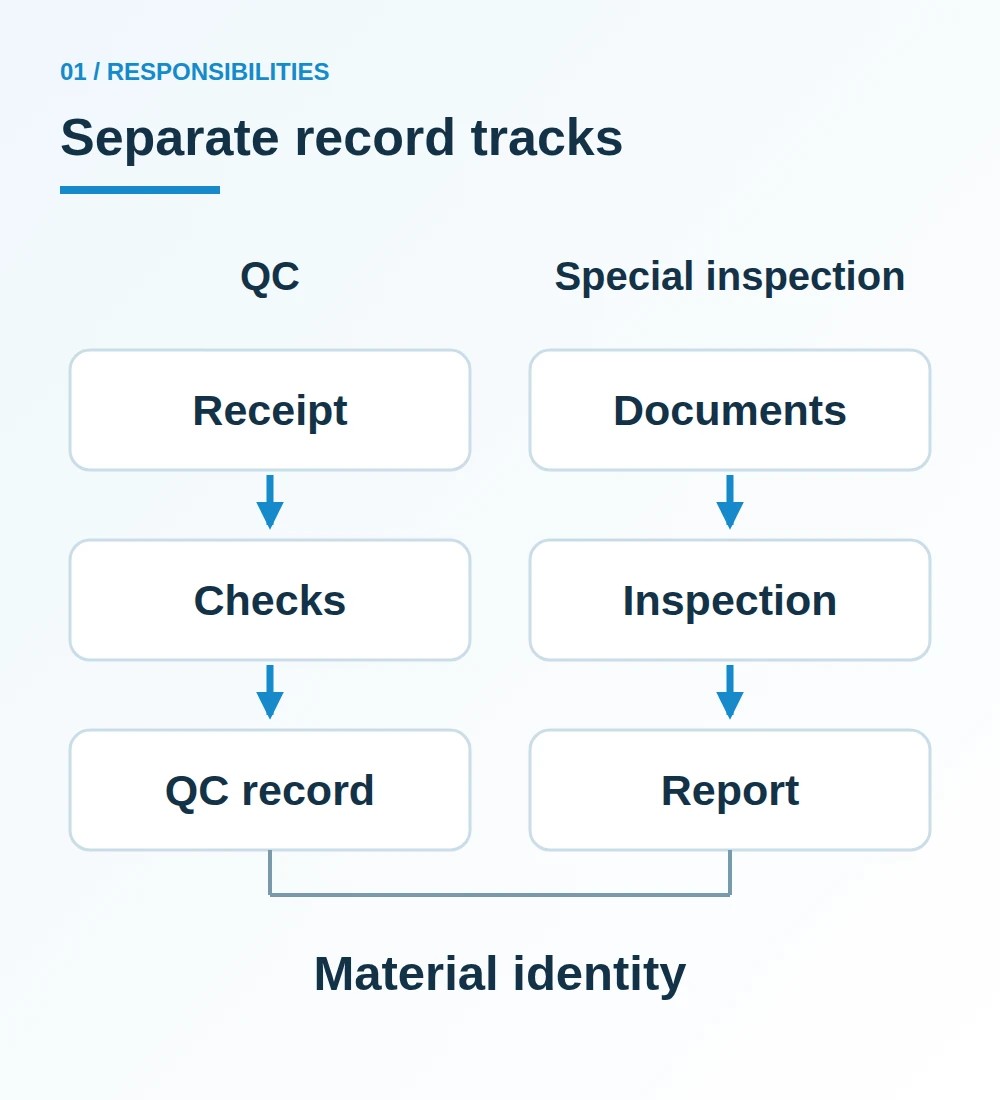
Illustration: shared identity supports coordination; the two tracks retain separate records and responsibilities.
Scroll horizontally to see all columns.
| Input or item | Value or source | Why it matters |
|---|---|---|
| Applicable jurisdiction and code edition | Design professional and authority | Determines which local requirements apply |
| Inspection scope and timing | Approved project documents and required inspection schedule | Identifies what must remain observable |
| Material-package identifier | Submittal, delivery and location registers | Connects paperwork to the work inspected |
| Notice and access arrangements | Project procedure and inspection party | Makes the inspection possible at the relevant operation |
| Report and discrepancy status | Inspection records and formal responses | Separates observation from correction and closeout |
Use the Planning collection for related project controls, and the construction QC plan to assign the contractor’s internal checks.
Where does QC end and required special inspection begin?
QC manages the contractor’s work against project requirements; a required special inspection follows its own assigned scope, responsible party and reporting procedure. Plan both, and retain their distinct evidence. A good receiving record can support an inspector’s traceability review without becoming an inspection report.
The following comparison is an editorial coordination aid. It does not allocate statutory authority across jurisdictions.
Scroll horizontally to see all columns.
| Record or activity | Coordination purpose | Dominant Failure Mode & Prevention |
|---|---|---|
| Material receipt and contractor QC | Record identity, condition and project checks | A delivery signature is treated as acceptance of concealed work; name exactly what was checked and keep release decisions separate |
| Required special inspection | Document the assigned inspection against the applicable requirements | The inspector arrives after access is lost; put notice, work sequence and access in the package handoff |
| Ordinary authority inspection | Address the authority’s separate inspection process | One inspection appointment is assumed to cover every obligation; maintain the authority’s requirements separately |
| Discrepancy correction and closeout | Connect the issue, approved action and verification record | A repair photograph is mistaken for formal closure; obtain the response and reporting required by the project procedure |
Do not infer inspection frequency from this table. Continuous or periodic attendance, sampling and acceptance limits must be taken from the applicable requirements. Use the stage-by-stage QC checklist for the contractor’s observations while keeping the required inspection record separately identified.
What does the NYC local example actually establish?
Local example — New York City, 2022 Building Code: Chapter 17, BC 1704.1.1 divides responsibilities among the registered design professional of record, special inspection agency and permit holder. Its subparagraphs address identification of required inspections, agency independence, accessible approved documents, inspection reports, discrepancy responses and the permit statement.
These provisions illustrate why the worksheet needs distinct fields for requirements, documents, observations and correction. They do not decide the inspection scope for a project outside NYC. For the actual project, have the design professional and authority identify the applicable edition, required inspections, responsible parties and reporting process; do not import a NYC category into another jurisdiction.
The downloaded city PDF also identifies a Chapter 17 amendment by Local Law 77 of 2023. Treat the source as the city-hosted 2022-code document with its stated amendments, and verify the governing provisions for the permit at issue.
What belongs in the material-package handoff worksheet?
Carry one package identifier from the reviewed submittal to the delivered material, installation location and inspection record. The receiver should be able to find the governing requirement and the next responsible person without guessing from a supplier’s product description.
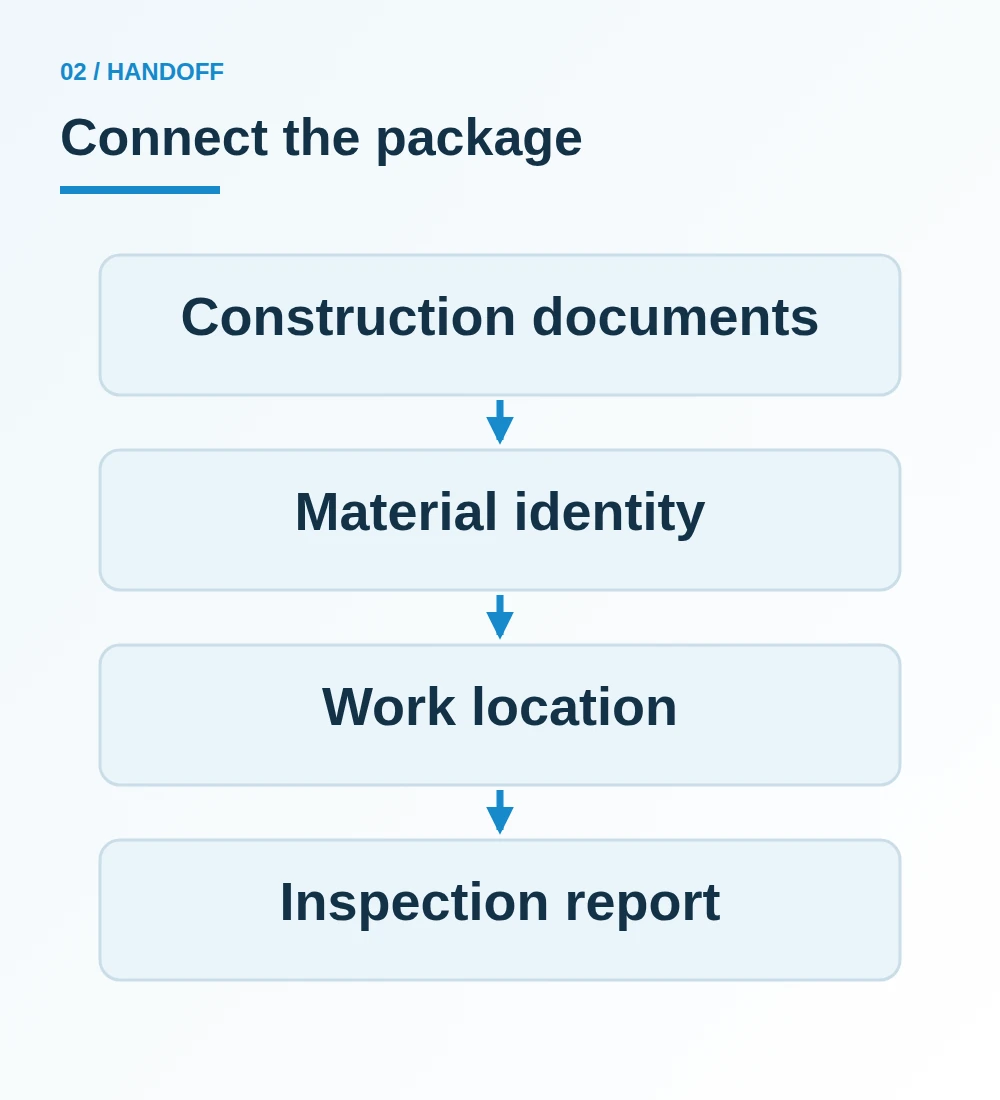
Illustration: document and report terminology follows the NYC example; linking them with one package ID is an editorial worksheet design.
Download the blank material-package handoff CSV, or copy this field list into the project’s required form. The CSV contains one empty record and no prefilled pass, release or inspection outcome.
Scroll horizontally to see all columns.
| Worksheet field | Project entry |
|---|---|
| Package ID / work feature / responsible trade | |
| Material description / delivery or lot ID | |
| Intended work location / drawing reference | |
| Approved construction document ID / revision | |
| Submittal or shop drawing ID / review reference | |
| Required inspection / governing requirement reference | |
| Requirement confirmed by / date | |
| Responsible inspection party / contact reference | |
| Operation to be observed / required timing | |
| Notice requirement / recipient / notice record | |
| Access and work-readiness confirmation | |
| Contractor QC record ID / status | |
| Special inspection report ID / status | |
| Discrepancy ID / response authority / action reference | |
| Required verification / closure record reference | |
| Permission to proceed / responsible authority / date |
Use “unknown — confirmation needed” for an unresolved requirement, rather than entering “not required.” Record the person responsible for resolving it. Leave observation, result and release fields empty until the relevant action occurs.
A material substitution should trigger a check of affected documents and inspection arrangements before it is treated as equivalent. The specification comparison guide helps identify changed references; it does not authorize the substitution.
When should the team stop the handoff?
Procedural threshold rule: if even one required pre-concealment inspection remains undocumented, or its required timing is unresolved, flag the affected work for hold and obtain direction from the project’s designated authority before concealment. This is an editorial coordination rule, not a code-defined stop-work order. The governing project procedure determines who may impose and release the hold and what evidence permits progression.
“Inspector booked” is a schedule state. “Report received” is a document state. “Discrepancy closed” is an issue state. Give them separate fields so a calendar booking does not change the status of the work.
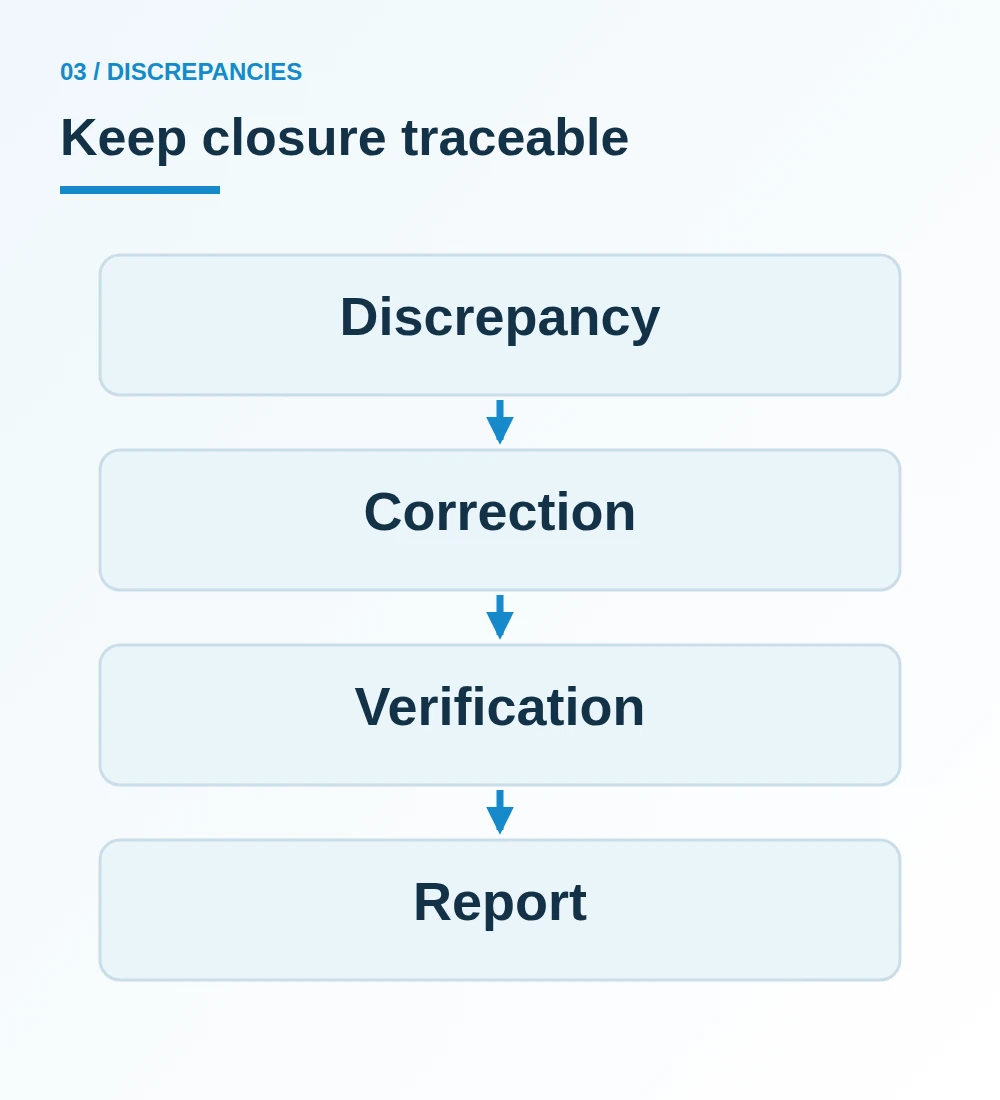
Illustration: keep the correction record and verification record traceable to the discrepancy. Actual reporting and release authority follow the project requirements.
How do you account for inspection-related delay without inventing fees?
Measure crew exposure in hours first, using actual site records. A delay can involve repeated access preparation, a missed inspection window or reopening; separate those activities from productive installation so the same time is not counted twice.
Exposed crew-hours = affected crew count × hours of unavailable planned work.
Worked example with assumed planning inputs: 2 workers × 3 hours = 6 crew-hours of unavailable planned work. This is arithmetic, not a prediction of delay or an inspection charge. If the crew moves to other productive work, record that reassignment and reduce idle hours accordingly.
Scroll horizontally to see all columns.
| Time ledger line | Quantity to record | Supporting live guide |
|---|---|---|
| Document reconciliation | Actual staff-hours reviewing package mismatches | Material procurement process |
| Repeated access preparation | Actual crew-hours and reason for repetition | Site coordination handoffs |
| Unavailable planned work | Crew count, start/end time and productive reassignment | Material procurement log |
| Correction and verification | Separate correction hours, return visit and report references | Construction QC plan |
The ledger exposes coordination losses without asserting a labor rate, inspection price or compensation entitlement. If the issue needs a decision, use the OAC meeting record to identify the action owner and link the formal response. A meeting note alone does not close an inspection discrepancy.
Methods and sources
Updated October 19, 2026. This guide uses the city-hosted NYC 2022 Building Code Chapter 17 PDF, BC 1704.1.1 and its responsibility subparagraphs, as a labeled local example. The worksheet, comparison, diagrams, procedural threshold and time ledger are editorial coordination tools derived from that separation of responsibilities. The worked line uses assumed hours and crew count. No project-specific inspection scope, technical acceptance threshold, test result or release decision is supplied here.
Related articles
PCO in Construction: From Material Change to Order Release
Understand construction PCO terms, distinguish bulletins from change orders, and use a blank record to connect material revisions to order-release authority.
Read article: PCO in Construction: From Material Change to Order Release
Construction Site Management Plan
Record work tasks, sequence, and resource types in a construction site management plan, plus a blank material-readiness row. Durations and costs stay empty.
Read article: Construction Site Management Plan
Construction Quality Control Checklist: A Blank Template
Use stage-by-stage construction QC checks, material receipt prompts and a copyable blank template to record requirements, findings, evidence and sign-off.
Read article: Construction Quality Control Checklist: A Blank Template