
AIA Contract Documents: A Procurement Form Guide

Signing the wrong AIA family costs the project when the price clause and the general conditions point at different parties. AIA contract documents are a matched set: the procurement route picks the agreement, and that agreement picks the general conditions.
AIA’s published synopses, retrieved 20 October 2026, sort the choice by payment basis and by who builds. A101–2017 is the stipulated-sum owner-contractor agreement and adopts A201–2017. A102–2017 is cost of the work plus a fee with a guaranteed maximum price, also with A201–2017. A103–2017 is cost plus a fee without that ceiling, and AIA states it is not for competitive bidding. A104–2017 is a short agreement with its own general conditions. A133–2019 is the construction manager as constructor with a GMP. A141–2024 is traditional design-build, with the contract sum in a later amendment. A401–2017 is the subcontract, and it incorporates A201–2017 unless it is modified.
This map sits in the Procurement collection. The route comparison, without the form numbers, is construction procurement methods.
Scroll horizontally to see all columns.
| Input or item | Published AIA reference | Why it matters |
|---|---|---|
| Stipulated sum, competitive bids | A101–2017 with A201–2017; bidding instructions A701–2018 | Fixed price and bid procedure are different forms |
| Cost plus a fee with a GMP | A102–2017 with A201–2017 | The ceiling is in the owner-contractor agreement, not in A201 alone |
| Cost plus a fee, cost unknown, not a bid | A103–2017 with A201–2017 | AIA states this form is not for competitive bidding |
| Limited scope | A104–2017, internal general conditions | A201 is not the keystone of this agreement |
| CM as constructor with a GMP | A133–2019 and its GMP amendment | The price binds when the amendment is signed |
| Design-build | A141–2024 and the Design-Build Amendment | Owner’s criteria come before the contract sum |
| Subcontract under A201 | A401–2017 | Must be modified if the prime is A104 or A105 |
Three stacks and a roll stand in for separate forms. Blank paper is not an AIA document and carries no clause.
Which agreement matches the price clause?
AIA’s conventional-family synopsis for A101–2017 describes a stipulated sum, or fixed price, and states that A101 adopts A201–2017 by reference and is drafted for use with an insurance and bonds exhibit. The same synopsis points smaller work to A104–2017 or A105–2017 instead of A101. A102–2017 is the synopsis’s form when the basis of payment is the cost of the work plus a fee with a guaranteed maximum price, again with A201–2017. A103–2017 is the synopsis’s form when that cost is not fully known at the start and there is no guaranteed maximum price. The A103 synopsis states that A103–2017 is not intended for competitive bidding.
A701–2018 is the bidding instruction, coordinated with A201. The synopsis says bond type and amount are established on A312, and that G612–2017 Part B is used to complete A701. A701 does not set the contract sum. It tells bidders how to submit a price into whichever owner-contractor agreement the invitation names.
A104–2017 is the break in that pattern. AIA’s synopsis calls it a stand-alone agreement with its own internal general conditions, for limited scope, and says payment can be a stipulated sum or cost plus a fee, with or without a guaranteed maximum price. Parties on a cost-plus A104 also use A104 Exhibit A for the cost of the work. B104–2017 is the architect agreement AIA coordinates with A104. Treating A104 as if it still needed A201 stacks two general-conditions documents.
Where each family fails
Scroll horizontally to see all columns.
| Family | Bond path in the set | Dominant failure mode | Prevention |
|---|---|---|---|
| A101–2017 + A201–2017 | Stipulated sum; A201 incorporated | A cost-plus job is forced into a lump sum before quantities exist | Use A101 when the synopsis’s stipulated-sum basis is the one in the invitation |
| A102–2017 + A201–2017 | Cost plus fee with a GMP | The GMP is negotiated in a side letter the subcontract never sees | Keep the ceiling in A102 and flow it down through A401 |
| A103–2017 + A201–2017 | Cost plus fee, no GMP | The form is used for competitive bids | AIA’s synopsis says A103 is not for competitive bidding; use A101 or A102 for a bid |
| A104–2017 | Internal general conditions | A201 is added beside A104, and A401 is left unmodified | Stop at A104’s own conditions; modify A401, which the synopsis requires for an A104 prime |
| A133–2019 | CM as constructor; GMP amendment | Adviser general conditions (A232–2019) are attached to a constructor agreement | AIA’s A232 synopsis says not to combine A232 with A133 or A134 |
| A141–2024 | Design-build; sum in the amendment | A stipulated sum is written before Owner’s Criteria exist | Follow the synopsis: criteria, preliminary design, then the Design-Build Amendment |
The construction manager at risk note covers the GMP amendment timing on A133–2019. This page only marks which family that amendment belongs to.
Rules of thumb before the form is edited
Rules of thumb. If the invitation is a competitive bid for a stipulated sum, start from A101–2017 and A701–2018, not from A103–2017. If the agreement is A104–2017, do not also incorporate A201–2017; the synopsis gives A104 its own general conditions. If the builder is a construction manager as constructor and the price is a GMP, the matching AIA agreement is A133–2019, and the A232–2019 synopsis says not to use A232 with A133. If design and construction are one contract under A141–2024, the contract sum is in the Design-Build Amendment after Owner’s Criteria, not in the first signature.
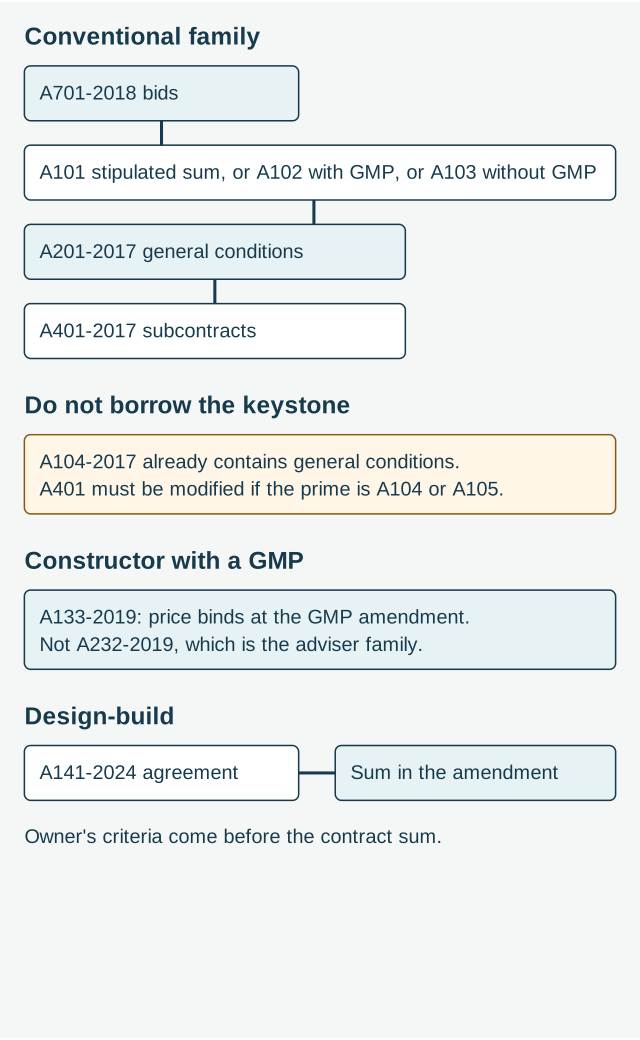
Conventional forms share A201. A104 carries its own conditions. A133 binds at the GMP amendment. A141 puts the sum in a later amendment. Schematic, not a signed set.
Work the order-by day and a stipulated-sum payment
Procurement timing is a date subtraction, not a form number. For a need-on-site day D, a review allowance R, a fabrication allowance F, and a transit allowance T, in the same day count:
O = D − (R + F + T)
Worked example. D = day 120, R = 14 days, F = 56 days, T = 7 days. Those four numbers are planning inputs, not durations printed in A101 or A201.
O = 120 − (14 + 56 + 7) = 120 − 77 = day 43
If the project calendar is already on day 60, the buy is 60 − 43 = 17 days past the order-by day. That gap is schedule loss. It is not a liquidated-damages figure, and it is not an AIA default lead time.
A stipulated-sum pay application uses the percent complete and the retainage rate the parties fill in. AIA’s A101 synopsis does not publish a retainage percentage. With contract sum C, percent complete p, retainage rate r, and previous payments P:
N = C × p × (1 − r) − P
Worked example. C = $2,000,000, p = 0.40, r = 0.05, P = $0. The 5 percent retainage is an example fill-in, not a rate from the synopsis.
N = 2,000,000 × 0.40 × 0.95 − 0 = $760,000
Completed work is $800,000. Retainage held in this example is $40,000. Changing r changes N. Changing the form from A101 to A102 also changes the pay clause, because A102 pays cost of the work plus a fee under a GMP rather than a percent of a lump sum.
What the material order still has to survive
The form pair does not receive the truck. Construction material procurement is the record of takeoff, submittal, purchase order, and receiving. A clean A101 still fails in the field when the subcontract scope and the delivered package disagree.
A blank clipboard at the gate is the receiving step. It does not show that A401 and the purchase order describe the same package.
Count the documents that have to be reissued when the prime family changes. One owner-contractor agreement plus each subcontract written on unmodified A401 is the set. If the prime moves from A201 to A104, the A401 synopsis says A401 must be modified. For 12 subcontracts, that is 1 + 12 = 13 forms to reopen. That count is paperwork, not a price.
Where these synopses stop
The numbers above are the editions in AIA’s family synopses retrieved 20 October 2026: A101, A102, A103, A104, A201, and A401 from the 2017 conventional set, A701–2018, A133–2019, A232–2019, and A141–2024. A later edition, a project exhibit, or a counsel edit can change a blank. This page does not copy the forms and does not choose insurance limits. AIA’s own A101 synopsis says the insurance and bonds exhibit is part of the agreement and is discussed with legal and insurance counsel. The executed set, not this map, is the contract.
Methods and sources
Form names, payment bases, and the incorporation notes come from AIA Contract Documents’ “Document Synopses by Family” and the current-template list on help.aiacontracts.com, both retrieved 20 October 2026. The order-by day and the pay-application arithmetic use the stated example inputs. They are not filled blanks from a project. Route context is on this site’s procurement-methods and construction-manager notes, which cite different public texts.
Source documents read:
- AIA document synopses by family (retrieved 20 October 2026).
- AIA document templates, formats and availability (retrieved 20 October 2026).
- List of current AIA Contract Documents (retrieved 20 October 2026).
Related articles
Construction Procurement Methods Compared: How to Choose the Right Route
How design-bid-build, design-build, management contracting and CM/GC split design, price and overlap, and why five-method lists disagree.
Read article: Construction Procurement Methods Compared: How to Choose the Right RouteHow to Choose Construction Material Procurement Software: A Demo Worksheet
Evaluate construction material procurement software with a blank five-test vendor demo worksheet covering submittal revisions, PO release, split deliveries, damaged receipts and CSV export.
Read article: How to Choose Construction Material Procurement Software: A Demo Worksheet
Construction Manager at Risk: When the Price Is Set
A construction manager at risk advises during design, then builds under a price ceiling. When that price is set, what it includes, and who awards the trades.
Read article: Construction Manager at Risk: When the Price Is Set