
Concrete Test Cylinders vs Mix Design Submittals: ASTM C31 Curing, 28-Day Breaks, and ACI 318 Acceptance
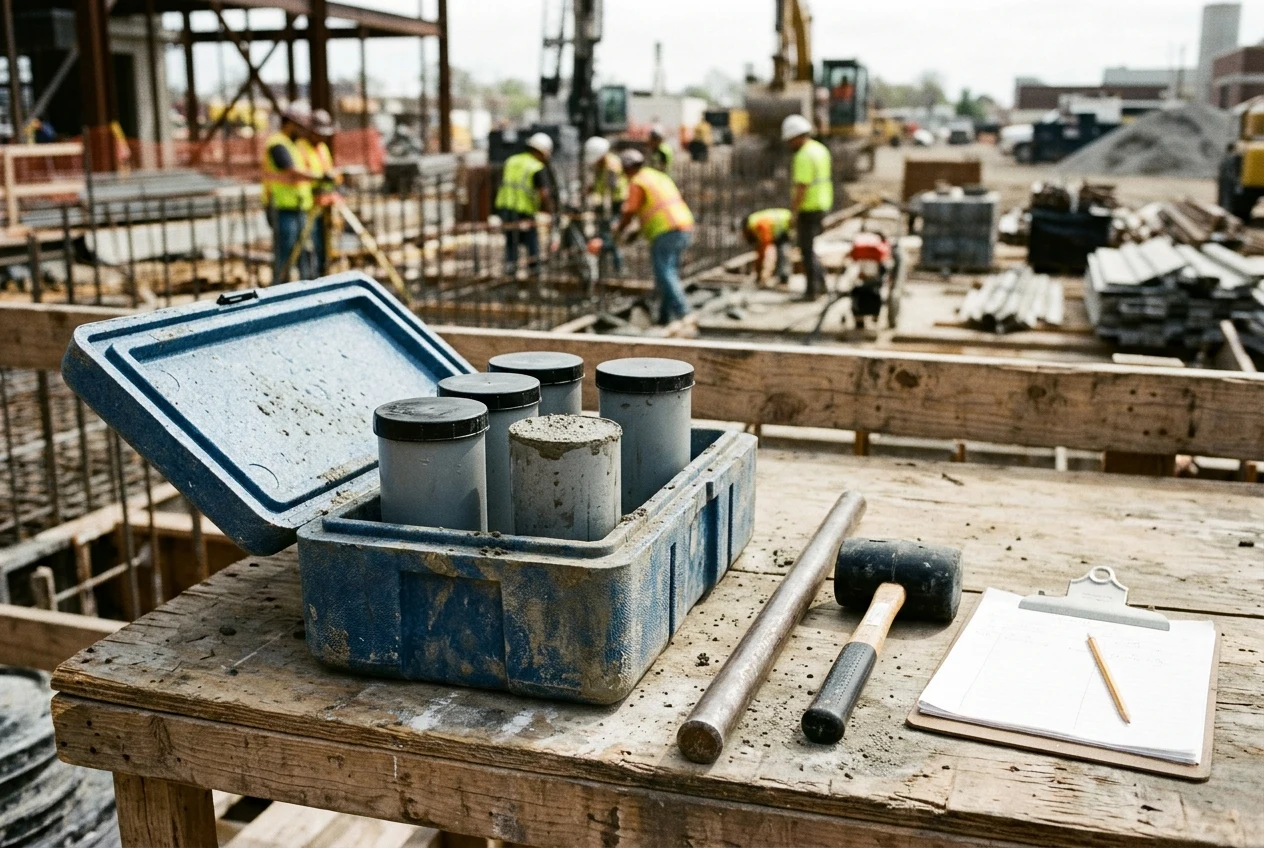
Separate pre-pour mixture qualification, batch delivery records, and hardened concrete test cylinders before evaluating a placement package. Use the review worksheet at the end of this guide to organize mixture submittals, delivery tickets, and cylinder break reports across the project team. For broader project controls, browse our Planning guides and compare steel material test reports and heat-number traceability.
While the concrete supplier optimizes ingredient materials to develop mixture proportions for a mixture submittal, ultimately the acceptance criteria on a project govern over the submittal.
Concrete cylinders are cured under standard conditions and usually tested at 28 days in accordance with ASTM standards, where one test result is the average strength of a set of two 6×12 in. (150×300 mm) or three 4×8 in. (100×200 mm) cylinders made from the same concrete sample.
In some cases concrete cylinders are tested at 7 days to get an early indication of potential strength, but these test results are not to be used to determine the acceptability of the concrete.
Cylinders used for acceptance of concrete should not be confused with field-cured cylinders, which are used to evaluate whether in-place concrete has been properly cured and protected, to estimate early-age strength in the structure to strip forms or for post-tensioning, and to continue construction activity.
Review the pre-pour concrete mix design submittal
Coordinate the pre-pour mixture review alongside your construction submittal register and action codes so target strength calculations and supporting test records stay linked to each concrete class before placement begins.
ACI 318 and ACI 301 recognize that when concrete mixtures are proportioned to meet the requirements of the standards, strength test results will fail to comply with acceptance criteria about one time in 100 tests due to normal variability.
An individual strength test falling below f’c does not by itself constitute non-compliance with acceptance criteria; when proportioned to f’cr, the probability of not complying with acceptance criteria is about 1% while the probability of an individual strength test being less than specified strength is about 10%.
Calculate target average compressive strength from standard deviation or overdesign tables
Review the producer’s overdesign calculation to confirm whether sample standard deviation equations or no-deviation overdesign tables govern the proposed mixture proportions:
Under ACI 301 Section 4.2.3, required average compressive strength f’cr for f’c of 5000 psi or less is the larger of f’c plus 1.34 times kss (Eq. 4-3) and f’c plus 2.33 times kss minus 500 psi (Eq. 4-4); for f’c over 5000 psi, f’cr is the larger of f’c plus 1.34 times kss (Eq. 4-3) and 0.90 times f’c plus 2.33 times kss (Eq. 4-5).
The k-factor for increasing sample standard deviation is 1.16 for 15 tests, 1.08 for 20 tests, and 1.03 for 25 tests (for example, field test data with 18 records and a standard deviation of 500 uses k-factor 1.16).
For a 4500 psi mixture with a standard deviation of 560 psi and a 12-test average of 5425 psi at 28 days, Fcr equals 4500 plus 1.34 times 560 psi (5250 psi) and 4500 plus 2.33 times 560 psi minus 500 psi (5305 psi), so the larger value of 5305 psi governs as the required average strength.
Under ACI 301 Section 4.2.3.3 Table 4.2.3.3.b, when no standard deviation is available, the required average compressive strength f’cr is f’c plus 1000 psi for f’c less than 3000 psi, f’c plus 1200 psi for f’c from 3000 to 5000 psi, and 1.1 times f’c plus 700 psi for f’c over 5000 psi.
For a 3500 psi mixture where the average strength of 14 test records is 4850 psi at 28 days, Table 4.2.3.3.b establishes the required average strength as Fcr = 3500 plus 1200 = 4700 psi, and since 4850 psi exceeds 4700 psi, the mixture qualifies.
Verify historical field test records and laboratory trial mixtures
Check that the strength record or trial batch package submitted with the mixture proportions satisfies similarity, collection window, and batch size rules:
For the purpose of establishing required average strength from a recent strength test record, a similar type of concrete is one whose specified strengths are within 1000 psi, and the strength test record should not be older than 24 months.
When a strength test record exists, the standard deviation from a similar class of concrete whose specified strength f’c is within 1000 psi of the proposed work is used to calculate required average strength, provided the strength test record is not more than 24 months old and was collected over a period not less than 45 days.
Under the field data submittal option, the concrete supplier submits field test records of at least 10 consecutive strength tests of the proposed class of concrete documenting that strength equals or exceeds the established f’cr and meets other specification requirements.
Under the laboratory trial mixture submittal option, ACI 301 permits the concrete supplier to interpolate using three or more trial mixtures varying w/cm or cementitious materials content to arrive at the proportions of the proposed mixture.
Proposed mixture characteristics can be documented by producing a batch of at least 3 cu. yd. in the concrete production facility, and ACI 318-19 requires that trial mixture data be developed within 24 months of submittal.
During the course of a project, when a minimum of 15 strength test results are available to calculate a standard deviation, the producer is permitted, with the approval of the engineer, to revise the required average strength and modify the concrete mixture.
Check ready-mix delivery tickets and jobsite water adjustments
Pair the approved mixture submittal with the batch ticket on each ready-mix truck arrival before concrete discharge begins.
Ready-mixed concrete is sold by volume in cubic yards (cubic meters); the basis of sale is addressed in ASTM C94/C94M. Per NRMCA CIP31, truck mixer capacity varies between 8 to 12 cubic yards (5 to 9 m3), and the quantity ordered should be 4% to 10% more than an estimate calculated from plan dimensions.
Federal cast-in-place concrete guide specifications establish the following batching, mixing, and placement controls:
Batching equipment must consistently measure concrete ingredients within tolerances of 1 percent for cement and water, 2 percent for aggregate, and 3 percent for admixtures, with mandatory batch ticket information furnished for each load of ready mix concrete.
Concrete mixing must begin within 30 minutes after cement is added to aggregates, concrete must be placed within 90 minutes of adding mixing water or cement to aggregates, and a retarder must be used when concrete temperature is 30 degrees C (85 degrees F) or greater.
Control point-of-discharge slump checks and jobsite retempering
Track arrival times, preliminary consistency checks, and any authorized water additions directly on the delivery ticket:
The concrete producer is responsible for the specified concrete slump for a period of 30 minutes after the requested time or the time the truck arrives at the site, whichever is later, measured within tolerances at the point of discharge from the transportation unit.
If slump is measured prior to discharging concrete on the job, it should be on a preliminary sample obtained after discharging the first 1/4 cu yd [0.2 m3] as an indicator of consistency only and not an acceptance test, whereas tests for acceptance of concrete must be on samples obtained in accordance with ASTM C172.
For each load of concrete delivered, delivery tickets that include the reporting requirements of ASTM C94/C94M must be collected and submitted, recording any jobsite addition of water or admixtures with the signature of the person requesting the adjustment.
A rule of thumb for jobsite retempering is 1 gallon, or roughly 10 lb., of water per yd3 for a 1 inch increase in slump [5 liters, or 5 kg, of water per m3 for a 25 mm increase in slump].
All water added to concrete on the jobsite must be measured and recorded on the delivery ticket with the purchaser’s designated representative signing or initialing to acknowledge the quantity added, and ASTM C94/C94M requires an additional 30 revolutions of the mixer at mixing speed after adding water or admixtures at the jobsite.
After adding water at the jobsite, the concrete must be mixed for 30 revolutions of the mixer drum at mixing speed, and water must not be added if the maximum water-cementitious materials ratio is reached, the maximum slump is obtained, or more than about 1/4 cu yd (0.2 m3) has been discharged from the mixer.
Sample fresh concrete and mold test cylinders in the field
Integrate field sampling and technician verification into your construction quality control plan so every concrete placement follows consistent sampling, consolidation, and documentation steps.
ACI 318 requires laboratories to conform to ASTM C1077 for their quality system and personnel qualifications. Laboratories should be inspected by CCRL or an equivalent program, and field testing personnel must have a current ACI Grade I Field Testing Technician certification, or equivalent.
Technicians making cylinders in the field should be certified by the ACI Field Testing Certification Grade I or an equivalent program, and when making cylinders for acceptance of concrete must also test fresh concrete temperature, slump, density (unit weight), and air content for inclusion on the strength test report.
Air content of concrete is measured by the pressure method (ASTM C231) or by the volumetric method (ASTM C173) for lightweight concrete, and for air-entrained concrete the tolerance on air content as ordered or specified is ±1.5%.
A strength test result is always the average of at least two specimens tested at the same age, and a set of 2 to 6 cylinders may be made from the same sample of concrete at a minimum for every 150 cubic yards (115 m3) of concrete placed.
For federal cast-in-place concrete work, the guide specification sets the following sampling frequency across a project:
Strength test samples for each concrete mixture placed each day must be taken not less than once a day, nor less than once for each 115 cubic meters (150 cubic yards) of concrete, nor less than once for each 450 square meters (5000 square feet) of surface area for slabs or walls, and no less than five sets of samples per mix design for the entire project.
Obtain a representative composite sample and consolidate each layer
Follow composite sampling and layer consolidation rules so the molded specimens represent the concrete delivered in the load:
Concrete should not be sampled from the first or last 10% of the discharge; from a truck mixer, the entire discharge stream should be diverted into a wheelbarrow in at least two portions taken within 15 minutes of each other, with a minimum sample size of 1 cu ft (28 L).
After remixing the concrete sample in the wheelbarrow, the technician must begin slump, density (unit weight), and air content tests within 5 minutes and start molding cylinders within 15 minutes after the sample was obtained.
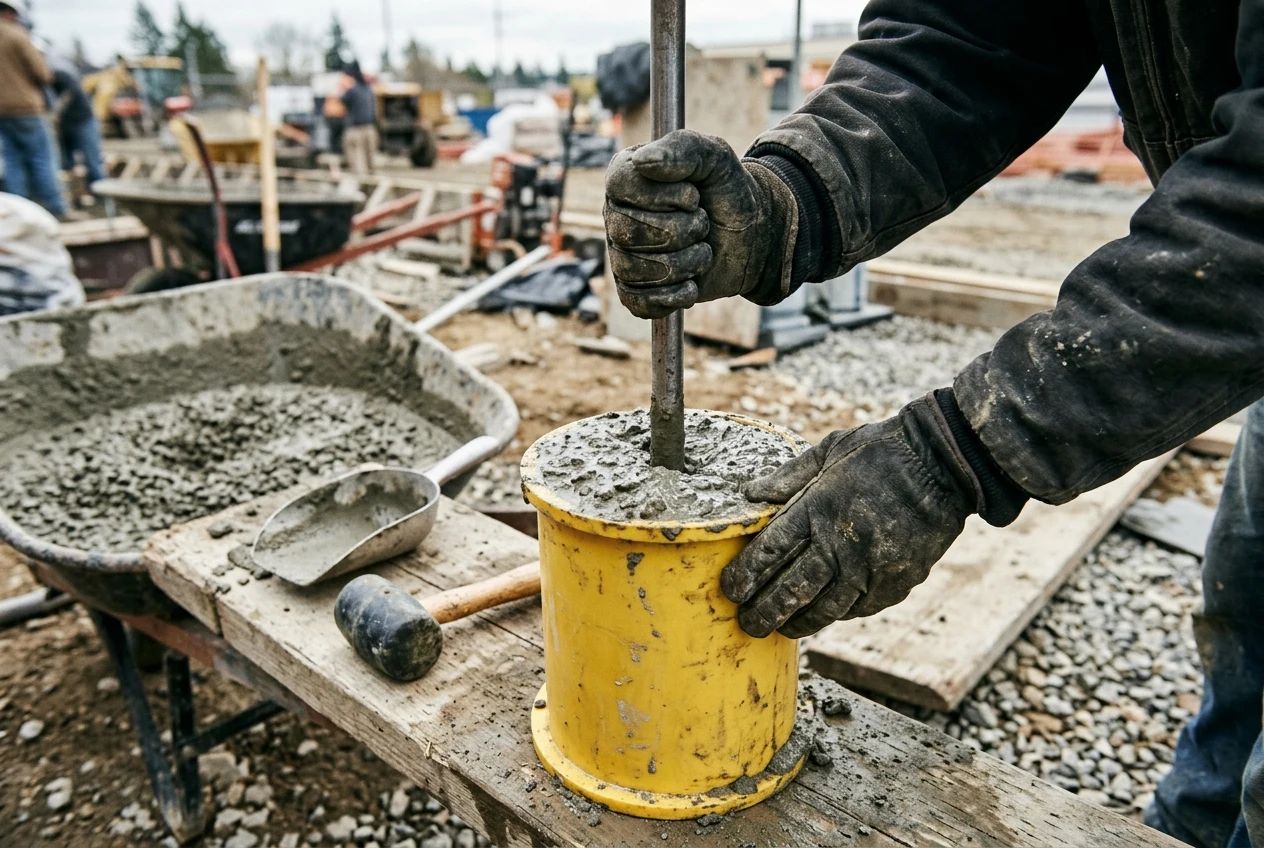
Concrete with slump less than 1 in. (25 mm) is consolidated by vibration in two equal layers, while concrete with slump 1 in. (25 mm) or higher is rodded or vibrated—placing rodded samples in 3 equal layers for larger cylinders and 2 equal layers for smaller cylinders and rodding each layer 25 times evenly distributed.
When consolidating cylinders, the bottom layer is consolidated throughout its depth and upper layers are penetrated 1 in. (25 mm) into the underlying layer, followed by tapping the sides of the mold 10-15 times with the mallet to close any insertion holes.
Separate standard-cured acceptance cylinders from field-cured cylinders
Keep the curing method and intended purpose recorded on the sample log so early-age construction checks are not mistaken for contract acceptance tests.
According to ASTM C31, strength results of standard-cured cylinders are used for acceptance testing for specified strength, verifying mixture proportions for strength, and quality control.
Field-cured cylinders are used for determining when a structure can be put into service, comparing with results of standard-cured specimens or in-place tests, evaluating the adequacy of curing and protecting concrete in the structure, and scheduling removal of forms or shoring.
The strength results of field-cured specimens are not recognized for determining the acceptability of the quality of concrete furnished for the work.
Protect initial field curing and transport specimens to the laboratory
Published ready-mixed concrete guidance states two high-strength thresholds for tightening the initial field-curing temperature window: NRMCA CIP34 uses greater than 6000 psi (40 MPa), while NRMCA CIP41 uses exceeds 5000 psi (35 MPa).
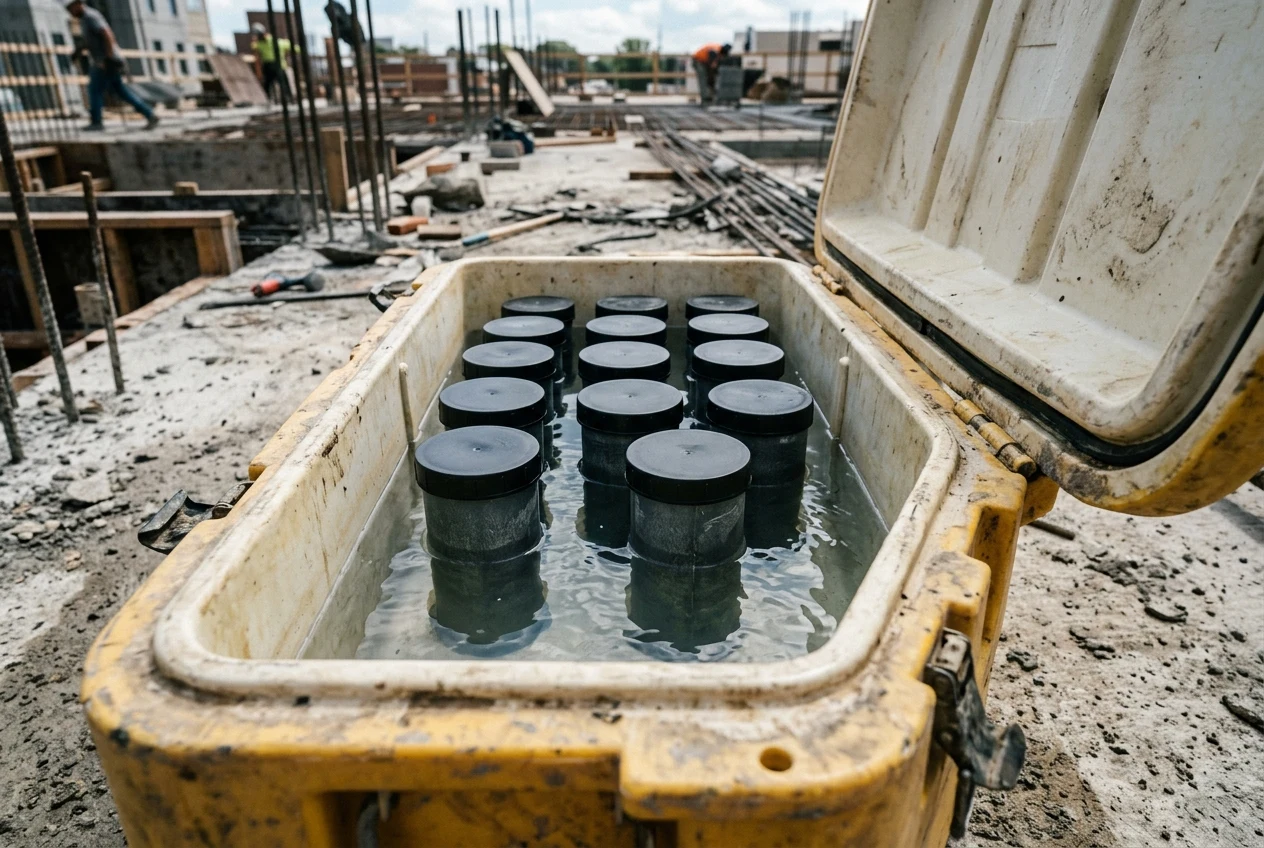
During initial curing in the field, cylinders must be placed on a flat surface in a controlled environment with temperature maintained in the range of 60-80ºF (16-27ºC), or in the range of 68-78ºF when concrete specified strength is greater than 6000 psi (40 MPa).
For acceptance of concrete, strength test specimens should be standard-cured according to ASTM C31 and maintained at the jobsite in a moist condition in a temperature range of 60 to 80°F (16 to 27°C), or in a temperature range of 68 to 78°F (20 to 26°C) if the specified strength exceeds 5000 psi (35 MPa).
Cylinders must be transported back to the laboratory within 48 hours of casting, should not be moved until at least 8 hours after final set, and transportation duration from the jobsite to the laboratory should not exceed 4 hours.
Significant handling and testing deficiencies that reduce measured cylinder strength include improperly finished surfaces, initial curing over 80°F (27°C), frozen cylinders, extra days in the field, damage during transportation, delay in stripping molds and curing at the lab, improper capping, and insufficient care in breaking cylinders.
Verify laboratory break procedures and evaluate compressive strength results
Review the laboratory break report alongside your special inspections and testing program to verify specimen conditioning, capping method, companion-cylinder uniformity, and rolling averages.
Cylinders are capped with sulfur mortar (ASTM C617) applied at least two hours and preferably one day before testing, or with neoprene pad caps (ASTM C1231) used to measure concrete strengths between 1500 and 12,000 psi (10 to 80 MPa) with durometer hardness varying from 50 to 70.
Bonded caps in accordance with ASTM C617 are effective when specimen end surfaces have depressions or projections less than 1/8 in (3 mm), while unbonded cap systems in accordance with ASTM C1231 are effective with end surface defects up to 1/5 in (5 mm).
Neoprene pad caps should be replaced after 100 uses, or after 50 uses when testing concrete strength between 7000 and 12,000 psi (50 and 80 MPa).
Cylinder diameter is measured in two locations at right angles at mid-height and if the two diameters differ by more than 2% the cylinder should not be tested; specimen ends should not depart from perpendicularity with the cylinder axis by more than 0.5º and should be plane to within 0.002 inches (0.05 mm).
Cylinders should be centered in the compression-testing machine and loaded to complete failure, with the loading rate on a hydraulic machine maintained in a range of 28 to 42 psi/s (0.20 to 0.30 MPa/s) during the latter half of the loading phase.
Concrete compressive strength is calculated by dividing maximum load at failure by average cross-sectional area—applying C39 correction factors if the length-to-diameter ratio is between 1.75 and 1.00—and the average strength of at least two cylinders tested at the same age is reported to the nearest 10 psi (0.1 MPa).
Check companion-cylinder range, report fields, and acceptance criteria
Compare companion cylinder breaks from the same sample before evaluating rolling three-test averages and single-test lower bounds:
The strength range of two or three cylinders prepared from the same concrete sample should rarely exceed 8.0% or 9.5% of the strength average, respectively.
The coefficient of variation between companion cylinders tested at the same age should be about 2 to 3%, and if the difference between companion cylinders exceeds 8% for two or 9.5% for three more than 1 time in 20, the testing procedures should be evaluated and rectified.
The strength test report should include information required by ASTM C39—storage and curing of specimens before testing, location in the work represented by each strength test, date and time of sampling, and batch ticket number—and be distributed to all stakeholders within 7 days according to ACI 301.
Concrete strength acceptance criteria require that (a) the average of three consecutive tests equals or exceeds the specified strength, and (b) no single test is lower than the specified strength by more than 500 psi (3.5 MPa) when the specified strength is less than or equal to 5000 psi (35 MPa), or lower than (0.9 × specified strength) when the specified strength is greater than 5000 psi (35 MPa).
Investigate low cylinder breaks with in-place tests and drilled cores
When standard-cured cylinder break reports fall short of acceptance thresholds, follow a structured progression from laboratory and curing verification to in-place evaluation and core testing.
For estimating in-place strength for formwork removal or putting a slab into service, ACI 318-19 Commentary R26.11.2.1(e) methods include testing cast-in-place cylinders per ASTM C873 (for slabs with concrete depth between 5 and 12 in. [127 and 305 mm]), penetration resistance per ASTM C803, pullout strength per ASTM C900, and maturity index measurements and correlation per ASTM C1074.
In the probe penetration resistance test, accurate measurement of the exposed length of the probe is required, probes should be spaced at least 7 in. apart and not be close to the edge of the concrete, and probes not firmly embedded should be rejected.
ACI 318 requires tests of cores from the structure only when strength tests do not comply with the individual-test lower-bound acceptance criterion and calculations indicate that structural adequacy is significantly reduced, with cores obtained and conditioned in accordance with ASTM C42.
Under ASTM C42, core testing requires a minimum of 3 cores for each location represented by low strength tests, with a minimum diameter of 3.7 in. (85 mm) or at least twice the nominal maximum aggregate size.
Drilled cores should have a length-to-diameter ratio (L/D) around 2 and at least 1 1/2, and coring should avoid top layers of columns, slabs, walls, or footings, which will be 10 to 20 percent weaker than cores from mid or lower portions.
Ideal core diameters should be at least 3.70 in. with length 1.9 to 2.1 times the diameter; cores can have length/diameter (L/D) as low as 1.0, and if L/D is less than 1.75, correction to the final strength must be made as outlined in ASTM C42/C42M.
Drilled cores must be stored in sealed watertight bags or containers, have their ends sawed or ground within 2 days after drilling, and be kept in a sealed condition for at least 5 days after last wetted before testing in accordance with ASTM C42 and ACI 318.
Under ACI 318 Section 26.12.1.1(c) and (d), certified laboratory technicians must perform all required laboratory tests and trimmed cores are tested between 5 and 7 days after coring.
Evaluate drilled core strength results against structural adequacy criteria
Compare both the three-core average and the lowest individual core against the structural adequacy thresholds:
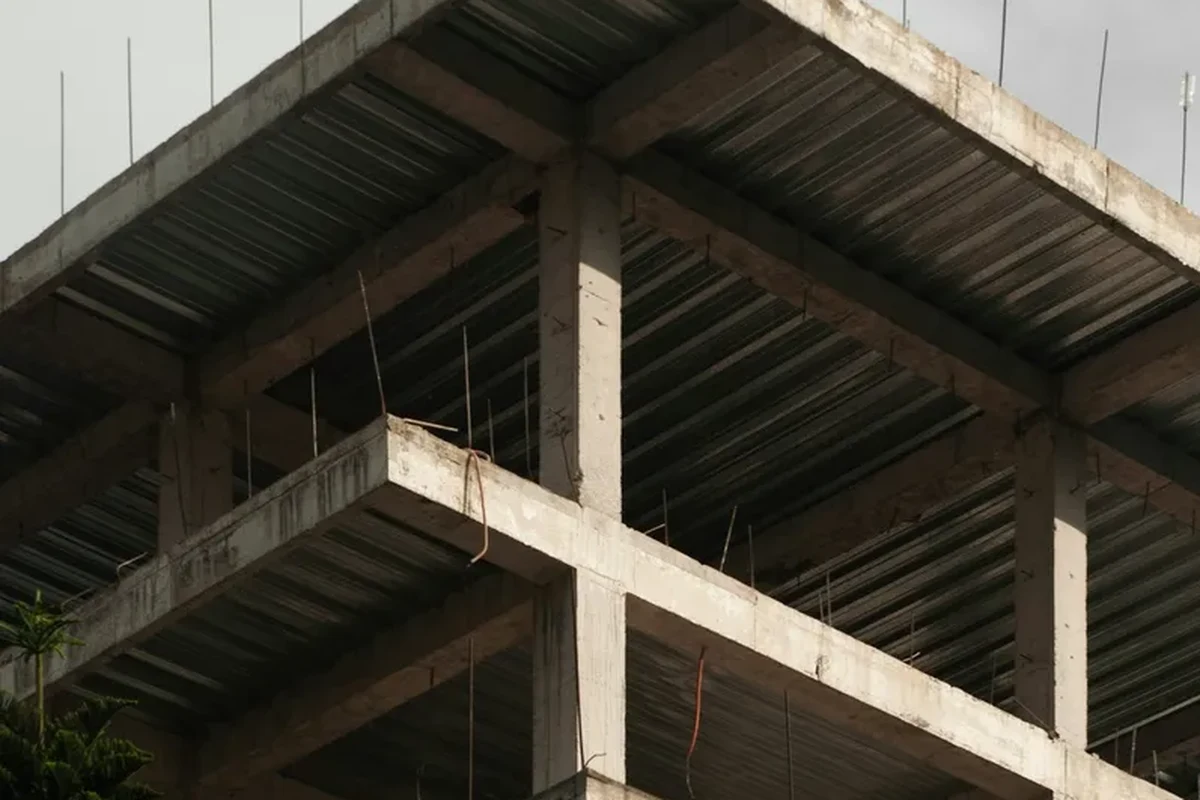
The ACI Building Code (ACI 318) recognizes that concrete construction is considered structurally adequate if the average of three cores from a region represented by non-compliant concrete strength tests equals or exceeds 85 percent of specified strength f’c with no single core less than 75 percent of f’c, and measured core strengths are not corrected for age.
Under ACI 318 Section 26.12.6.1(e) and ACI 301 Section 1.7.6.3 for a 4000 psi slab, an average core strength of 3470 psi exceeds 85% of specified f’c (0.85 × 4000 psi = 3400 psi) and a lowest core strength of 3140 psi exceeds 75% of specified f’c (0.75 × 4000 psi = 3000 psi).
Under ACI 318 Section 26.12.6.1(e) and ACI 301 Section 1.7.6.3 for a 4000 psi slab, an average core strength of 3797 psi exceeds 85% of specified f’c (3400 psi), but a single core at 2160 psi is less than 75% of specified f’c (3000 psi) and fails.
Under ACI 318 Section 26.12.6.1(f), if one or more cores are considered to have erratic strength, extracting additional cores from that area is permitted, and the licensed design professional or the building official determines what is an erratic core.
Under ACI 318 Section 26.12.6.1(e) and ACI 301 Section 1.7.6.3 for a 4000 psi slab, three cores at 3270 psi, 3360 psi, and 3180 psi have a lowest core strength of 3180 psi, but their average of 3270 psi is less than 85% of specified f’c (0.85 × 4000 psi = 3400 psi) and fails.
Concrete mix submittal and cylinder acceptance worksheet
Copy these prompts into your project quality record to link pre-pour mixture qualification, ready-mix delivery tickets, and cylinder break reports for each placement.
- Mixture submittal review: concrete class, specified design strength, target average strength calculation, standard deviation or overdesign basis, and supporting field test record or trial batch documentation.
- Delivery ticket check: batch plant, truck identifier, batching time, arrival time, discharge start and completion times, and signed record of any jobsite water or admixture adjustment.
- Fresh concrete and sampling log: placement location, batch ticket reference, composite sample time, fresh concrete temperature, slump, unit weight, air content, and field technician certification record.
- Cylinder molding and curing record: specimen size and count, consolidation method, curing classification, initial field curing temperature log, and laboratory transport timestamp.
- Laboratory break and acceptance review: test age, capping method, specimen dimensions, companion cylinder range, reported average strength, rolling consecutive test average, and individual test compliance check.
- Low-break investigation and core disposition: handling and curing audit, in-place nondestructive test summary, core drilling locations and conditioning dates, individual and average core results, and structural disposition.
Sources
-
National Ready Mixed Concrete Association — Concrete in Practice Series on Low Concrete Cylinder Strength
-
National Ready Mixed Concrete Association — Concrete in Practice Series on Strength of In-Place Concrete
-
National Ready Mixed Concrete Association — Concrete in Practice Series on Jobsite Addition of Water
-
National Ready Mixed Concrete Association — Concrete in Practice Series on Ordering Ready Mixed Concrete
-
National Ready Mixed Concrete Association — Concrete in Practice Series on Making Cylinders in the Field
-
National Ready Mixed Concrete Association — Concrete in Practice Series on Testing Compressive Strength of Concrete
-
National Ready Mixed Concrete Association — Concrete in Practice Series on Acceptance Testing of Concrete
-
National Ready Mixed Concrete Association — Technical Information Series on Establishing Target Average Strength of Concrete Mixtures
-
National Ready Mixed Concrete Association — Technical Information Series on Capping Cylindrical Concrete Specimens with Sulfur Mortars and Unbonded Caps
-
National Ready Mixed Concrete Association — Guide to Improving Specifications for Ready Mixed Concrete
-
American Concrete Institute — Technical Guidance on Curing Cylinders for Acceptance Testing
-
American Concrete Institute — Evaluation of Concrete Cores Test Results
-
Alabama Concrete Industries Association — Review of Concrete Mixtures Specification Provisions
-
Unified Facilities Guide Specifications — Cast-in-Place Concrete
Related articles
Special Inspections in Construction: A Material Handoff Worksheet
Separate construction QC from required special inspections, then use a material-package worksheet to coordinate documents, access, reports and closeout.
Read article: Special Inspections in Construction: A Material Handoff Worksheet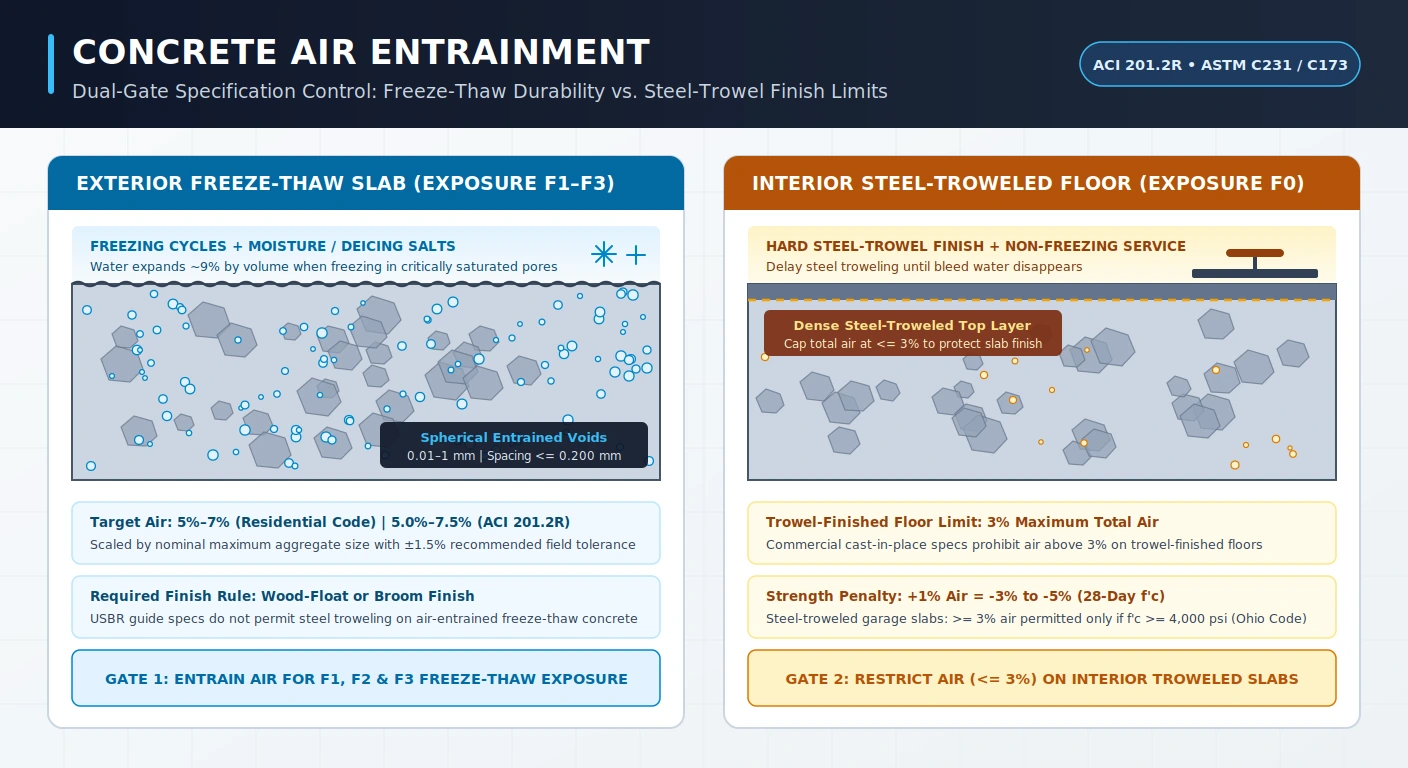
Concrete Air Entrainment: Limits & Finish
Specify concrete air entrainment by freeze-thaw exposure class, aggregate size, ASTM C231 vs C173 testing, and the 3% interior steel-trowel limit.
Read article: Concrete Air Entrainment: Limits & Finish
Shop Drawings in Construction: Fabrication Tolerances, Specification Deviations, and AIA A201 Review
Review shop drawings against contract requirements, check fabrication and field tolerances, document specification deviations, and resolve VIF dimensions.
Read article: Shop Drawings in Construction: Fabrication Tolerances, Specification Deviations, and AIA A201 Review