
Concrete Air Entrainment: Limits & Finish
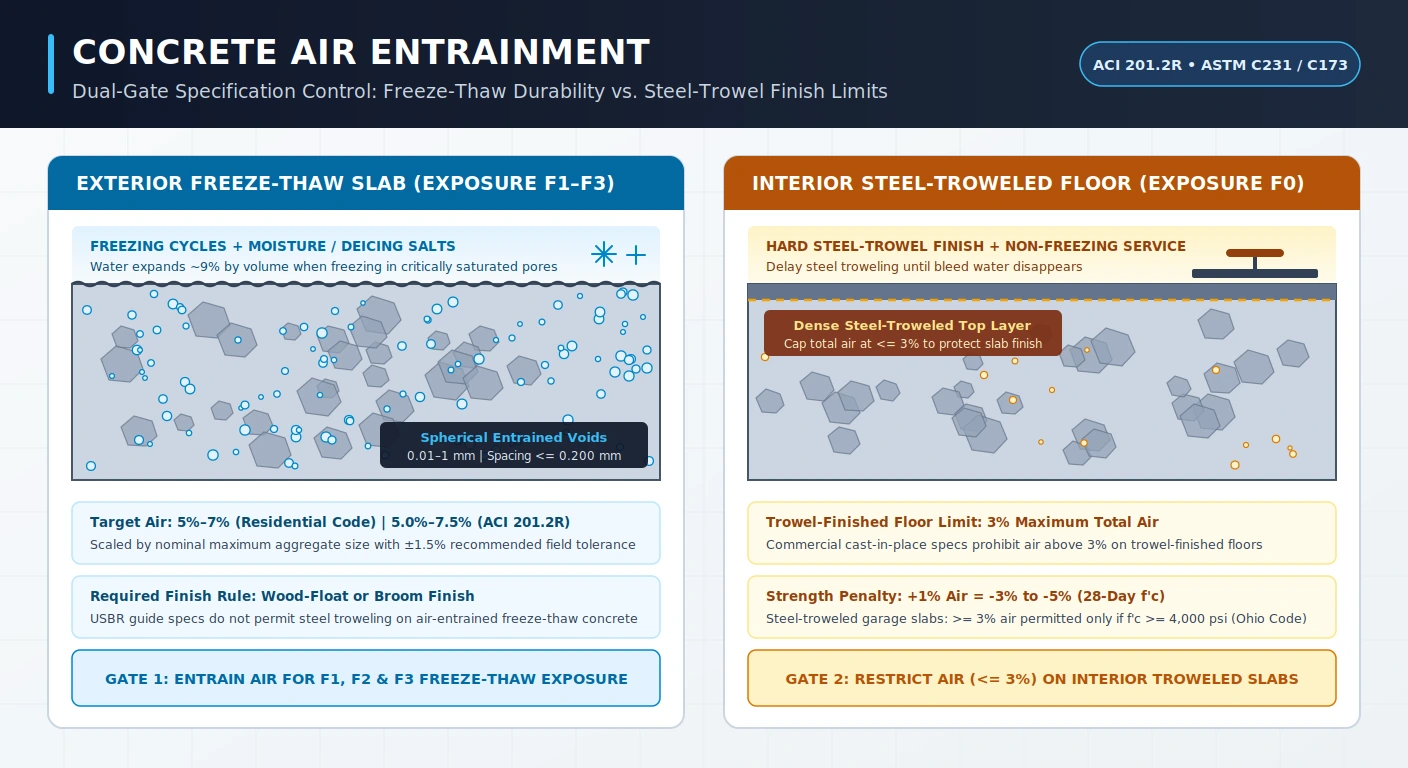
Concrete air entrainment intentionally stabilizes microscopic spherical air bubbles during mixing using ASTM C260 surfactants to protect concrete from freeze-thaw cracking and deicing salt scaling. Specify air-entrained concrete at 5% to 7.5% total air for freezing exposures F1 through F3, while capping total air at 3% maximum on interior steel-troweled floor slabs to preserve finish and strength.
Specifiers and project engineers control air entrainment at two points: mix-design submittal review and point-of-placement discharge verification. Pair this specification guide with our Planning guides, align fresh air checks with pre-pour mix qualification in concrete test cylinders vs. mix design submittals, and document field sampling roles inside your construction quality control plan and special inspections program.
When Should You Specify Air-Entrained Concrete?
Specify air-entrained concrete whenever a structural or architectural element faces freezing and thawing cycles in service or during construction—corresponding to ACI 201.2R Exposure Classes F1, F2, and F3 and moderate or severe weathering zones under building codes. Concrete in Exposure Class F0 that never experiences freezing cycles does not require air entrainment for frost resistance.
Under FHWA Tech Brief FHWA-HIF-17-009, ACI 201.2R classifies freeze-thaw exposure by both freezing occurrence and moisture saturation risk. Separately, Residential Code of Ohio Section 402.2 requires air entrainment for concrete subject to moderate or severe weathering, for concrete exposed to freezing and thawing during construction, and under Section 402.3 for precast concrete foundations exposed to freezing and thawing.
ACI Freeze-Thaw Exposure Classes and Code Triggers
Scroll horizontally to see all columns.
| Exposure Class or Code Scope | Severity / Condition | Representative Concrete Elements | Air-Entrainment Requirement |
|---|---|---|---|
| ACI Class F0 | Not applicable; no freezing and thawing cycles | Climate-controlled interior slabs and protected framing | Not required for freeze-thaw protection |
| ACI Class F1 | Moderate; freezing with very low saturation probability | Vertical surfaces above snow accumulation and elevated horizontal floors protected from direct moisture | Required; 5.0% to 7.0% target by aggregate size |
| ACI Class F2 | Severe; freezing with high saturation probability, no deicers | Vertical surfaces below snow accumulation, retaining walls with one wet side, and unprotected slabs-on-grade | Required; 5.5% to 7.5% target by aggregate size |
| ACI Class F3 | Very severe; freezing plus deicing chemicals or frequent seawater | Sidewalks, pavements receiving deicers, and vertical faces with deicer-contaminated snow | Required; 5.5% to 7.5% target plus max 0.40–0.45 w/cm |
| Residential Code of Ohio Table 402.2 | Moderate or severe weathering, or freezing during construction | Exterior porches, carport slabs, steps, exterior walls, and garage slabs | 5% to 7% total air by volume (2,500–3,500 psi min f’c) |
| Residential Code of Ohio Section 402.3 | Precast concrete foundations exposed to freezing and thawing | Precast foundation wall panels in cold climates | Minimum 5% total air and minimum 5,000 psi (34,470 kPa) at 28 days |
Under Residential Code of Ohio Table 402.2, minimum 28-day specified compressive strength scales alongside weathering severity: unexposed basement walls and interior slabs-on-grade require 2,500 psi across all weathering levels; exterior vertical concrete walls require 2,500 psi in negligible weathering and 3,000 psi in moderate or severe weathering; and exterior porches, carport slabs, steps, and garage floor slabs require 2,500 psi (negligible), 3,000 psi (moderate), and 3,500 psi (severe).
What Is the Purpose of Air Entrainment in Concrete?
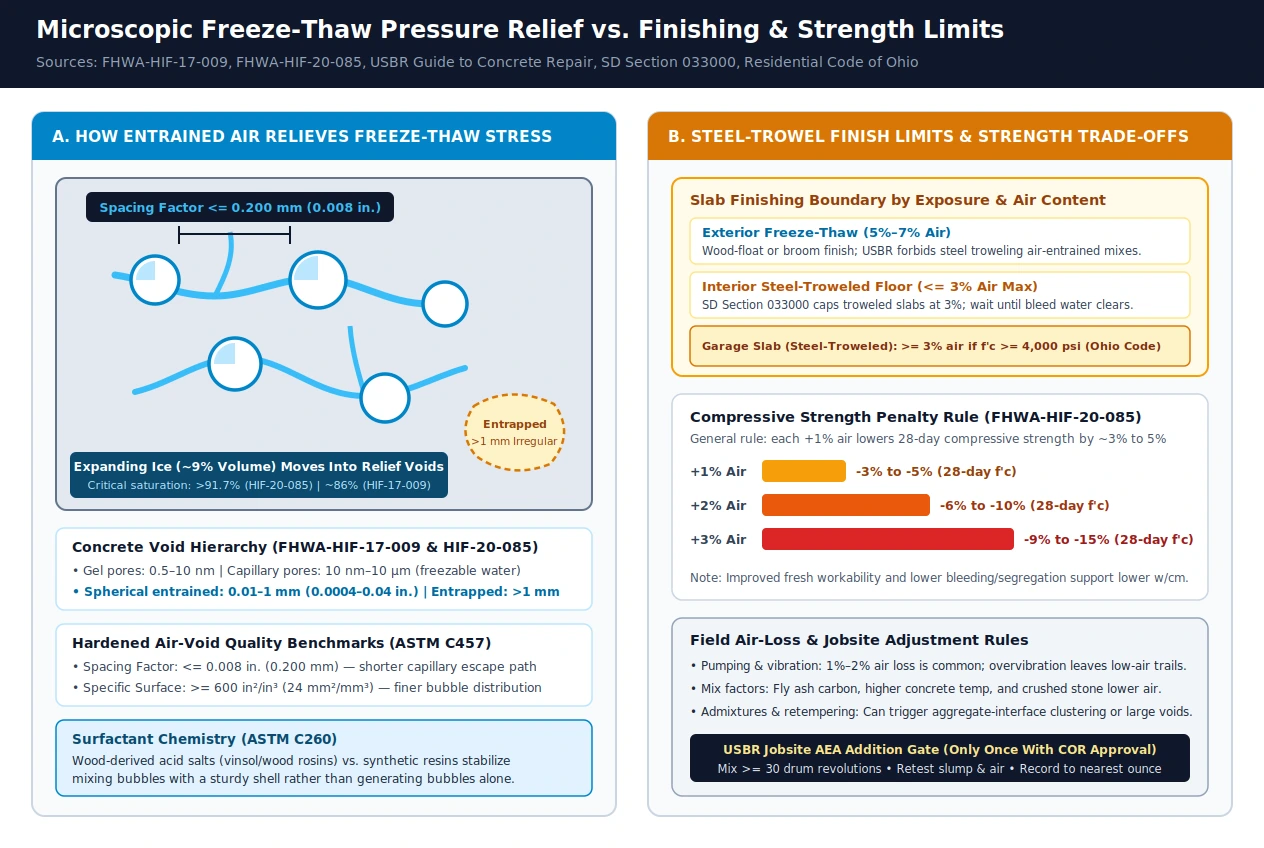
The purpose of concrete air entrainment is to embed closely spaced microscopic spherical air voids inside hydrated cement paste so freezing capillary pore water—which expands by roughly 9% in volume—can move into nearby relief chambers instead of cracking the concrete matrix. Without these relief voids, critically saturated concrete suffers freeze-thaw damage even during a single freezing cycle.
Concrete is naturally porous across distinct void scales documented in FHWA-HIF-17-009 and FHWA-HIF-20-085: gel pores (0.5 to 10 nm) intrinsic to hydration products, capillary pores (10 nm to 10 μm) left by original mixing water, purposefully entrained spherical air voids (0.0004 to 0.04 in. or 0.01 to 1 mm per FHWA-HIF-20-085; 0.05 to 1.25 mm per FHWA-HIF-17-009), and irregular entrapped air voids larger than 0.04 in. (1 mm). When moisture reaches critical saturation, exceeding 91.7% per FHWA-HIF-20-085 or between 75% and 91% with recent research pointing to roughly 86% per FHWA-HIF-17-009, ice expansion exerts hydraulic and osmotic pressure exceeding concrete tensile strength unless closely spaced spherical voids shorten the water travel path.
Entrained vs. Entrapped Air and ASTM C260 Surfactant Chemistry
Not all air inside fresh concrete protects against frost. Irregular entrapped air voids larger than 0.04 in. (1 mm) occur naturally in all concrete mixes and are far less effective than microscopic spherical entrained voids because entrapped voids leave long unprotected distances across the capillary paste.
Air-entraining admixtures governed by ASTM C260 (cited in the U.S. Bureau of Reclamation Guide to Concrete Repair) are surface-active surfactants combining a nonpolar water-repelling hydrocarbon chain with an anionic polar water-attractive chain. Rather than generating bubbles chemically on their own, these surfactants stabilize microscopic bubbles whipped in during mixing by reducing water surface tension and forming a sturdy shell that hinders coalescence. FHWA-HIF-20-085 groups them into two primary classes:
- Wood-derived acid salts (vinsol resins and wood rosins): Used for decades with reliable bubble structures in low water-cementitious mixes, though they tend to lose air with haul time and distance.
- Synthetic resins (detergents, fatty acids, gum resins, and tall oils): Can produce smaller, more closely spaced air bubbles than vinsol resins and wood rosins for higher freeze-thaw durability, but can cause total air content to climb after delayed water additions.
What Is the Target Concrete Air Entrainment Percentage?
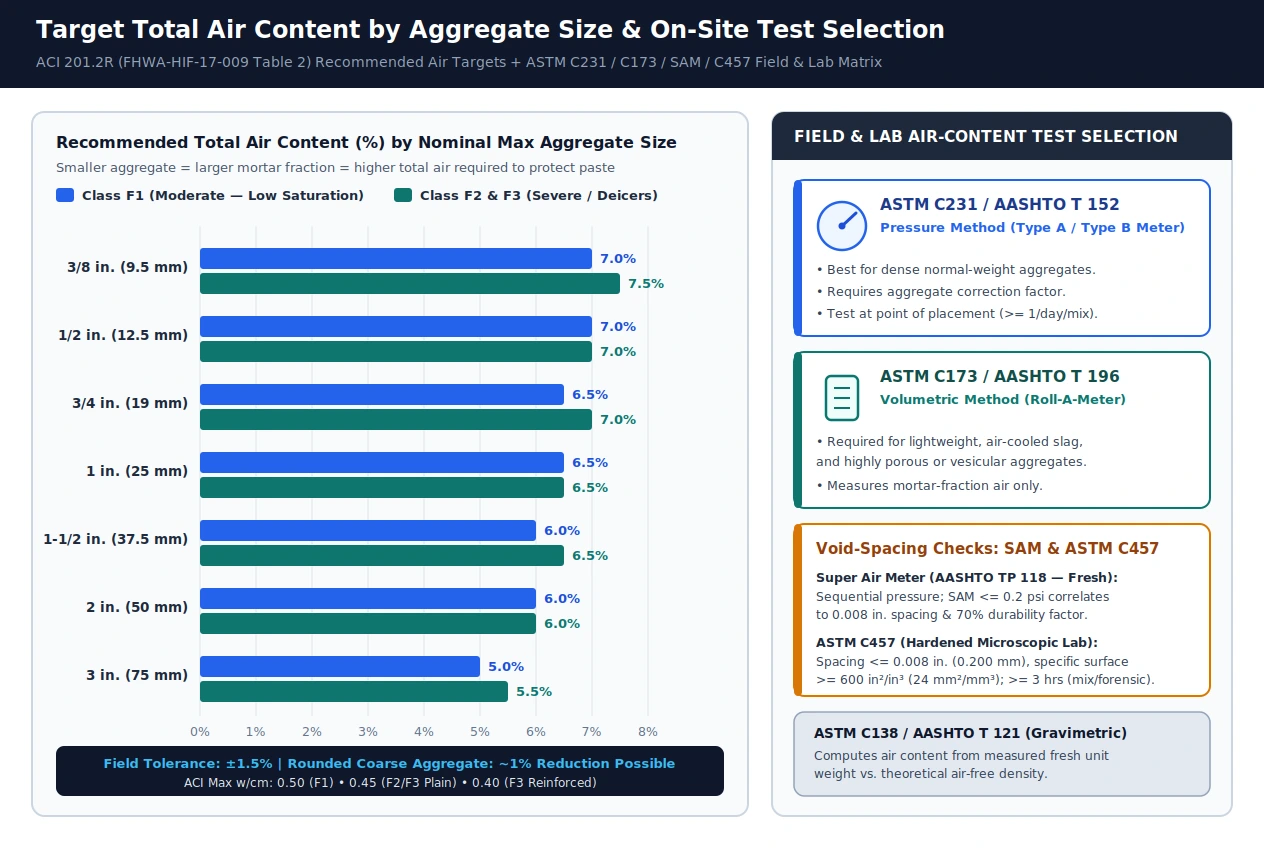
Target total concrete air content ranges from 5% to 7.5% by volume under ACI 201.2R (FHWA-HIF-17-009 Table 2) with a ±1.5% recommended field tolerance, rising as nominal maximum aggregate size decreases and mortar fraction grows. Under Residential Code of Ohio Table 402.2 Footnote d, air-entrained concrete must stay between 5% and 7% total air by volume.
Because entrained air protects the hydrated cement paste rather than the stone, mixtures made with smaller coarse aggregate contain a higher mortar fraction and therefore need a higher total air percentage. FHWA-HIF-17-009 also notes that ACI mixture targets assume angular coarse aggregates, so specifiers can sometimes reduce target air content by roughly 1% when using rounded coarse aggregates.
Recommended Total Air Content by Nominal Maximum Aggregate Size
Scroll horizontally to see all columns.
| Nominal Maximum Aggregate Size | Exposure Class F1 (Moderate) Target Air | Exposure Classes F2 & F3 (Severe / Deicers) Target Air | Recommended Field Tolerance |
|---|---|---|---|
| 9.5 mm (3/8 in.) | 7.0% | 7.5% | ±1.5% |
| 12.5 mm (1/2 in.) | 7.0% | 7.0% | ±1.5% |
| 19 mm (3/4 in.) | 6.5% | 7.0% | ±1.5% |
| 25 mm (1 in.) | 6.5% | 6.5% | ±1.5% |
| 37.5 mm (1-1/2 in.) | 6.0% | 6.5% | ±1.5% |
| 50 mm (2 in.) | 6.0% | 6.0% | ±1.5% |
| 75 mm (3 in.) | 5.0% | 5.5% | ±1.5% |
Companion Water-Cementitious Ratio and SCM Limits
Air content alone does not guarantee freeze-thaw durability if high permeability lets water saturate the capillary network rapidly. Per ACI 201.2R guidance reproduced in FHWA-HIF-17-009, pair target air percentages with maximum water-cementitious materials ratios of 0.50 for Exposure Class F1 and 0.45 for plain concrete in Exposure Classes F2 and F3, tightening to 0.40 for reinforced concrete in Exposure Class F3. For hand-finished surfaces exposed to deicing chemicals, limit supplementary cementitious materials to a maximum of 25% fly ash or 50% slag cement by mass of total cementitious materials.
How Is Concrete Air Entrainment Tested on Site?
Test fresh concrete air content at the point of placement using the ASTM C231/C231M-24 pressure method (AASHTO T 152) for normal-weight dense aggregates and the ASTM C173/C173M-24 volumetric method (AASHTO T 196 Roll-A-Meter) for lightweight, air-cooled slag, or porous aggregates. Commercial cast-in-place specifications require at least one point-of-placement test per composite sample and per day’s pour of each mix.
Choosing the wrong meter introduces systematic error. ASTM C231 observes concrete volume change under applied air pressure and excludes air inside dense aggregate particles only after applying an aggregate correction factor, so porous or lightweight aggregates skew pressure readings. By contrast, ASTM C173 measures air directly inside the mortar fraction regardless of aggregate porosity, making it valid for dense, cellular, lightweight, air-cooled slag, and vesicular natural aggregates.
Field and Laboratory Air-Content Test Methods
Scroll horizontally to see all columns.
| Test Standard | Method Type | Applicable Aggregates / State | What It Measures | Key Operational Limit or Benchmark |
|---|---|---|---|---|
| ASTM C231 / AASHTO T 152 | Pressure method (fresh) | Relatively dense normal-weight aggregates | Total air volume by pressure-volume change | Requires aggregate correction factor; unsuitable for porous/lightweight stone |
| ASTM C173 / AASHTO T 196 | Volumetric Roll-A-Meter (fresh) | Any aggregate (dense, lightweight, slag, porous, vesicular) | Mortar-fraction total air volume | Unaffected by internal aggregate particle pores |
| ASTM C138 / AASHTO T 121 | Gravimetric density (fresh) | Fresh concrete with verified ingredient specific gravities | Total air from measured vs. theoretical air-free density | Sensitive to batching proportion and density input accuracy |
| AASHTO TP 118 (SAM) | Sequential pressure Super Air Meter (fresh) | Fresh concrete evaluated for void distribution | Total air volume plus SAM Number | 0.2 psi SAM failure limit correlates to 0.008 in. spacing and 70% durability factor |
| ASTM C457 | Hardened microscopic analysis (lab) | Polished hardened concrete slices | Total air, spacing factor, and specific surface | Spacing <= 0.008 in. (0.200 mm); specific surface >= 600 inch2/inch3 (24 mm2/mm3); >= 3 hours |
Sampling Frequency, Void-Spacing Verification, and Jobsite Admixture Rules
Under South Dakota Cast-in-Place Concrete Specifications, field quality assurance technicians must run ASTM C231/C231M at the point of placement for each composite sample—at least once per day’s pour for each concrete mixture—plus additional checks whenever concrete consistency appears to shift. Because standard pressure and volumetric meters measure only total air volume rather than bubble spacing, FHWA-HIF-17-009 highlights the Super Air Meter (AASHTO TP 118) for fresh screening and ASTM C457 microscopic testing for mixture qualification or forensic investigation, since ASTM C457 takes 3 hours or more per polished specimen and requires days for results.
When a truck arrives below target air content at discharge, uncontrolled dosing ruins batch uniformity. U.S. Bureau of Reclamation specifications permit adding air-entraining admixture at the jobsite only once with formal Contracting Officer’s Representative approval, followed by at least 30 revolutions of the mixer drum at mixing speed, mandatory re-testing of both slump and air content, and recording the added admixture volume on the batch ticket to the nearest ounce.
How Do Air-Entraining Agents Affect Workability and Strength?
Air-entraining admixtures improve fresh concrete workability while reducing segregation and bleeding, but they directly lower hardened concrete strength: FHWA-HIF-20-085 states that each 1% increase in total air content decreases 28-day compressive strength by roughly 3% to 5%. Mix designers must balance frost durability against structural strength margins rather than overdosing air to ease placement.
While improved cohesion and plasticity often help crews place stiff mixes cleanly, excessive air erodes 28-day compressive strength margins quickly before any curing or testing deficiency is even considered. That strength trade-off makes accurate point-of-placement testing essential whenever high-strength structural mixes also carry freeze-thaw requirements.
Placement Losses, Material Variables, and Irregular Air-Void Systems
Fresh air content measured at the ready-mix chute rarely stays constant through placement. FHWA-HIF-17-009 identifies several recurring field mechanisms that shift in-place air content or undermine void quality even when chute tests pass:
- Pumping and overvibration losses: Air-void system instability commonly causes a 1% to 2% drop in total air during pumping and consolidation, and overvibration can strip localized air along segregated vibrator trails that later exhibit freeze-thaw damage.
- Ingredient and temperature sensitivity: Carbon in fly ash and finely ground or porous supplementary cementitious materials significantly reduce air content; higher concrete temperatures demand higher admixture dosages; higher cement alkalinity increases air; crushed stone entrains less air than gravel; and middle sand fractions between No. 30 and No. 100 sieves are most effective at entraining air.
- Irregular air-void systems: A load can meet total fresh air volume yet still suffer frost damage or compressive strength loss if polycarboxylate water reducers interact with the surfactant to produce large widely spaced bubbles, if retempering non-vinsol air-entraining mixes or batching dry porous aggregates causes air voids to accumulate at coarse aggregate interfaces, or if insufficient mixing causes voids to coalesce inside the paste.
How Do Exterior Freeze-Thaw Slabs Differ From Interior Steel-Troweled Slabs?
Exterior freeze-thaw slabs require entrained air (5% to 7.5%) finished with a wood float or broom, whereas interior floor slabs receiving a hard steel-troweled finish must cap total air content at 3% maximum. Carrying an exterior air-entrained mix indoors—or steel-troweling an exterior air-entrained slab—violates established specification boundaries and compromises surface durability.
Under South Dakota cast-in-place concrete specifications, commercial floor requirements maintain air within ACI 301 limits while explicitly forbidding air content of trowel-finished floor slabs from exceeding 3%. On exterior freezing concrete, the U.S. Bureau of Reclamation Guide to Concrete Repair goes equally direct: Reclamation concrete guide specifications do not permit steel trowel finishing of air-entrained concrete exposed to freezing and thawing weather, requiring minimal finishing manipulation and stating that a wood float finish is preferable to a steel trowel finish.
Slab Air-Content and Finishing Decision Matrix
Scroll horizontally to see all columns.
| Slab Application | Exposure Condition | Air-Content Specification | Permitted Finish & Timing Rule |
|---|---|---|---|
| Exterior sidewalks, curbs, porches, and pavements | Freeze-thaw with moisture and/or deicers (F2, F3) | 5% to 7% (Ohio Code) or 5.5% to 7.5% ±1.5% by aggregate size (ACI 201.2R) | Wood-float or broom finish; USBR does not permit steel troweling air-entrained freeze-thaw concrete |
| Interior commercial warehouse or building floor slabs | Non-freezing indoor service (F0) | Maximum 3% total air (South Dakota Cast-in-Place Spec / ACI 301) | Hard steel-trowel finish; wait until bleed water disappears and avoid excessive troweling |
| Residential steel-troweled garage floor slabs | Transitional cold-climate garage exposure | Reduction to not less than 3% permitted only if specified f’c >= 4,000 psi (Ohio Table 402.2 Footnote f) | Steel-trowel finish only after bleed water disappears and floated surface has sufficiently hardened |
| Unexposed interior slabs and basement slabs | Non-freezing indoor service (F0) | Non-air-entrained (<= 3% if troweled) | Float or steel-trowel per floor covering specification; minimum 2,500 psi under Ohio Table 402.2 |
When steel troweling is specified on unformed floors, USBR execution clauses mandate waiting until bleed water has completely disappeared and the floated surface has sufficiently hardened to prevent drawing excess fines to the surface, followed by firm uniform passes without excessive troweling. For transitional residential garage slabs that must resist road moisture while still receiving a smooth steel-troweled finish, Residential Code of Ohio Table 402.2 Footnote f establishes a narrow conditional path: total air content may be reduced to not less than 3% only if specified 28-day compressive strength is increased to not less than 4,000 psi.
Concrete Exposure, Finishing, and Air-Content Submittal Checklist
Use this verification checklist during pre-pour mix submittal review and on-site discharge inspection to keep exposure class, finishing method, and air-content testing aligned across every placement:
- Exposure class and weathering trigger: Confirm whether each concrete element is ACI Class F0, F1, F2, or F3, or exposed to freezing during construction, before assigning an air-entrained or non-air-entrained mix ID.
- Aggregate size and target air band: Match the submittal’s nominal maximum coarse aggregate size (3/8 in. through 3 in.) against ACI 201.2R targets, verify the ±1.5% field tolerance, and note any ~1% adjustment for rounded coarse aggregate.
- Companion durability caps: Verify maximum w/cm (0.50 for F1, 0.45 for F2/F3 plain, 0.40 for F3 reinforced) and hand-finished SCM ceilings (25% fly ash or 50% slag cement) alongside ASTM C260 admixture class (wood-derived vs. synthetic).
- Interior trowel and garage boundaries: Lock a 3% maximum total air limit on every interior steel-troweled floor mix, prohibit steel troweling on exterior air-entrained freeze-thaw pours, and confirm >= 4,000 psi specified strength if using the >= 3% steel-troweled garage slab provision.
- Point-of-placement test protocol: Assign ASTM C231 (with verified aggregate correction factor) for dense normal-weight mixes or ASTM C173 Roll-A-Meter for lightweight, slag, or porous aggregates, sampling at the point of placement after pumping losses rather than only at the truck chute.
- Low-air jobsite adjustment gate: Permit on-site ASTM C260 addition only once with formal approval, enforce at least 30 mixer drum revolutions at mixing speed, re-test both slump and air content, and log the added dosage on the delivery ticket to the nearest ounce.
Frequently Asked Questions
What is the standard concrete air entrainment percentage for exterior slabs?
For exterior slabs exposed to freezing and thawing, Residential Code of Ohio Table 402.2 requires 5% to 7% total air by volume, while ACI 201.2R (FHWA-HIF-17-009 Table 2) sets targets from 5.5% (3 in. aggregate) up to 7.5% (3/8 in. aggregate) for Exposure Classes F2 and F3 with a ±1.5% recommended field tolerance.
Why is air content capped at 3% for interior steel-troweled concrete floors?
Commercial cast-in-place specifications prohibit air content above 3% on trowel-finished floor slabs (South Dakota Cast-in-Place Concrete Specifications) and USBR guide specifications do not permit steel troweling on air-entrained concrete exposed to freezing weather, because high air content conflicts with dense steel-trowel finishing and reduces 28-day compressive strength by roughly 3% to 5% per 1% added air.
When should you use ASTM C173 instead of ASTM C231 to test concrete air content?
Use the ASTM C173 volumetric method (Roll-A-Meter) whenever concrete contains lightweight aggregates, air-cooled slag, or highly porous or vesicular natural aggregates. ASTM C231 pressure testing is intended only for relatively dense normal-weight aggregates where a valid aggregate correction factor can be established.
How much does air entrainment reduce concrete compressive strength?
According to FHWA-HIF-20-085, a 1% increase in concrete air content decreases 28-day compressive strength by about 3% to 5% as a general rule. Mix designers offset part of this reduction by leveraging the improved fresh workability of air-entrained paste to lower the water-cementitious ratio.
Does passing a fresh ASTM C231 air test guarantee freeze-thaw durability?
Not always. Standard pressure and volumetric meters measure only total air volume, not bubble size or spacing. Pumping and consolidation commonly remove 1% to 2% air, and admixture interactions or retempering can create widely spaced bubbles or aggregate-interface clustering; verifying void distribution requires the Super Air Meter (AASHTO TP 118, <= 0.2 psi) in fresh concrete or ASTM C457 microscopic analysis (spacing factor <= 0.008 in. / 0.200 mm) in hardened concrete.
Sources
- FHWA Tech Brief FHWA-HIF-17-009: Air Entrainment and Concrete Durability — Pore hierarchy, critical saturation range, ACI 201.2R Exposure Classes F0 through F3, Table 2 aggregate-size air targets and ±1.5% tolerance, maximum w/cm and hand-finished SCM limits, AASHTO and ASTM fresh and hardened testing (C231, C173, C138, SAM AASHTO TP 118, C457), pumping air loss, and irregular air-void systems.
- FHWA Mobile Concrete Technology Center FHWA-HIF-20-085: Air-Entraining Admixtures for Concrete — Ice volume expansion (~9%) at critical saturation (>91.7%), spherical entrained (0.01 to 1 mm) vs. entrapped (>1 mm) voids, wood-derived acid salt vs. synthetic resin surfactants, workability and bleeding benefits, and the 3% to 5% 28-day compressive strength reduction per 1% air increase.
- Residential Code of Ohio Chapter 4 — Foundations and Concrete (Ohio Administrative Code 4101:8-4-01, Cornell LII) — Section 402.2 weathering and construction-freeze triggers, Table 402.2 compressive strength tiers, Footnote d 5% to 7% air range, Footnote f steel-troweled garage slab provision (>= 3% air at >= 4,000 psi), and Section 402.3 precast foundation rules (5% minimum air, 5,000 psi).
- South Dakota State Specification: Cast-in-Place Concrete — ACI 301 air-content compliance, 3% maximum total air limit for trowel-finished floor slabs, and ASTM C231/C231M point-of-placement field testing frequency.
- U.S. Bureau of Reclamation Guide to Concrete Repair — ASTM C260 air-entraining admixture reference, prohibition against steel-trowel finishing air-entrained concrete exposed to freeze-thaw weather, bleed-water timing rules for steel troweling, and once-only jobsite air-entraining admixture addition protocol (>= 30 drum revolutions, retesting, nearest-ounce batch-ticket logging).
- ASTM C231/C231M-24 Standard Test Method for Air Content of Freshly Mixed Concrete by the Pressure Method — Scope of pressure-method fresh concrete air testing for relatively dense aggregates and aggregate correction factor requirement.
- ASTM C173/C173M-24 Standard Test Method for Air Content of Freshly Mixed Concrete by the Volumetric Method — Scope of volumetric mortar-fraction air testing for dense, cellular, lightweight, air-cooled slag, and highly porous or vesicular aggregates.
Related articles
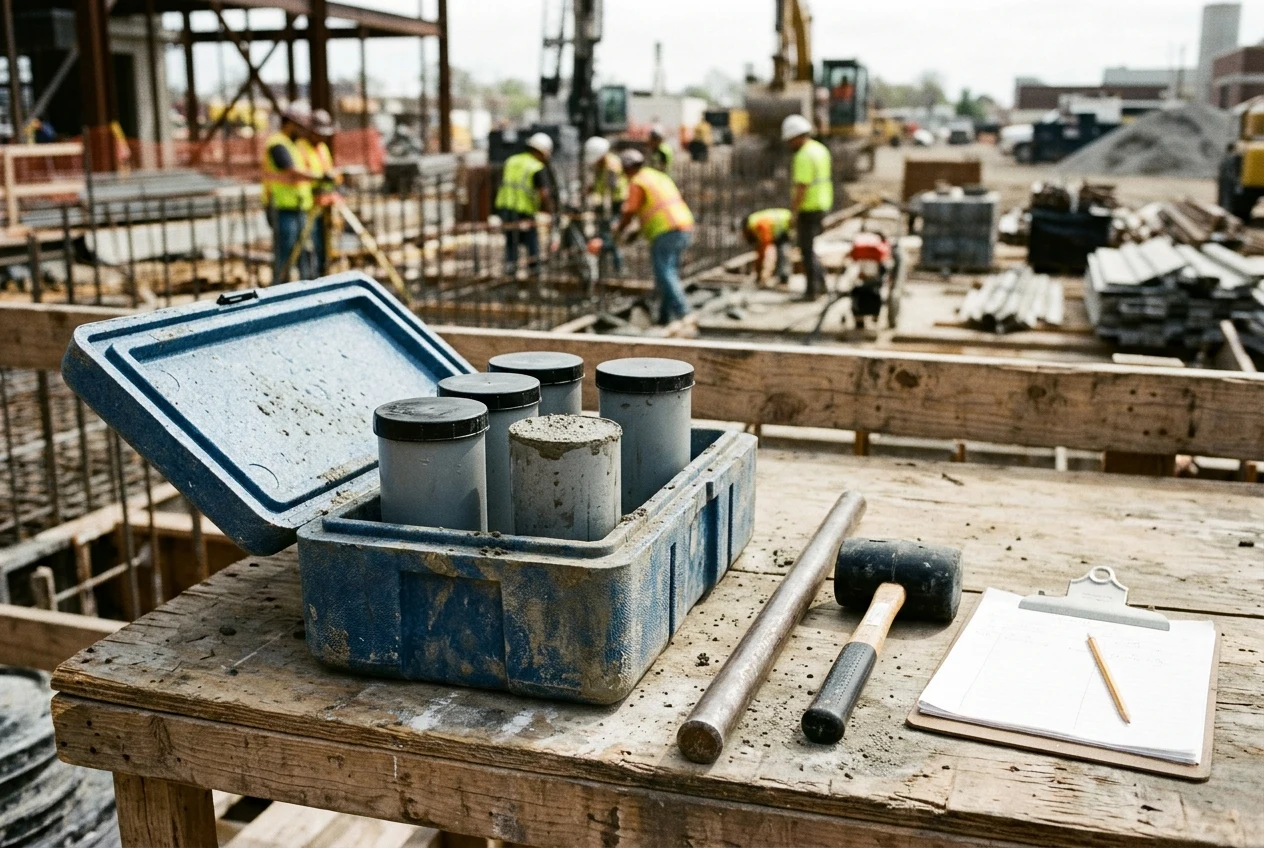
Concrete Test Cylinders vs Mix Design Submittals: ASTM C31 Curing, 28-Day Breaks, and ACI 318 Acceptance
Separate pre-pour concrete mix design submittals, ready-mix delivery tickets, and concrete test cylinders across curing, break testing, and acceptance.
Read article: Concrete Test Cylinders vs Mix Design Submittals: ASTM C31 Curing, 28-Day Breaks, and ACI 318 Acceptance
Shop Drawings in Construction: Fabrication Tolerances, Specification Deviations, and AIA A201 Review
Review shop drawings against contract requirements, check fabrication and field tolerances, document specification deviations, and resolve VIF dimensions.
Read article: Shop Drawings in Construction: Fabrication Tolerances, Specification Deviations, and AIA A201 Review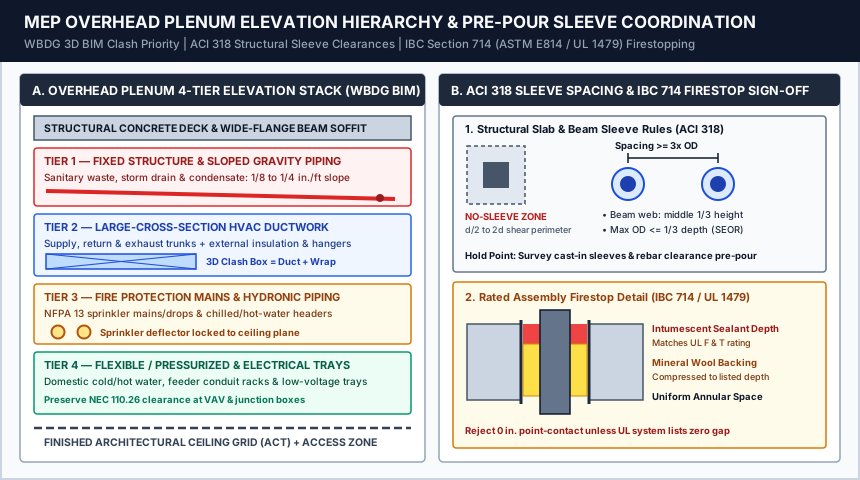
Construction Project Coordination Checklist: Weekly Subcontractor, MEP, Curtain Wall & Crane Control
Run weekly construction project coordination across GC and subcontractor lookaheads, MEP sleeve and firestop sign-offs, curtain wall embed surveys, tower crane hook-time slots, and long-lead rigging.
Read article: Construction Project Coordination Checklist: Weekly Subcontractor, MEP, Curtain Wall & Crane Control