
RFI in Construction: Meaning, Routing & Log
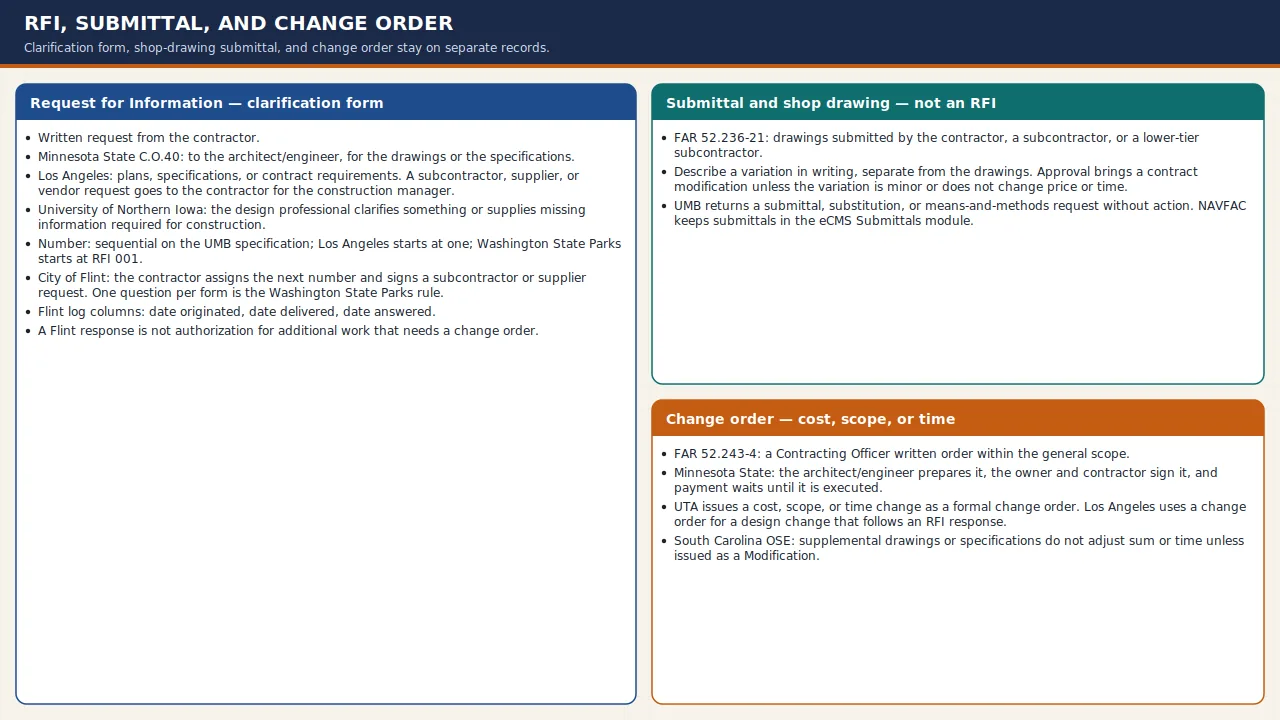
An RFI in construction (Request for Information) is a written request from the contractor. Minnesota State C.O.40 addresses that request to the architect/engineer for clarification of the drawings or the specifications. The Los Angeles Bureau of Engineering form requests information or clarification related to the plans, specifications, or contract requirements, and a subcontractor, supplier, or vendor request goes to the contractor for processing to the construction manager. University of Northern Iowa procedures use the form to ask the design professional to clarify something or provide missing information required for construction.
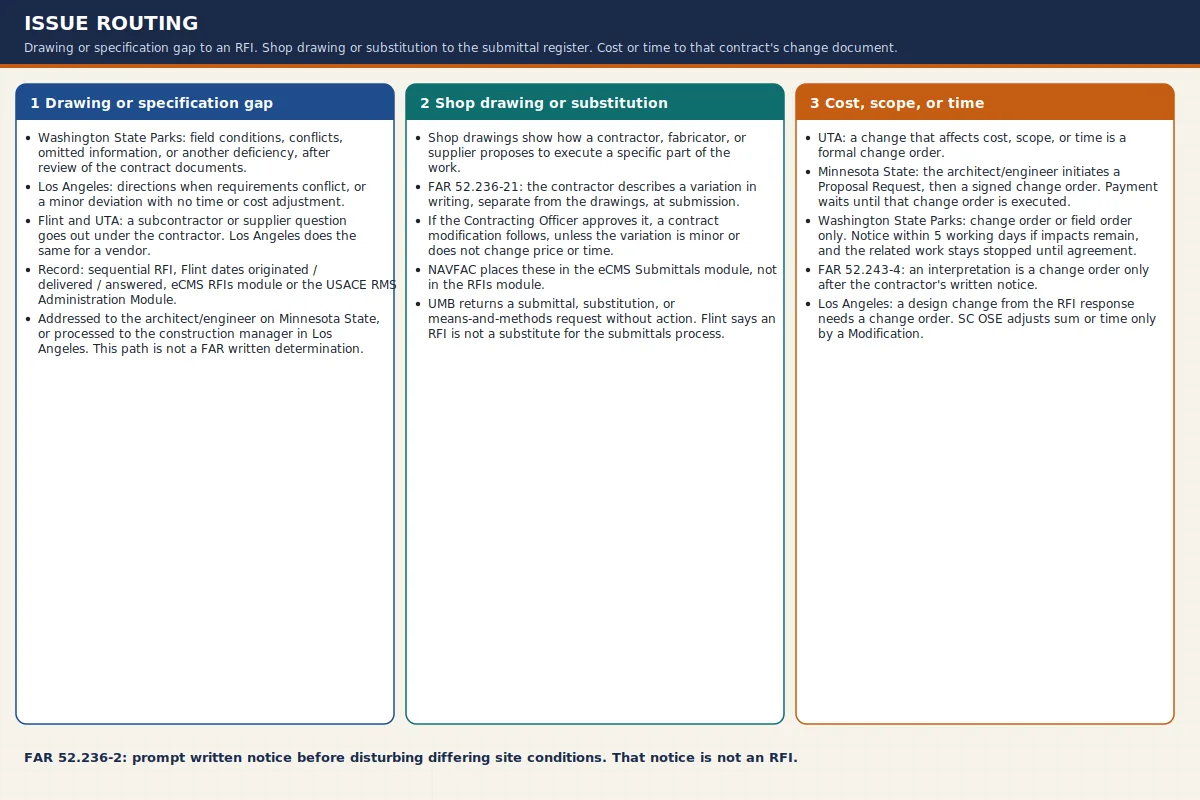
Washington State Parks Section 012613 has the contractor submit a written request for information, after review of the contract documents, when clarification is required for field conditions, conflicts, omitted information, or another deficiency. The Los Angeles procedure also uses the RFI to request approval for minor deviations from contract requirements that do not involve any time or cost adjustment, and to obtain directions when contract requirements conflict. Shop drawings and substitutions are a different record: the University of Maryland, Baltimore specification returns requests for approval of submittals, substitutions, and the contractor’s means and methods without action, the City of Flint specification states that RFIs are not a substitute for the submittals process, and the Los Angeles procedure states that an RFI should not be used as a substitute for a shop-drawing submittal or to change the design. The University of Texas at Arlington guidelines issue a change that affects cost, scope, or time as a formal change order, and the University of Maryland, Baltimore specification returns a request for an adjustment in the Contract Time or the Contract Sum without action.
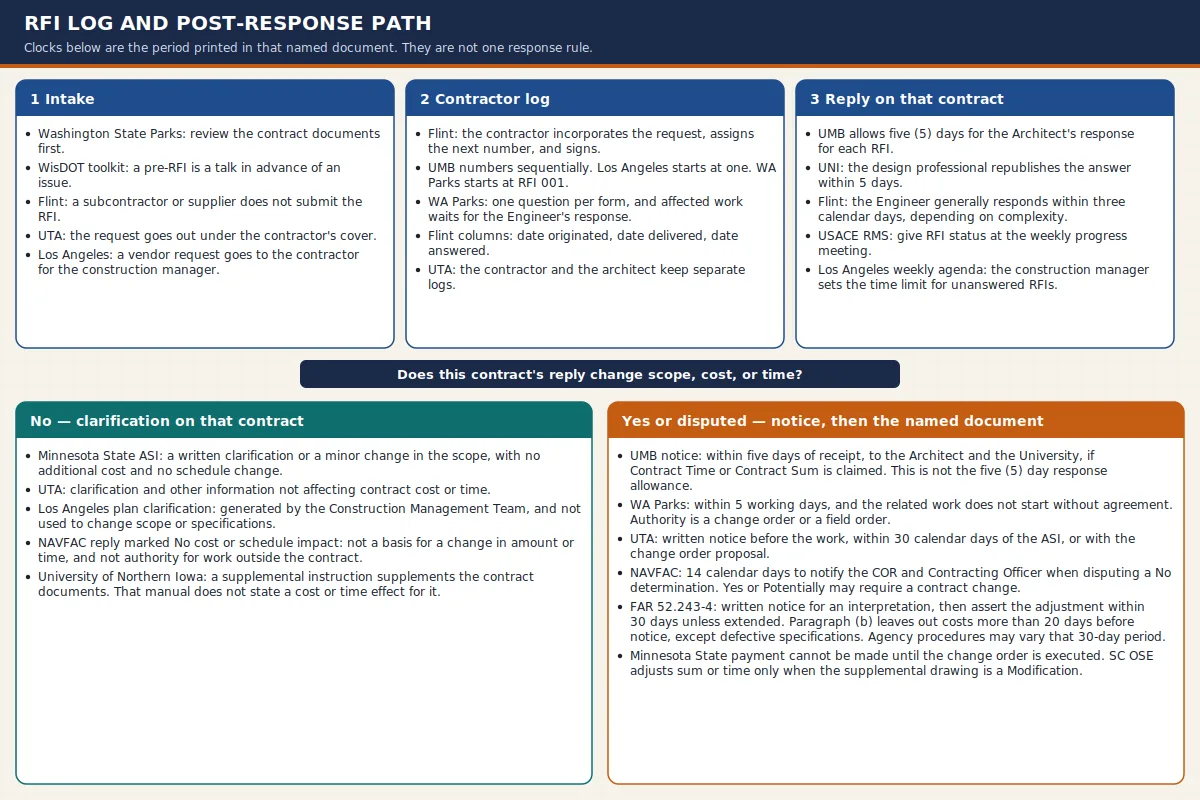
The University of Maryland, Baltimore specification allows five (5) days for the Architect’s response for each RFI. University of Northern Iowa procedures have the design professional republish the answer within 5 days of the request. The City of Flint specification says the Engineer will generally respond within three calendar days of receipt, depending on the complexity of the inquiry. On the Los Angeles Bureau of Engineering weekly agenda, the construction manager should establish the time limit for unanswered RFIs.
Coordinate field clarifications with the B2B construction procurement strategies and milestone payment gates in Procurement, and keep construction submittal action codes on the construction submittal register and action codes page. When fabrication drawings describe how a contractor, fabricator, or supplier proposes to execute a specific part of the work, follow shop drawings review, tolerances, and specification deviations, and when an RFI reply leads to a scope, cost, or schedule change, preserve the source drawing, bulletin, RFI, or submittal reference and revision in bulletins, PCOs, and change orders.
What Does RFI Mean in Construction Contracts?
In the WisDOT Construction Quality Management Toolkit, RFI is listed separately from a design issue notice and a request for price, the contractor develops RFIs while the WisDOT region manages RFIs, and the toolkit says to talk in advance of an issue, which it calls a pre-RFI, and to log RFIs and design issue notices when used to consider pursuit of errors and omissions.
Under DFARS 252.236-7001, the contractor checks all furnished drawings immediately upon receipt, compares all drawings and verifies the figures before laying out the work, promptly notifies the Contracting Officer of any discrepancies, and is responsible for errors that might have been avoided by those checks. Large-scale drawings govern small-scale drawings, figures marked on the drawings are followed in preference to scale measurements, and an omission or misdescription of a detail that is manifestly necessary to carry out the intent of the drawings and specifications, or that is customarily performed, does not relieve the contractor from performing that detail. Separate federal clauses govern site conditions: FAR 52.236-2 requires prompt written notice to the Contracting Officer before the conditions are disturbed, covering subsurface or latent physical conditions that differ materially from those indicated in the contract and unknown physical conditions of an unusual nature that differ materially from those ordinarily encountered, and it bars an equitable-adjustment request unless that notice was given and bars a differing-site-conditions request made after final payment, while FAR 52.236-3 records the contractor’s acknowledgment that it investigated the general and local conditions which can affect the work or its cost and states that the Government assumes no responsibility for contractor conclusions drawn from Government-furnished information.

How Does an RFI Differ From Submittals and Change Orders?
The City of Flint specification limits the RFI process to clarification of technical or administrative matters. A response might lead to a change in scope, cost, or time, but the RFI is not a substitute for the notification requirements in the general conditions, and a response is not authorization to perform additional work that would require a change order or a written amendment. Shop drawings describe how a contractor, fabricator, or supplier proposes to execute a specific part of the work. A Minnesota State change order is a written document prepared by the architect/engineer and signed by the owner and the contractor, stating a change in the work, an adjustment to the contract sum, or an adjustment in the contract time.
Under FAR 52.236-21, shop drawings are drawings submitted to the Government by the contractor, a subcontractor, or any lower-tier subcontractor. If those shop drawings show variations from the contract requirements, the contractor describes the variations in writing, separate from the drawings, at the time of submission. If the Contracting Officer approves a variation, the Contracting Officer issues an appropriate contract modification, except when the variation is minor or does not involve a change in price or in time of performance. NAVFAC UFGS 01 31 23.13 20 places contractor RFIs in the eCMS RFIs module and contractor submittals in the eCMS Submittals module. The Los Angeles procedure states that an RFI should not be used as a substitute for a shop-drawing submittal, and that an RFI should not be used to change the design.
Under the University of Maryland, Baltimore project RFI specification, the Architect returns without action any RFI that requests approval of submittals, substitutions, or contractor means and methods, coordination information already shown in the Contract Documents, an adjustment in Contract Time or Contract Sum, an interpretation of the Architect’s action on a submittal, or an incomplete or inaccurately prepared form. Minnesota State C.O.40 says an RFI may result in an Architect’s Supplemental Instruction or a Proposal Request, and it defines that instruction as a written clarification or a response for a minor change in the scope that does not result in additional cost or a change in schedule. The University of Texas at Arlington Project Administration guidelines let the Architect issue clarification and other information not affecting the contract cost or time by an Architect’s Supplemental Instruction or a similar form. University of Northern Iowa procedures define a supplemental instruction as a written instruction or a clarification from the design professional that supplements the contract documents. The Los Angeles Plan Clarification procedure says plan clarifications are generated by the Construction Management Team, while RFIs are generated by the contractor, and a plan clarification is not used to change scope or specifications.
Scroll horizontally to see all columns.
| Record Type | Initiating Party | Permitted Scope | Cost or Schedule Authority |
|---|---|---|---|
| Request for Information (RFI) | Contractor; Flint and UTA fold in a subcontractor or supplier request, and Los Angeles sends a vendor request to the contractor | Flint limits the process to technical or administrative clarification; Los Angeles also allows a minor deviation with no time or cost adjustment | A Flint response is not authorization for additional work that needs a change order; a NAVFAC reply marked No cost or schedule impact is not a basis for a change in contract amount or time; Minnesota State says the RFI may result in an ASI or a Proposal Request |
| Architect’s Supplemental Instruction or plan clarification | Architect/engineer for an ASI; Construction Management Team for a Los Angeles plan clarification | Minnesota State: a written clarification or a minor change in the scope; UTA: information not affecting contract cost or time; UNI: a written instruction or clarification that supplements the contract documents | Minnesota State: no additional cost and no schedule change; UTA: no effect on contract cost or time; Los Angeles: not used to change scope or specifications |
| Shop drawing | Contractor, subcontractor, or lower-tier subcontractor under FAR 52.236-21; fabricator or supplier on the shop-drawing guide | Drawings for how that party proposes to execute a specific part of the work; a variation is described in writing, separate from the drawings | eCMS Submittals module, apart from the RFIs module; an approved variation is a contract modification unless the variation is minor or does not change price or time of performance |
| Change order | Contracting Officer under FAR 52.243-4; the architect/engineer prepares it and the owner and contractor sign it under Minnesota State | FAR: specifications, including drawings and designs, method of performance, Government-furnished property or services, or acceleration; Minnesota State: a change in the work, the contract sum, or the contract time | Minnesota State payment cannot be made until the change order is executed; UTA issues a change that affects cost, scope, or time as a formal change order |
What Response Times and Notice Clocks Apply to RFIs?
Review clocks stay on the specification that prints them. The University of Maryland, Baltimore project RFI specification tells the contractor to prepare and submit an RFI immediately on discovery of the need for additional information, clarification, or interpretation of the Contract Documents, and it allows five (5) days for the Architect’s response for each RFI. University of Northern Iowa procedures direct the constructor to publish the RFI on the project management system and the design professional to republish the answer within 5 days of the request. The City of Flint specification says the Engineer will generally respond within three calendar days of receipt, depending on the complexity of the inquiry, while South Carolina Office of State Engineer supplementary conditions delete Section 4.2.14 and substitute a duty for the Architect to review and respond in writing with reasonable promptness.
Under Washington State Parks Section 012613, the contractor submits RFIs far enough in advance for appropriate Engineer response time, receives no additional payment for delay costs caused by tardy RFIs, and shall not proceed with the affected work until receiving the Engineer’s response. The Los Angeles Bureau of Engineering Meetings procedure says the pre-construction meeting should address submittals, requests for information, and change orders, and it should be held within 15 working days after Notice to Proceed. Kutztown University Section 013119 lists procedures for requests for information, procedures for change orders, and procedures for submittals as separate pre-construction agenda items. On the Los Angeles weekly agenda, the construction manager should establish the time limit for all unanswered RFIs, separately from the priorities for unapproved submittals and the time limit for each outstanding change order.
Scroll horizontally to see all columns.
| Contract or Procedure | Reviewer Response Rule | Contractor Post-Response Notice Window |
|---|---|---|
| University of Maryland, Baltimore RFI specification | Allows five (5) days for the Architect’s response for each RFI | Written notice to the Architect and the University within five days of receipt of the RFI response if the contractor believes the response warrants a change in Contract Time or Contract Sum |
| University of Northern Iowa Construction Procedures | Design professional republishes the answer on the project management system within 5 days of the request | A supplemental instruction is a written instruction or a clarification from the design professional that supplements the contract documents |
| City of Flint RFI specification | Engineer generally responds within three calendar days of receipt, depending on complexity | The RFI does not replace the general-conditions notice, and the response does not authorize additional work that needs a change order |
| Washington State Parks Section 012613 | Submit far enough in advance for appropriate Engineer response time, and do not proceed with the affected work until the reply | Notify the Engineer within 5 working days if cost or schedule impacts remain unaddressed, and do not start the related work without agreement |
| NAVFAC UFGS 01 31 23.13 20 (eCMS) | Create the RFI in the eCMS RFIs module; paper or email may be used if eCMS is unavailable for 8 hours or more, then recreate the final record | 14 calendar days to notify the COR and the Contracting Officer in writing when the contractor disagrees with a No cost determination, a No schedule impact determination, or both |
| University of Texas at Arlington Project Administration | The contractor and the architect keep separate RFI logs; an ASI is clarification or other information not affecting contract cost or time | Written notice before the work considered to be a change, within 30 calendar days of receipt, or with the change order proposal |
When Does an RFI Response Require a Change Order?
On these contracts the RFI reply is not itself the change document. The University of Texas at Arlington guidelines issue a change that affects cost, scope, or time as a formal change order. Washington State Parks Section 012613 authorizes an RFI response that modifies the work only by change order or field order. The Los Angeles procedure requires a change order when a design change is needed from an RFI response. The City of Flint specification says a response is not authorization to perform additional work that would require a change order or a written amendment. South Carolina Office of State Engineer supplementary conditions state that, unless issued pursuant to a Modification, supplemental drawings or specifications will not involve an adjustment to the Contract Sum or Contract Time.
Under FAR 52.243-4, a written change order makes changes in the work within the general scope of the contract, including changes in the specifications (including drawings and designs), the method or manner of performance, Government-furnished property or services, or directing acceleration. Any other written or oral order from the Contracting Officer, including a direction, instruction, interpretation, or determination, that causes a change is treated as a change order only if the contractor gives written notice of the date, circumstances, and source and states that the contractor regards the order as a change order. Except as that clause provides, no order, statement, or conduct of the Contracting Officer entitles the contractor to an equitable adjustment. Except for an adjustment based on defective specifications, no adjustment for a change under paragraph (b) is made for costs incurred more than 20 days before the contractor gives written notice. The contractor must assert its right to an adjustment within 30 days after receipt of a written change order or after furnishing the written notice, unless the Government extends the period, and the prescribing note says that 30-day period may be varied according to agency procedures.
Under NAVFAC UFGS 01 31 23.13 20, a government RFI reply marked No cost or schedule impact is not a basis for a change in the amount or time of the contract and does not authorize work that is not currently included in the contract. A reply marked Yes or Potentially may require a change to the contract. A contractor who disagrees with a No cost determination, a No schedule impact determination, or both, has 14 calendar days to notify the COR and the Contracting Officer in writing. Under Minnesota State C.O.40, when the architect/engineer determines there is a change in scope, cost, or schedule based on an RFI, the architect/engineer initiates a Proposal Request, the change order is prepared by the architect/engineer and signed by the owner and the contractor, and payment cannot be made until the change order is executed. The Los Angeles procedure says that if the RFI will lead to a change order, the construction manager should note on the RFI that a change order will be forthcoming. Washington State Parks Section 012613 has the contractor provide cost and schedule information under Section 012600, requires notice to the Engineer within 5 working days when the response leaves cost or schedule impacts unaddressed, and says the related work must not start without agreement on those impacts.
What Belongs on an RFI Checklist and Status Log?
Before issuing a drawing-conflict RFI, Washington State Parks Section 012613 has the contractor review the contract documents, and the City of Flint specification has the contractor keep a log with the date originated, the date delivered, and the date answered:
- Under DFARS 252.236-7001, check all furnished drawings immediately upon receipt, compare all drawings and verify the figures before laying out the work, and follow figures marked on the drawings in preference to scale measurements. Where the WisDOT Construction Quality Management Toolkit applies, talk in advance of an issue, which that toolkit calls a pre-RFI.
- On the City of Flint specification, a subcontractor or supplier may not submit the RFI; the contractor incorporates the request, assigns the next number, and signs. On the University of Texas at Arlington guidelines, a subcontractor request goes out under cover of the contractor, who reviews the question and numbers it sequentially. On the Los Angeles procedure, a subcontractor, supplier, or vendor request goes to the contractor for processing to the construction manager.
- The University of Maryland, Baltimore specification numbers each RFI sequentially, Washington State Parks Section 012613 begins with RFI 001, and the Los Angeles procedure starts with the number one. On a NAVFAC eCMS contract, confirm the numbering convention with the COR when it differs from the eCMS default. Washington State Parks Section 012613 says to submit only one question per RFI form.
- On the University of Maryland, Baltimore specification, if the contractor’s suggested resolution impacts the Contract Time or the Contract Sum, the contractor states that impact in the RFI. On Washington State Parks Section 012613, the contractor shall not proceed with the affected work until receipt of a response from the Engineer.
- The University of Texas at Arlington guidelines require the contractor and the architect to maintain separate RFI logs. The USACE RMS specification says to provide RFI status at the weekly progress meeting. If eCMS is unavailable for 8 hours or more, NAVFAC UFGS 01 31 23.13 20 allows paper or email in the interim, and the final records are recreated in the appropriate module once the system is operational.
Scroll horizontally to see all columns.
| Status-Log Field | Recorded Entry | Governing Contract Rule |
|---|---|---|
| Sequential RFI Number | Consecutive number | UMB numbers the RFI sequentially; WA Parks begins with RFI 001; Los Angeles starts with the number one; NAVFAC confirms a non-default convention with the COR |
| Single Question | One question on the form | WA Parks Section 012613 submits only one question per RFI form; UMB returns an incomplete or inaccurately prepared RFI without action; Flint limits the process to technical or administrative clarification |
| Drawing or Specification Reference | Plan sheet or specification section | Los Angeles uses plans, specifications, or contract requirements; Minnesota State uses drawings or specifications; WA Parks covers conflicts, omitted information, or another deficiency; preserve that reference later on the PCO and change-order record |
| Date Originated | Date the contractor originates the RFI | Required column on the contractor RFI log in the City of Flint specification |
| Date Delivered | Date the RFI is delivered | Required column on the contractor RFI log in the City of Flint specification; the Engineer’s three calendar days run from receipt and depend on complexity |
| Date Answered | Date answered on the Flint log | The City of Flint log records the date answered; USACE RMS provides RFI status at the weekly progress meeting; the Los Angeles weekly agenda has the construction manager establish the time limit for unanswered RFIs |
Sources
- eCFR: Federal Acquisition Regulation Specifications and Drawings for Construction
- eCFR: Federal Acquisition Regulation Changes Clause
- eCFR: Federal Acquisition Regulation Differing Site Conditions
- eCFR: Federal Acquisition Regulation Site Investigation and Conditions Affecting the Work
- eCFR: Defense Federal Acquisition Regulation Supplement Contract Drawings and Specifications
- University of Maryland, Baltimore: Project Management and Coordination Specification
- University of Northern Iowa: Construction Phase Procedures Manual
- Minnesota State: Construction Change Overview
- University of Texas at Arlington: Project Administration Guidelines
- Kutztown University: Project Meetings Specification
- Washington State Parks: Requests for Information Specification
- Los Angeles Bureau of Engineering: Request for Information Procedure
- Los Angeles Bureau of Engineering: Plan Clarification Procedure
- Los Angeles Bureau of Engineering: Project Meetings Procedure
- South Carolina Office of State Engineer: Standard Supplementary Conditions
- Wisconsin Department of Transportation: Construction Quality Management Toolkit
- NAVFAC Unified Facilities Guide Specifications: Electronic Construction and Facility Support Contract Management System
- USACE Unified Facilities Guide Specifications: Resident Management System Contractor Mode
- City of Flint: Requests for Information Specification
Related articles

Construction Submittal Register and Action Codes: CSI 01 33 00 Tracking and PO Release Gates
Build a CSI 01 33 00 submittal register from Part 1 specifications, separate action and informational submittals, and verify NET, MCN, and R&R PO release gates.
Read article: Construction Submittal Register and Action Codes: CSI 01 33 00 Tracking and PO Release GatesHow to Choose Construction Material Procurement Software: A Demo Worksheet
Evaluate construction material procurement software with a blank five-test vendor demo worksheet covering submittal revisions, PO release, split deliveries, damaged receipts and CSV export.
Read article: How to Choose Construction Material Procurement Software: A Demo Worksheet
Construction Material Procurement Log Template
Download a blank construction material procurement log and PO field sheet (CSV), with field definitions, a backward scheduling method and no assumed lead times.
Read article: Construction Material Procurement Log Template