
Masonry Mortar Types: M, S, N, O & Grout Guide
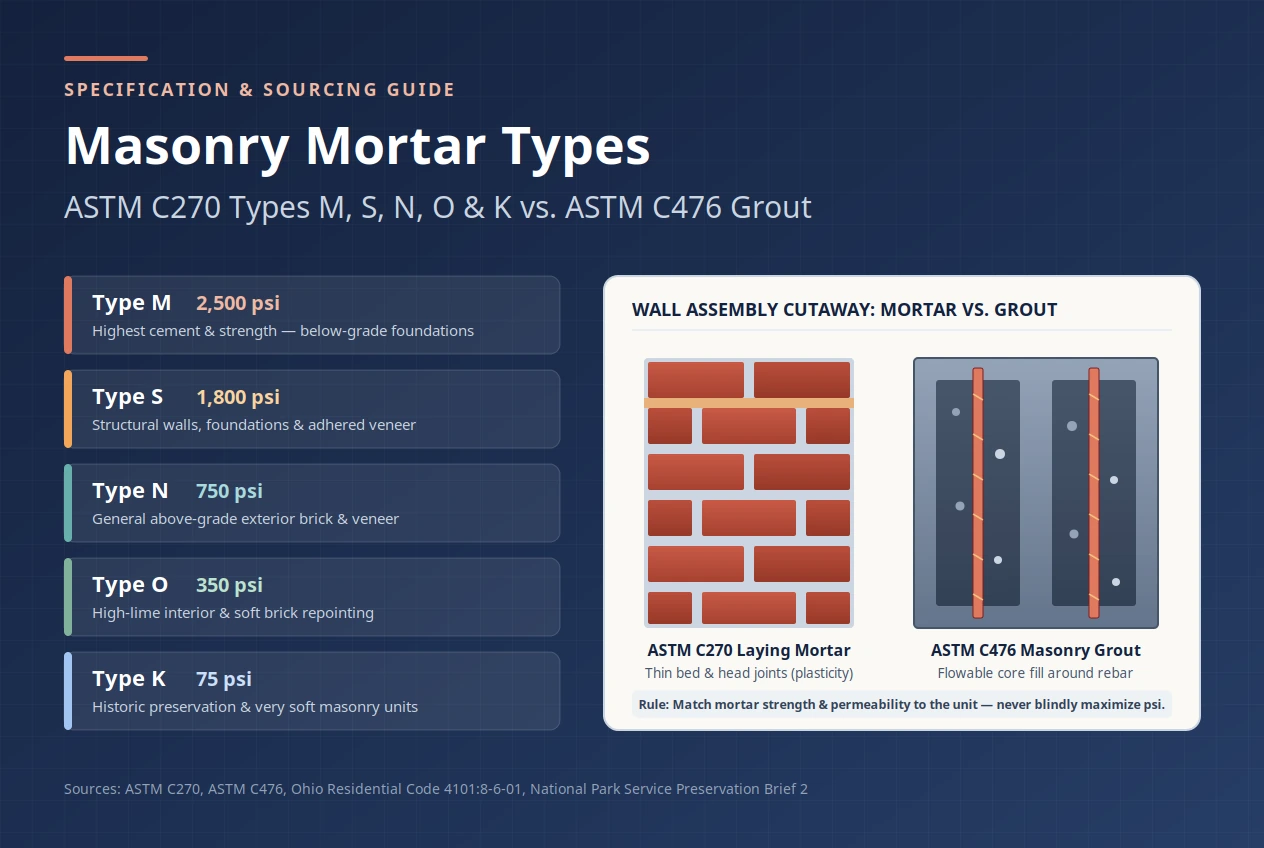
Under ASTM C270, standard masonry mortar types—Type M (2,500 psi), Type S (1,800 psi), Type N (750 psi), and Type O (350 psi), plus historic Type K (75 psi)—progress from highest Portland cement compressive strength to highest hydrated lime flexibility and vapor permeability. Specifiers match mortar to the masonry unit and exposure rather than maximizing strength.
Across commercial and residential masonry packages, ASTM C270-19ae1 governs unit-masonry laying mortar under two alternative compliance paths—proportion specifications and property specifications—while ASTM C476-20 governs flowable masonry grout used to fill hollow cells and bond reinforcement. Coordinate mortar submittals alongside other material sourcing standards in our Sourcing hub, align wall assembly exposure details with our wall-system planning guide, and verify test-method and edition citations using our specification comparison guide.
What Are the Different Types of Mortar in Construction?
Standard unit-masonry mortars defined under ASTM C270 fall into four primary designations—Type M (2,500 psi), Type S (1,800 psi), Type N (750 psi), and Type O (350 psi)—alongside historic Type K (75 psi), ordered from strongest cement-rich mixes to softest lime-rich mixes, while specialty masonry assemblies rely on separate material standards.
As documented in National Park Service Preservation Brief 2 and the Mortar (masonry) technical reference, both pre-mixed and site-mixed unit masonry mortars carry the five letters M, S, N, O, and K, where Type M is the strongest and Type K is the weakest. Higher amounts of Portland cement produce a harder mortar, whereas adding more hydrated lime makes the mortar softer, more plastic, more workable, and more vapor-permeable.
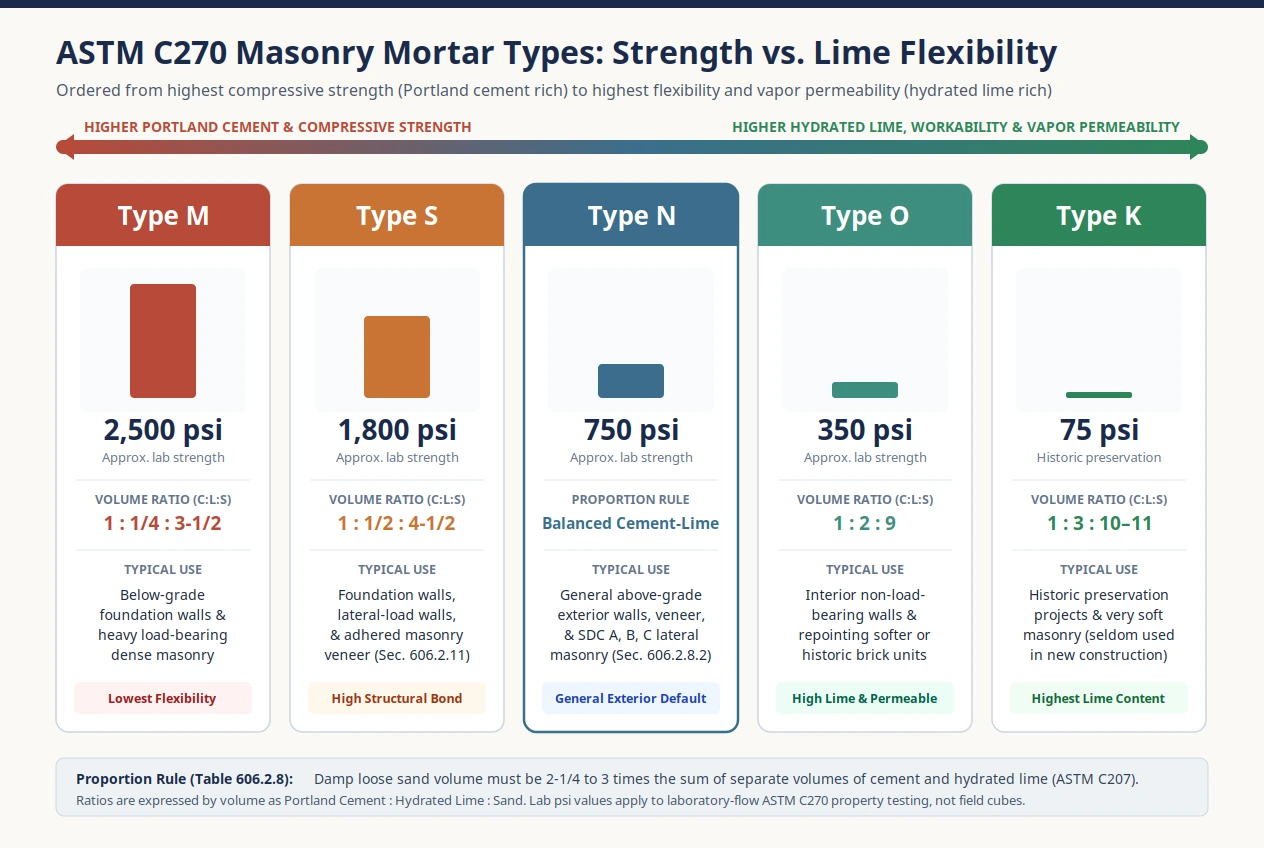
Standard ASTM C270 Unit-Masonry Mortars
Scroll horizontally to see all columns.
| Mortar Type | Approximate Strength (psi) | Binder Character | Documented Volume Ratio (Cement : Lime : Sand) | Primary Code or Field Scope |
|---|---|---|---|---|
| Type M | 2,500 psi | Highest Portland cement, lowest lime flexibility | 1 : 1/4 : 3-1/2 | Below-grade masonry foundation walls (Residential Code of Ohio Section 606.2.8.1) and heavy-load masonry |
| Type S | 1,800 psi | High cement with moderate lime plasticity | 1 : 1/2 : 4-1/2 | Foundation walls (Residential Code of Ohio Section 606.2.8.1), lateral masonry in SDC A, B, C, and adhered veneer (Residential Code of Ohio Section 606.2.11) |
| Type N | 750 psi | Balanced cement-lime workability and resilience | Governed by Residential Code of Ohio Table 606.2.8 proportion limits | General above-grade exterior walls, adhered veneer (Residential Code of Ohio Section 606.2.11), and SDC A, B, C lateral masonry |
| Type O | 350 psi | High hydrated lime (more lime than cement) | 1 : 2 : 9 | Interior non-load-bearing masonry and repointing softer or historic masonry units |
| Type K | 75 psi | Highest lime content among Portland-cement mixes | 1-3-10 (1 part cement, 3 parts lime, 10 parts sand) | Seldom used today outside specialized historic preservation work |
Specialty Mortars Outside Standard ASTM C270 Bed Joints
Not every masonry wall uses conventional ASTM C270 bed-joint mortar. Under the Residential Code of Ohio masonry rules, Section 606.2.8 carves out three specialty systems governed by separate standards:
- Surface-bonding mortar (Section 606.2.9): Surface-bonding mortar must comply with ASTM C887, and surface bonding of concrete masonry units must comply with ASTM C946.
- Autoclaved aerated concrete (AAC) masonry mortar (Section 606.2.10): Thin-bed mortar for AAC masonry must comply with Article 2.1 C.1 of TMS 602, while mortar used for AAC leveling courses must comply with Article 2.1 C.2 of TMS 602.
- Adhered masonry veneer mortar (Section 606.2.11): Mortar for adhered masonry veneer must conform to ASTM C270 Type S or Type N, or comply with ANSI A 118.4 for latex-modified Portland cement mortar.
Which Is Better for Exterior Brick Walls, Type N or Type S Mortar?
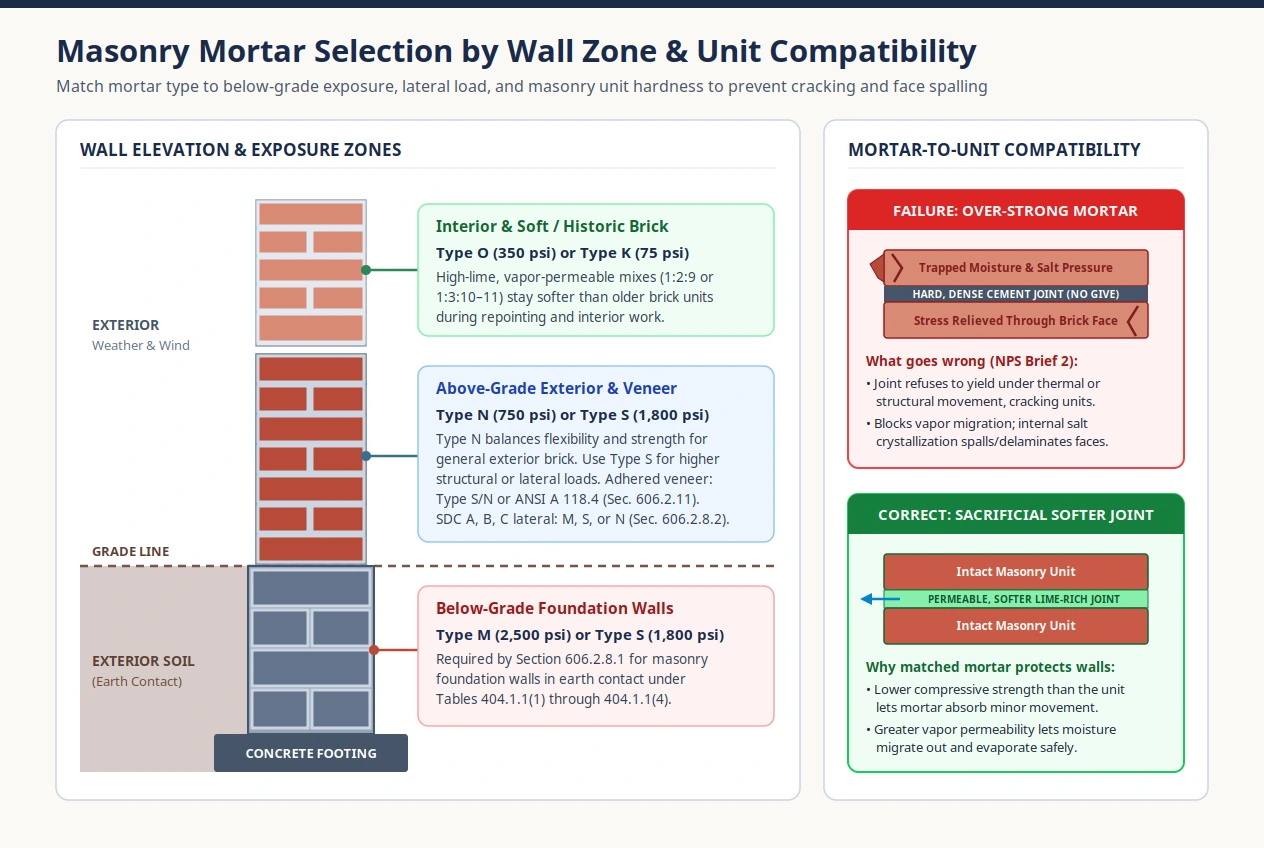
Neither Type N nor Type S is universally better for exterior brick walls: Type N (750 psi) suits general above-grade exterior brickwork and adhered veneers where flexibility and vapor permeability protect the units, whereas Type S (1,800 psi) is required where higher structural capacity, below-grade earth contact, or greater lateral resistance governs.
Under Section 606.2.8.2 of the Residential Code of Ohio, masonry serving as the lateral force-resisting system in Seismic Design Categories A, B, and C may use Type M, Type S, or Type N mortar. For adhered masonry veneer, Section 606.2.11 permits either ASTM C270 Type S or Type N (or ANSI A 118.4 latex-modified Portland cement mortar). Choosing between Type N and Type S therefore hinges on matching the mortar’s strength and permeability to the brick unit rather than defaulting to the higher psi figure.
Why Over-Strong Mortar Damages Exterior Brickwork
A common procurement and field error is substituting Type S or Type M mortar on softer clay brick under the assumption that higher compressive strength always improves durability. National Park Service Preservation Brief 2 establishes two physical requirements for compatible mortar: new mortar must have greater vapor permeability and lower compressive strength than the masonry units.
- Stress concentration and cracking: Mortar that is stronger in compressive strength than the masonry units will not yield under thermal or structural movement, forcing stresses to be relieved directly through the units and causing permanent cracking and spalling that cannot be easily repaired.
- Trapped moisture and salt crystallization: High-lime mortars are more vapor-permeable than denser cement mortars. When dense cement mortar blocks moisture or moisture vapor from migrating out of the wall and evaporating, soluble salt crystallization inside the masonry unit builds internal pressure that spalls or delaminates the outer face.
- Mixed-mortar cracking in existing walls: Lime mortar is softer than Portland cement mortar and lets brickwork adapt to shifting ground or changing conditions, whereas hard cement mortar allows little flexibility; combining both mortars in a single wall creates stiffness contrast that can crack the brickwork.
When Are Type M and Type O Masonry Mortars Specified?
Type M mortar (2,500 psi) is specified for below-grade masonry foundation walls in earth contact (alongside Type S under Section 606.2.8.1) and heavy-load dense masonry, whereas Type O mortar (350 psi) is specified for interior non-load-bearing masonry and repointing soft or historic brickwork that requires a softer, vapor-permeable joint.
Under Section 606.2.8.1 of the Residential Code of Ohio, mortar for masonry foundation walls constructed per Tables 404.1.1(1) through 404.1.1(4) must be Type M or Type S mortar. Type N and Type O are excluded from those below-grade foundation walls. Conversely, on historic or soft clay masonry, high-lime mixes containing more lime by volume than Portland cement—such as Type O (1:2:9), historic Type K (1:3:11 or 1:3:10), or straight lime-and-sand Type L (0:1:3)—keep the joint sacrificial so moisture escapes through the mortar rather than damaging the brick face.
How Do Mortar Mix Ratios Change Across M, S, N, and O?
Mortar mix ratios are always stated by volume in Portland cement : hydrated lime : sand order, shifting from cement-dominant Type M (1 : 1/4 : 3-1/2) and Type S (1 : 1/2 : 4-1/2) to lime-dominant Type O (1 : 2 : 9) and historic Type K (1 : 3 : 10 to 11), while total damp loose sand stays within 2-1/4 to 3 times the combined cementitious volume.
That aggregate proportion rule comes directly from Table 606.2.8 of the Residential Code of Ohio: damp loose aggregate volume must be not less than 2-1/4 and not more than 3 times the sum of the separate volumes of hydrated lime (if used) and cement. Because hydrated lime increases plasticity and workability while Portland cement increases hardness, shifting the cement-to-lime ratio controls both trowel performance and cured vapor permeability.
Volumetric Batching Weights and Material Rules
When crews batch proportion-specified mortar on site, Table 606.2.8 footnotes define the standard unit weights per cubic foot and two mandatory material restrictions:
Scroll horizontally to see all columns.
| Mortar Constituent | Volumetric Unit Weight (lb per cubic foot) | Code Material Rule (Table 606.2.8 Footnotes) |
|---|---|---|
| Portland cement | 94 lb | Base cementitious binder (1 part by volume in standard ratios) |
| Hydrated lime | 40 lb | Must conform to ASTM C207 (Footnote c) |
| Lime putty (quicklime) | 80 lb | Alternative lime form measured by volume (Footnote a) |
| Damp, loose sand | 80 lb of dry sand | Total sand must be 2-1/4 to 3 times combined cement and lime volumes |
In addition to requiring ASTM C207 hydrated lime, Table 606.2.8 Footnote b prohibits combining two air-entraining materials in the same mortar mix. Submittal reviewers should verify every cementitious bag and admixture sheet against this restriction before approving field batching.
How Do You Read a Masonry Mortar Types Chart for Specs?
To read a masonry mortar types chart for project specifications, first identify whether the contract invokes ASTM C270 proportion specifications or property specifications—with proportion specifications governing by default under Section 1.3—and recognize that published psi values are pre-construction laboratory-flow benchmarks rather than field-cube acceptance limits.
ASTM C270 explicitly defines two alternative compliance paths for non-reinforced and reinforced unit masonry mortars: proportion specifications and property specifications. Residential Code of Ohio Section 606.2.8 mirrors this split for residential masonry, requiring general masonry mortar to meet either Table 606.2.8 proportion specifications or ASTM C270 property specifications. Standard masonry terminology referenced across these submittals is defined in ASTM Terminologies C1180 and C1232 (ASTM C270 Section 1.6).
Proportion Specifications vs. Property Specifications in Submittals
Scroll horizontally to see all columns.
| Review Criterion | Proportion Specification (Default) | Property Specification (Lab-Qualified) |
|---|---|---|
| Default Status (ASTM C270 Section 1.3) | Governs automatically when neither specification is named in project documents | Applies only when specified or when accepted property data are submitted to the specifier |
| Testing Environment | No laboratory compressive-strength qualification required when standard proportions are met | Applies strictly to mortar mixed to a specific flow in a laboratory, not jobsite consistency |
| Testing Agency Qualification | Not applicable to standard proportion batching | Testing agency should be evaluated in accordance with ASTM Practice C1093 (ASTM C270 Note 1) |
| Field Compliance Verification | Confirm materials meet specified standards and are added to the mixer in proper proportions | Confirm delivered materials match qualified lab materials and are added to the mixer in proper proportions |
Why Field-Sampled Mortar Cubes Cannot Reject Mortar
Specifiers and inspectors frequently misapply concrete cylinder logic to masonry mortar. ASTM C270 explicitly states that it does not cover determining mortar strengths through field testing: compressive strength values from field-tested mortars do not represent laboratory mortar strength or in-wall mortar strength. Physical properties of field-sampled mortar must not be used to determine compliance with ASTM C270 or to accept or reject mortar. Instead, field compliance is verified by confirming that the materials used match the specification, meet material requirements, and are added to the mixer in the proper proportions.
How Does Masonry Grout Differ From Laying Mortar?
Masonry laying mortar (ASTM C270) is a lime-enriched, plastic bedding material formulated to bond masonry units in thin joints, whereas masonry grout (ASTM C476) is a flowable fine-aggregate or coarse-aggregate structural fill with minimal lime (0 to 1/10 part per part of Portland cement) placed to consolidate around steel reinforcement and fill hollow cores.
Although both materials use Portland cement, aggregate, and water, treating grout and mortar as interchangeable creates structural voids or bond failures. Under ASTM C476-20, masonry grout covers two aggregate types—fine grout and coarse grout—specified by either proportions or compressive strength requirements. Each type is further classified as conventional grout, which requires mechanical consolidation by puddling or vibration when placed, or self-consolidating grout, which requires no mechanical consolidation.
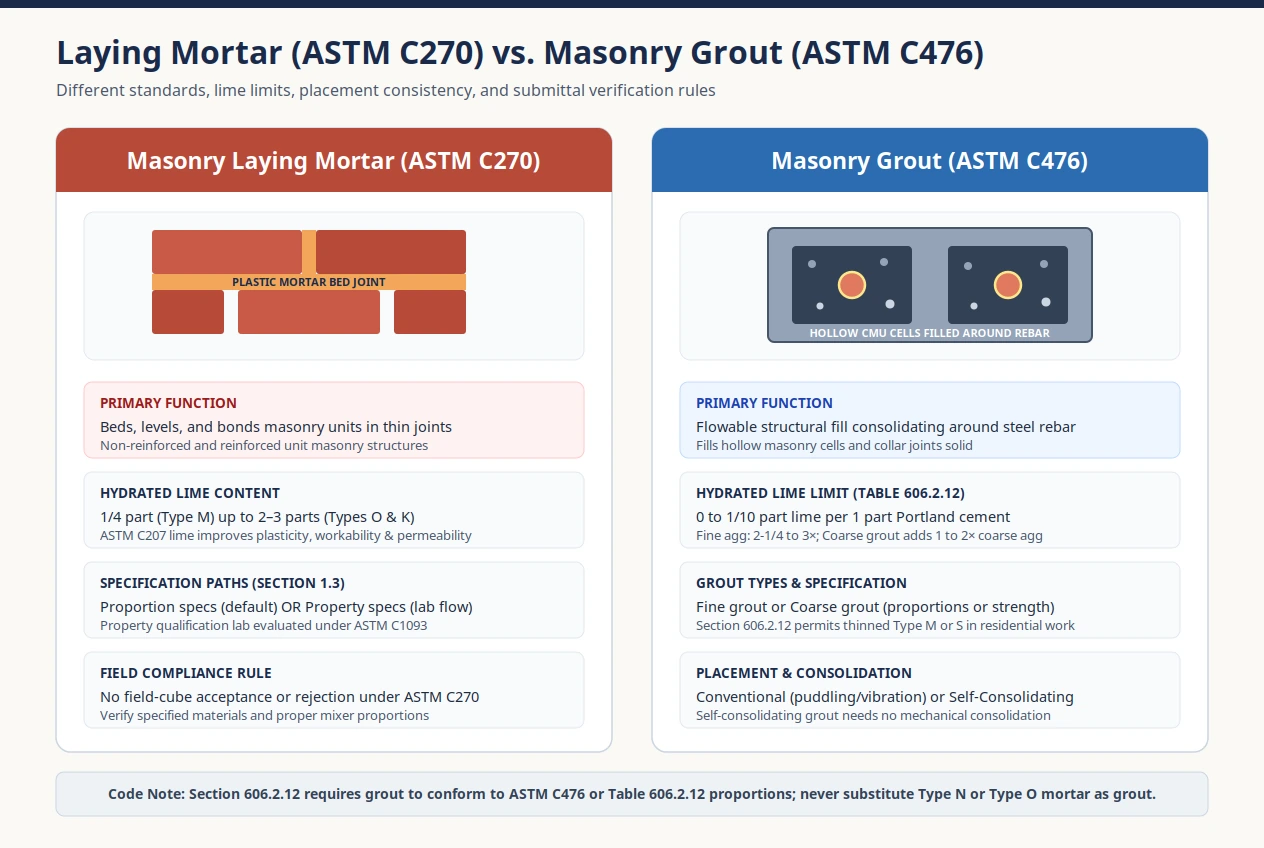
Grout vs. Mortar Specification Comparison
Scroll horizontally to see all columns.
| Specification Attribute | Masonry Laying Mortar (ASTM C270) | Masonry Grout (ASTM C476 & Residential Code of Ohio Table 606.2.12) |
|---|---|---|
| Governing Standard | ASTM C270 and Residential Code of Ohio Table 606.2.8 | ASTM C476 and Residential Code of Ohio Section 606.2.12 / Table 606.2.12 |
| Hydrated Lime Proportion | 1/4 part (Type M) up to 2–3 parts (Types O & K) per 1 part Portland cement | 0 to 1/10 part hydrated lime per 1 part Portland cement |
| Aggregate Composition | Damp loose sand at 2-1/4 to 3 times combined cementitious volume | Fine grout: 2-1/4 to 3 times fine aggregate; Coarse grout adds 1 to 2 times coarse aggregate |
| Placement & Consolidation | Spread in thin bed and head joints by trowel | Conventional grout (puddling or vibration) or self-consolidating grout (no mechanical consolidation) |
| Residential Thinned-Mortar Allowance | Not applicable to laying joints | Section 606.2.12 permits Type M or Type S mortar thinned with water to pouring consistency as grout |
Under Section 606.2.12 of the Residential Code of Ohio, masonry grout must conform to ASTM C476 or Table 606.2.12 proportion specifications, with a narrow residential provision permitting Type M or Type S mortar to be used as grout when sufficient water is added to produce pouring consistency. Type N and Type O mortars are not included in that allowance.
Frequently Asked Questions
What is the difference between Type M, S, N, and O mortar?
Under ASTM C270, Type M (2,500 psi), Type S (1,800 psi), Type N (750 psi), and Type O (350 psi) progress from highest Portland cement compressive strength to highest hydrated lime flexibility and vapor permeability. Type M and Type S are used for below-grade foundation walls and higher-load masonry, Type N serves general above-grade exterior walls and veneers, and Type O serves interior non-load-bearing masonry and soft brick repointing.
Can you use Type S mortar instead of Type N on older brick?
No. Using a mortar with higher compressive strength than the masonry units prevents stress relief in the joints and traps moisture behind a denser cement matrix, leading to permanent brick cracking, internal salt crystallization pressure, and face spalling. Mortar must remain softer and more vapor-permeable than the brick units.
What governs if a specification does not state proportion or property specs?
Under ASTM C270 Section 1.3, when project documents specify neither proportion nor property specifications, the proportion specifications govern automatically unless laboratory data are presented to and accepted by the specifier showing compliance with property specifications.
Can field-sampled mortar cubes be used to reject masonry mortar?
No. ASTM C270 does not cover determining mortar strengths through field testing, and field-sampled mortar physical properties must not be used for acceptance or rejection. Compliance is verified by confirming that the specified materials meet requirements and are added to the mixer in the proper proportions.
Can laying mortar be used as masonry grout?
Under residential code Section 606.2.12, only Type M or Type S mortar with sufficient water added to achieve pouring consistency is permitted as grout; otherwise, masonry grout must conform to ASTM C476 or Table 606.2.12 proportions, which cap hydrated lime at 0 to 1/10 part per 1 part Portland cement.
Sources
- ASTM C270-19ae1 Standard Specification for Mortar for Unit Masonry — Scope of proportion vs. property specifications, Section 1.3 default rule, laboratory-flow testing, ASTM C1093 lab evaluation, Terminologies C1180/C1232, and field-testing compliance limits.
- ASTM C476-20 Standard Specification for Grout for Masonry — Fine and coarse masonry grout types, proportion and strength specifications, and conventional vs. self-consolidating grout placement classifications.
- Residential Code of Ohio — Masonry Wall Construction (Cornell LII) — Sections 606.2.8 through 606.2.12, Table 606.2.8 mortar proportions and volumetric unit weights, foundation wall and seismic mortar restrictions, adhered veneer and AAC/surface-bonding standards, and Table 606.2.12 grout proportions.
- National Park Service Preservation Brief 2: Repointing Mortar Joints in Historic Masonry Buildings — Approximate mortar compressive strengths (Types M, S, N, O, K), cement-lime-sand ratio conventions, high-lime preservation mixes (Type O, Type K, Type L), vapor permeability, and over-strong mortar cracking and salt-spalling mechanisms.
- Wikipedia: Mortar (masonry) — Overview of M, S, N, O, and K mortar designations, Type M and Type S reference volume ratios, and stiffness-contrast cracking between lime and Portland cement mortars.
Related articles
Mill Test Report (MTR) and Steel Heat Number Traceability: Chemical, Mechanical, and Gate Verification
Review a mill test report alongside steel heat-number identification, chemical and mechanical results, certificate type, and fabrication records.
Read article: Mill Test Report (MTR) and Steel Heat Number Traceability: Chemical, Mechanical, and Gate Verification
How to Evaluate a Building Material Supplier Before Placing a First Order
A first order from a seller with the wrong plant address can be rejected or arrive damaged. Name the seller and the plant, and leave credit score, lead time, and payment split blank.
Read article: How to Evaluate a Building Material Supplier Before Placing a First Order